Before doing any research into Laos, I knew about one thing: tubing. While I’m not a big party girl, the notorious tube ride through the bar-studded Nam Song river in Vang Vieng intrigued me, and I knew I had to try it out.
While Vientiane may be the capital of Laos, Vang Vieng is definitely the country’s party capital and one of the top party destinations in all of Southeast Asia. While just a small town in the middle of nowhere, travelers flock to Vang Vieng for the cheap alcohol, easy drugs (think marijuana, mushrooms and opium) and a general outlet for unrestrained hedonism, which in the end boils down to one main event: tubing.
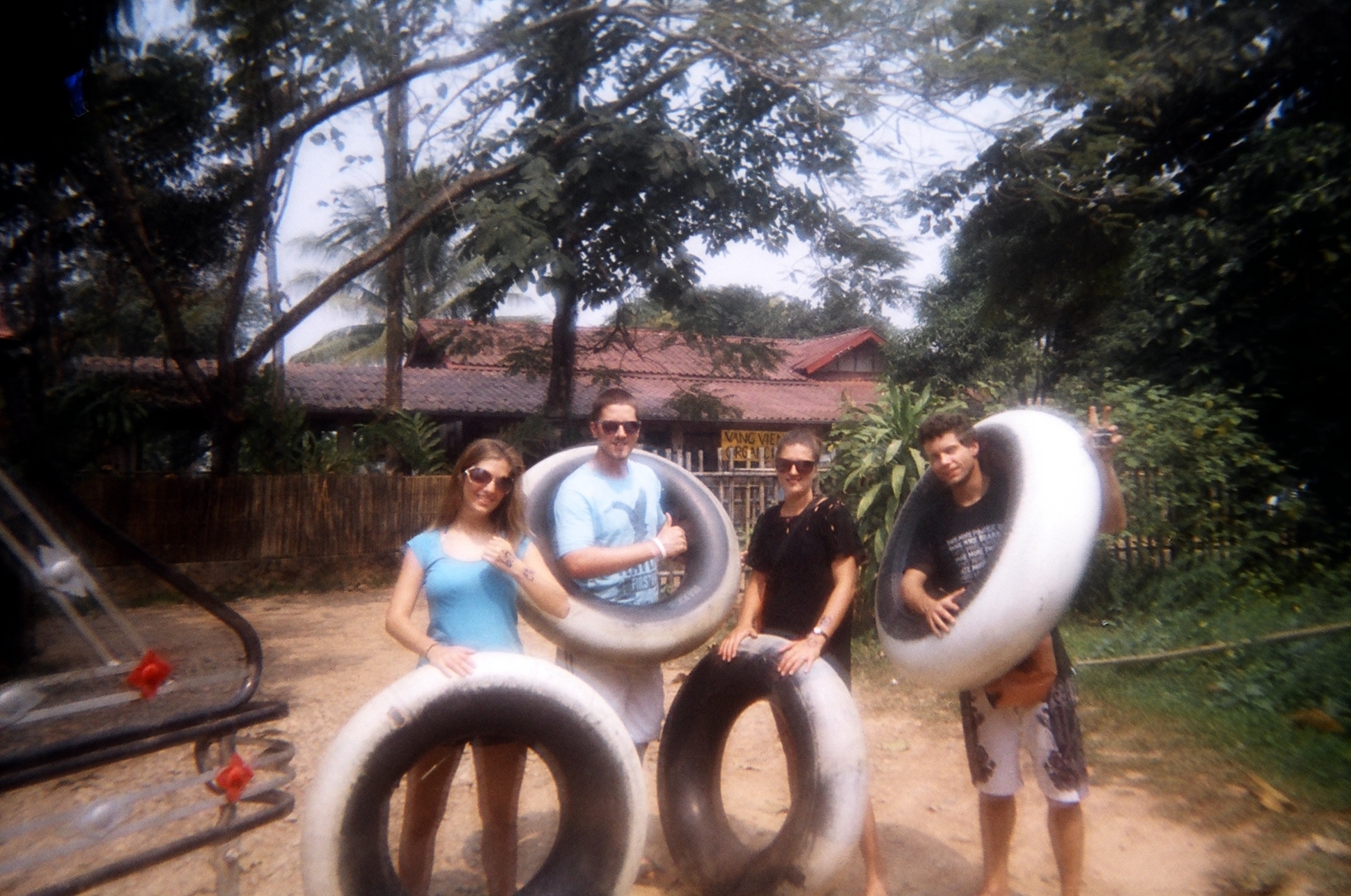
Ready with our tubes at the start of the river
The process is very simple. Starting around noon, you head to the town’s lone tube provider where you register your name and pay 55,000 kip (about $7) plus a 60,000 kip ($7.50) deposit for an inflated inner tube. A covered pick-up truck then drops you off at the start of the river where you have until 6 p. m. to make it back down to return the tube and retrieve your deposit money.
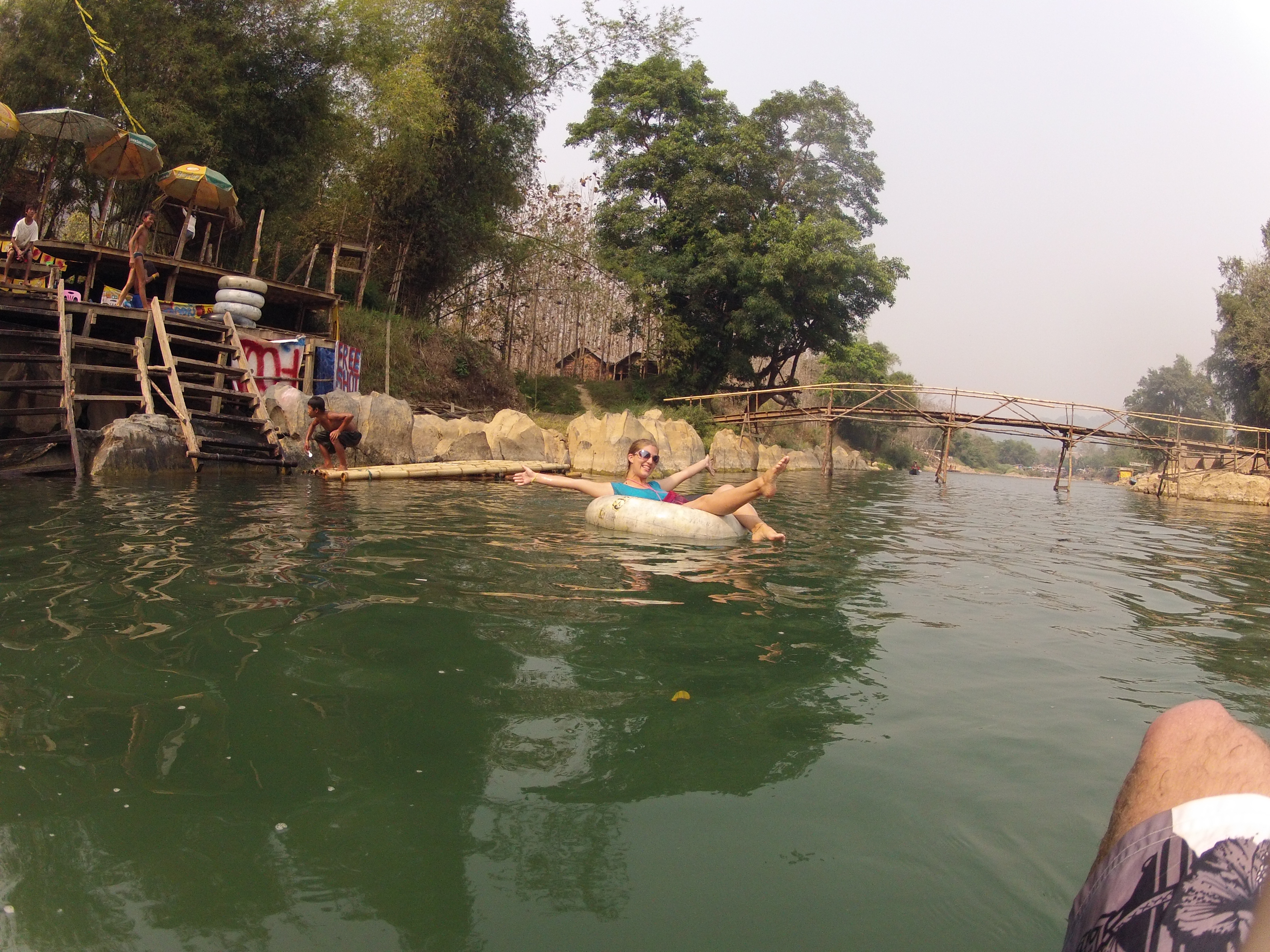
Now, if one were to just enjoy a leisurely tube ride down the river, the ride would take roughly two to three hours, depending on water levels. However, no one goes to Vang Vieng just to tube down the river. Instead, bars blasting dance music and offering water toys and games surround you on both shores, competing for your attention. If you want to come ashore, you simply grab one of the stringed water bottles and the bar staff will reel you in, often offering you free shots of homemade whiskey upon arrival.
What could be a better idea than combining alcohol, drugs and water sports in a country with virtually no safety regulations?
Tubing down the river!
If it sounds a bit dangerous to you, that’s because it is. In fact, several people die or are injured EVERY MONTH while tubing, often due to landing on hidden rocks while jumping in the water or drowning. In addition to sheets and towels, my room at Pan’s Place guest house came with a detailed advice book, which I like to call the “How to enjoy Vang Vieng and Not Die” book, including information on the dangers of tubing, the legality (or technically, non legality) of the drug scene and fun stories of people who have died while tubing. English expat owner Chris also offered up his own advice, such as, make sure you wear shoes.
“Stitches in this town are $7 a stitch, and they don’t use anesthetic,” he told us.
As you can probably gather from my tone, I was not a very active participant in the debauchery. First, as previously stated, I’m naturally not a big party girl. But second, and most importantly, I value my life and meeting St. Peter because I broke my neck jumping onto a hidden rock in shallow water while half out of my mind is not how I’d like to go.
But the reality is, tubing is super fun, even sober!
While I only had one drink throughout my entire journey, I loved visiting the bars, playing mud volleyball, shooting cans with slingshots, and yes, even jumping into the water off a few zip lines. Though I had not originally planned to do this, after watching all three of my travel buddies plus several Laos children swing into the water unharmed, I took my chances. And it was super fun! I did, however, draw the line at the massive “Slide of Death.”
After a few hours of fun, we were determined to actually enjoy the tube ride to the end, which was an estimated two hours further down the river after the last bar (loudly noted, “LAST BAR”). Problem was, thousands of shallow rocks a mere inches underneath us made the ride down more of an uncomfortable walk down, and we eventually gave up and took a tuk tuk back to town.
Altogether a fun experience. Remember kids, if you’re going to get drunk and go tubing down a river, always remember to wear your shoes :).
Yelling all around, shoving my way through a crowd of 20 men to squeeze through a two-foot gate with angry, baton-holding police at our heels, those few minutes during the Kuala Lumpur Bersih 2.0 rally ended up being some of the most terrifying minutes of my life.
Some few seconds before, I naively assumed my friend Jullian and I were in the “safe” zone, a quieter area on a hill above the city streets looking down on the now-vacant intersection of Jalan Pudu and Jalan Tun Perak that, minutes before, had been full of thousands of protesters demanding fair and frequent elections and an end to corruption.
Jullian and I had arrived earlier that day to Masjid Jamek – one of the protesters’ several gathering points throughout Kuala Lumpur – to witness a major political rally that had the potential to completely change the Malaysian government. After failing to compromise on a suitable protest location, the government had declared the street rally illegal, blocked all major accesses into the city and threatened to arrest anyone who disobeyed that day. Armed with a backpack full of bottled water, extra clothes, snacks and surgical masks, we had prepared for the worst.
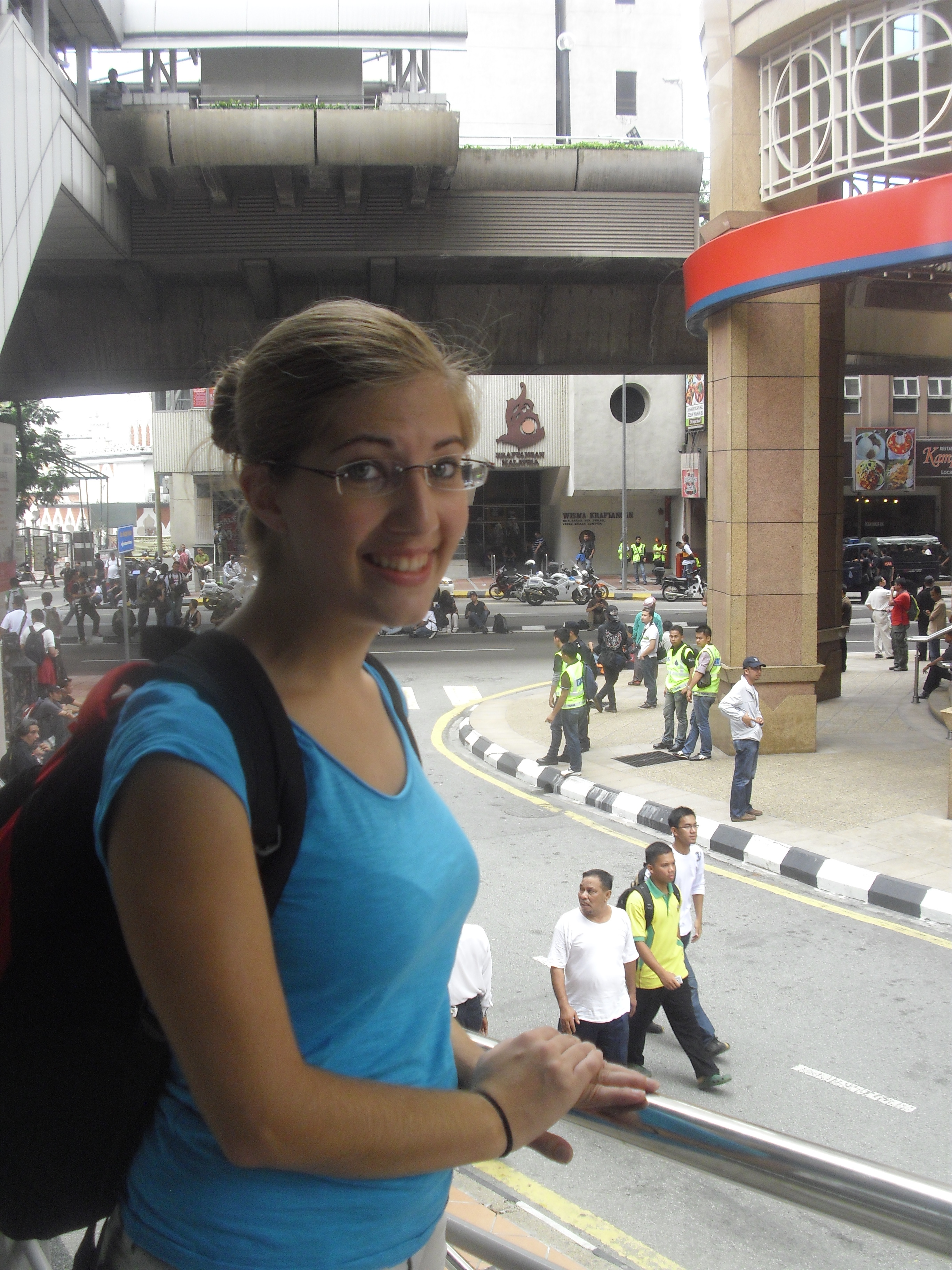
Me at Masjid Jamek before the rally - not really sure what's going to happen
Jullian and I had arrived at the Masjid Jamek subway station around noon, a full two hours before the protests were supposed to start. As I looked around outside, I was surprised to find things quite calm. As all major roads to the city had been shut down the night before, nearly all the shops were closed and most of the streets had been deserted. Local police officers in their dark blue uniforms casually patrolled the streets, as patches of reporters, gawkers and protestors stood around, some taking pictures, some chatting amongst themselves but all waiting for what was about to happen.
Behind the first line, however, it was clear that police were prepared for anything but a casual afternoon. Dark blue “Black Maria” trucks with benches in the boot and gates in the back waited to take away protesters. Behind them, giant red trucks stood patiently for their turn to hose down the crowds. All around, riot police, donned in black uniforms and red helmets, wielded their weapons, some toying with their tear gas guns, others tapping their batons against the plastic of their shin protectors.
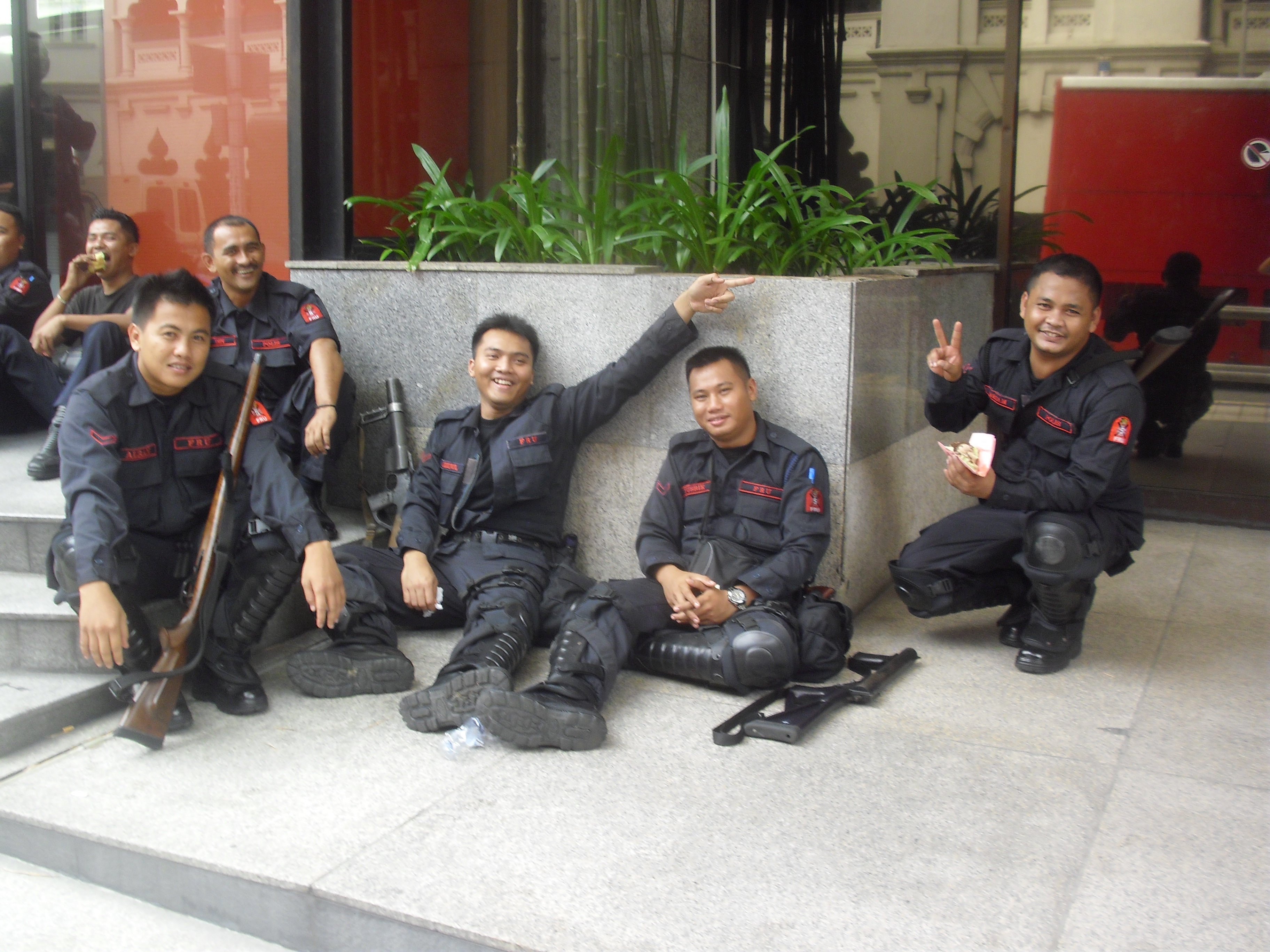
To avoid trouble, Jullian and I had decided to play the roles of tourist and tourist guide, despite the fact that I’ve been in Malaysia for a year now, and he is one of my best friends and colleagues. We did our best to smile and act normal as we walked behind the police lines and decided to join the cops and get an ice cream with the vendor on the corner. To my surprise, the police were really friendly with me. They welcomed my requests to take pictures and even invited me to pose with them, as they slouched on the steps, also enjoying their ice creams.
Riot police relaxing and eating ice cream before the rally
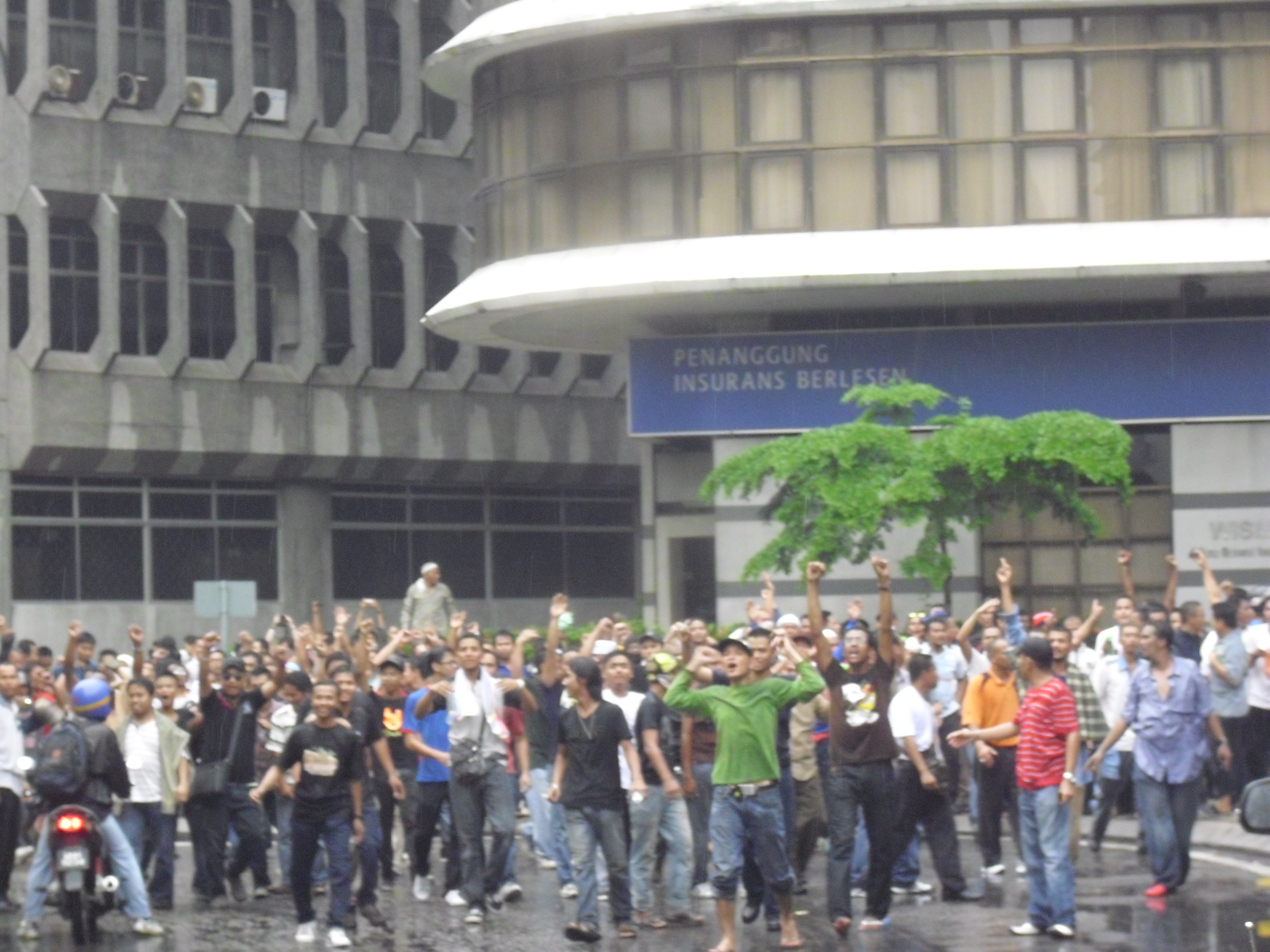
But within minutes, before I could even finish my ice cream, that peace was ended. Suddenly, the random crowds began to turn the corner, journalists running, and Jullian and I followed to find the rally had officially begun. With rhythmic chants of “Hidup, Hidup, Keadlian!” and “Reformasi!” (“Long Live Justice!” and “Reformation!”) several hundred protesters had begun to march.
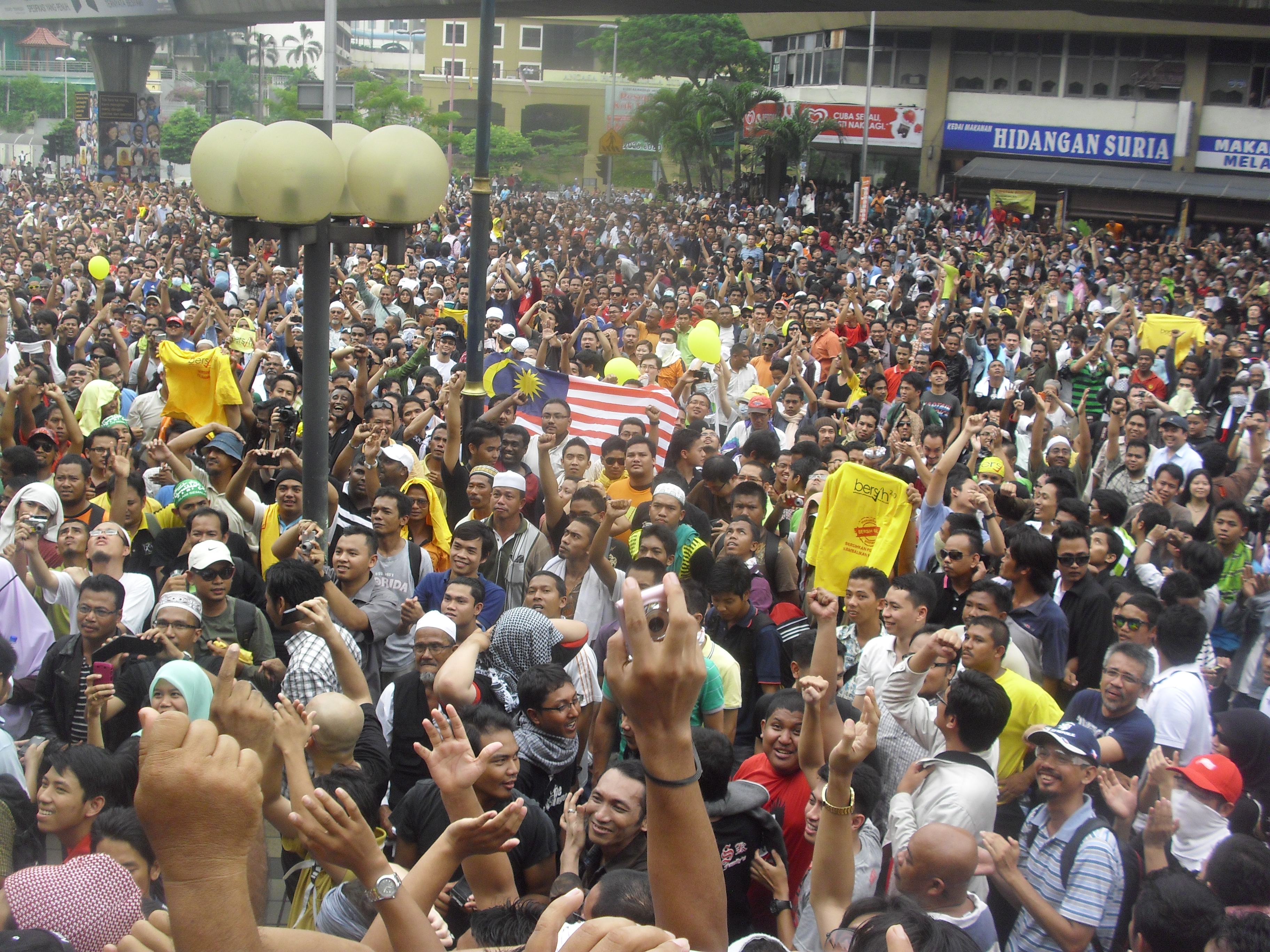
To my surprise, the protesting crowd was quite small, far less than the tens of thousands of people the organizers had expected. But as we made our way to Jalan Tun Perak, it soon became apparent that our little crowd was just the beginning. As we stood on the steps of the Maybank Tower, the apparent gathering point of the rally, we watched as swarms of protesters from all corners of the intersection joined in what soon became a massive crowd of thousands. Around us, people continued to chant, brandishing Malaysian flags and waving around smuggled in yellow t-shirts and balloons – representations of Bersih’s official color. Somewhere in the distance, instructions were being given in Malay from a loudspeaker connected to a phone from unseen leaders who had been banned from entering the city, while police on the outside began to warn the crowd to disperse immediately or they would move in.
Thousands of protesters gathered in Kuala Lumpur demanding fair and free elections
Jullian and I decided our best bet was to stay close to the police, with easy access to move behind the line and run if necessary. As we stood on the side, directly in line with the riot police, I realized the careless, relaxed faces I had seen earlier had been completely replaced with expressions of anger and threat.
As we watched the large red truck enter into the intersection, my heart began to race: the water cannons were coming first. Safe behind the police line, we watched as gallons of water were turned on the crowds, spewing around 180 degrees. It wasn’t until the red truck started reversing toward us and the tear gas came out that we began to run. Loud shots fired from behind and my heart began to pound as we headed even further behind the police line and stopped to watch what was going on. A haze of gas and water lie ahead of us in the street and all around people began to cough, some rinsing their eyes out with bottles of water to relieve the sting. It took a few minutes for me to feel the effects, but soon my eyes began to sting and tear, as if I had just cut up a lot of onions, and my throat began to burn. Jullian and I quickly joined with the others in rinsing our eyes with water and headed to higher ground in hopes of both escaping the gas and gaining a vantage point on what had happened to the crowds.
Riot police make an arrest during the Bersih 2.0 rally
As we reached the top of the hill, the saturated, foam-covered pavement below revealed there was clearly something other than just water in those cannons – and clearly that substance had done its job. Crowds began dispersing into other streets of the city, and though we were in front of the police line, I didn’t realize that the small crowd gathered around us, some praying fervently, would be next in line for arrest. As I stood photographing those who were praying, ignoring Jullian’s calls to move, I didn’t realize that a band of riot police were beginning to surround us, ready to charge. It wasn’t until Jullian screamed at me to run that I realized they were coming for us – and they had weapons. In front of me a group of men were fervently trying to squeeze through a narrow gate and Jullian kept pushing and yelling at me to run and get out. The prospect of brushing up and competing to escape against this aggressive, stampede of men more than terrified me, but when I turned around to see a line of angry riot police waving their batons and grasping for arrests, I was scared out of my mind. As the police grabbed one of the men and pulled him to the ground, I ran behind them and pressed myself against the wall of the building, clinging to Jullian and shaking in fear. For some reason, they didn’t bother with us and Jullian and I ducked slowly back to the “safe zone” to recuperate and observe.
Around, police began to bring in the new arrests, one dragged by his arms, another with torn clothing and still another, donned in bright yellow, wearing a tribal indigenous hat with a big smile on his face. Even old ladies were detained, and soon those earlier empty “Black Marias” were fully-loaded and headed for the jails.
Physically and emotionally exhausted, Jullian and I returned to Masjid Jamak – now vacant – to sit, relax and regroup. The angry crowds that had filled the street just hours before had vanished, though the groups of local police officers patrolling the now-closed subway entrance made it clear the battle was not yet over. Every now and then, Jullian and I caught a glimpse of a crowd turn the corner, smaller now, but chanting with every bit of passion they had displayed some few hours before.
Despite an exhausting cat and mouse game, protesters refused to give up
Word on the street was that the crowds were headed to the Kuala Lumpur City Centre, the heart of the capital and the site of its famous Petronas Twin Towers, for what could have been a dramatic end to the rally. But as we arrived in front of the gleaming iconic landmarks – representations of Malaysia’s growing strength and development – protesters were nowhere to be found. Instead, rows of riot police roamed the streets, this time on horseback, in an ironic contrast to the modern monuments behind them.
In the end, both the government and the protesters declared that day a success and as Jullian and I left the city centre, tired, sore and starving, I realized our day, too had been a success. Chased, tear-gassed and nearly arrested, we managed to walk away completely unscathed. And as I read of the more than 1600 people that were arrested that day, I recalled the images of the tattered shirts, dragging knees and grounded men and realized how truly lucky we were. Though no physical marks remain, the memory of the Bersih 2.0 rally was a life-changing experience that will stay with me forever.
To hear my live radio interview with WDET Detroit Public Radio on the event, please click here.
The rest of our time in Ubud was really nice. As Bali’s culture “capital,” Ubud is the place people go to learn about Balinese art, dance, traditions, yoga etc. (as opposed to surfing and partying). As Bali’s other tourist hotspot, it is also full of really cute boutiques and restaurants, and it seems everyone is willing to drive you somewhere or give you a massage.
Though we definitely indulged a bit in the shopping and spa treatments, we also made sure to try to explore the local culture. One of the things on my must-see list was to watch a traditional Balinese dance. The bright side of staying in a tourist area is there were plenty of options. The down side is that it’s hard to differentiate between the more authentic Balinese culture and the pre-packaged tourist garbage (we learned on day one that our hired driver had his own agenda in mind to take us to places where he’d get a commission. We had to give him very clear directions after that…). When it came to dancing, my guidebook had warned that there were a number of “B”-list dance troupes around and that authentic Balinese dance should not look like you could do it yourself…
We ended up selecting a dance hall near our homestay, and honestly, I cannot tell you which “level” of dance troupe we saw. To their credit, the setting was amazing. Located behind a lily-pad covered moat with a gold, regal-like backdrop, the open-air stage had a magical, enchanting feel to it. The dancers themselves were absolutely beautiful as well with exotic, colorful costumes and make-up. The performance also had on-stage musicians who play these unique gong and xylophone-like instruments, which is pretty cool to see.
The dance itself, however, was, in a word, unique… It is made up with a series of precise hand, arm, head and hip movements with a lot of bent-angle aesthetics that are often used to tell a story. What I found particularly interesting is that they actually use their eyes to dance by opening them wide and looking right to left to the music. It’s quite fun to watch, though slightly creepy…After watching the same few movements over and over and over again, however, it gets a bit redundant and I wouldn’t exactly describe much of the activity as anything that would require you to break into a sweat…Still an interesting experience though.
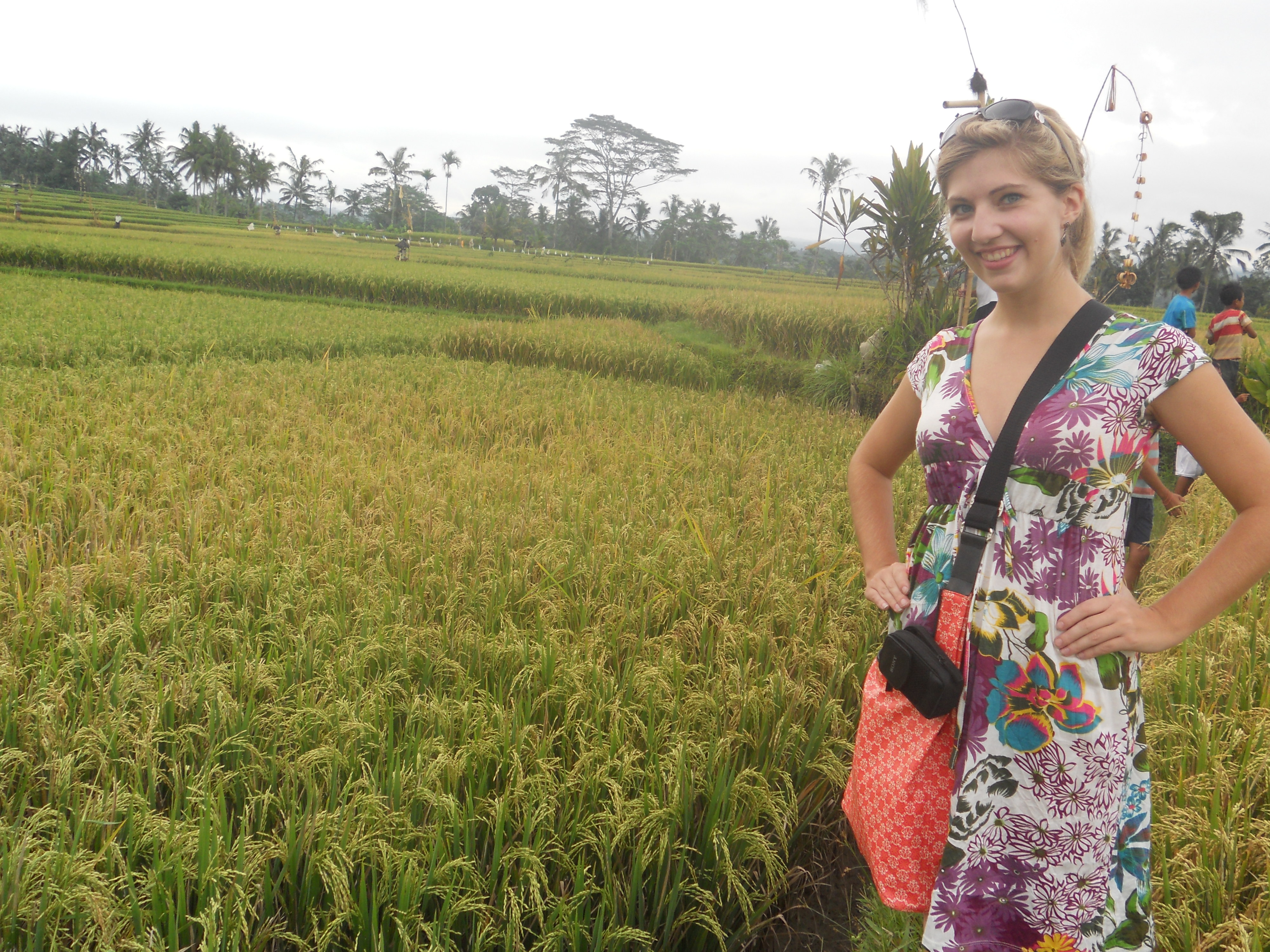
In addition to Balinese dancing, we also had the chance to explore some more local culture in Ubud with a half-day bike tour through the outside villages. What was great about the tour was that you get outside the tourist zones and get to cruise down the hillside (yes, all downhill!), past the rice paddies, past the women carrying baskets on their heads, and past all the local communities. We made several stops along the way to explore on foot, and I must admit, it was really cool to see what rice paddy looked like. Turns out, it looks kind of like wheat or any other grain, who knew?
Me and the Paddy Fields
One of the coolest parts of the trip, however, was our visit to the coffee plantation at the beginning. We got to check out where they grow coffee, vanilla, cinnamon and cocoa before sitting down to sample a few brews :). What was especially interesting, however, is that we got to try civet coffee, or what I prefer to call, “luwak-poo” coffee. For this delicacy, a weasel-like animal called a luwak first eats the berry surrounding the coffee bean, then poos it out. These beans are then roasted and made into a very expensive coffee. There seem to be several theories on why this coffee is so special. Some say enzymes in the luwak’s stomach changes the flavor of the coffee, while others say luwaks naturally choose the best berries, and therefore, the best beans in the wild and make the coffee roaster’s job easier. Either way, the coffee was good, strong, though I’m not enough of a coffee connoisseur to appreciate all its unique flavor :).
After four days in Cambodia, Karri and I headed over to Vietnam for four days in Ho Chi Minh City (formerly known as Saigon). I must say, Saigon was…interesting. Despite being neighbors, Vietnam was really different than Cambodia. The food, the culture and the whole atmosphere were completely different. Cambodia seemed a lot more like Thailand to me, whereas Vietnam is sort of what I imagine China to be like…
We happened to arrive during the eve of Tet, Vietnam’s biggest holiday of the year when they celebrate Lunar New Year. It was a pretty exciting time. The whole city was covered in festive New Year’s signs with red decorations and cat images, since 2011 is the Year of the Cat (however, according to China, 2011 is the Year of the Rabbit…). To our luck, Karri’s Vietnamese friend Michelle was home for the holidays and offered to show us around on her motorbike. I gotta say, at first I was scared. Traffic in Southeast Asia is crazy as it is, but Ho Chi Minh City was especially bad. The city in itself is crowded but in the streets motorbikes are SWARMING! I don’t think I’ve ever seen so many motorbikes in my life, it seemed as if nearly no one had a car. Anyway, not wanting to be rude, Karri and I hopped on and off we went on our Saigon adventure!
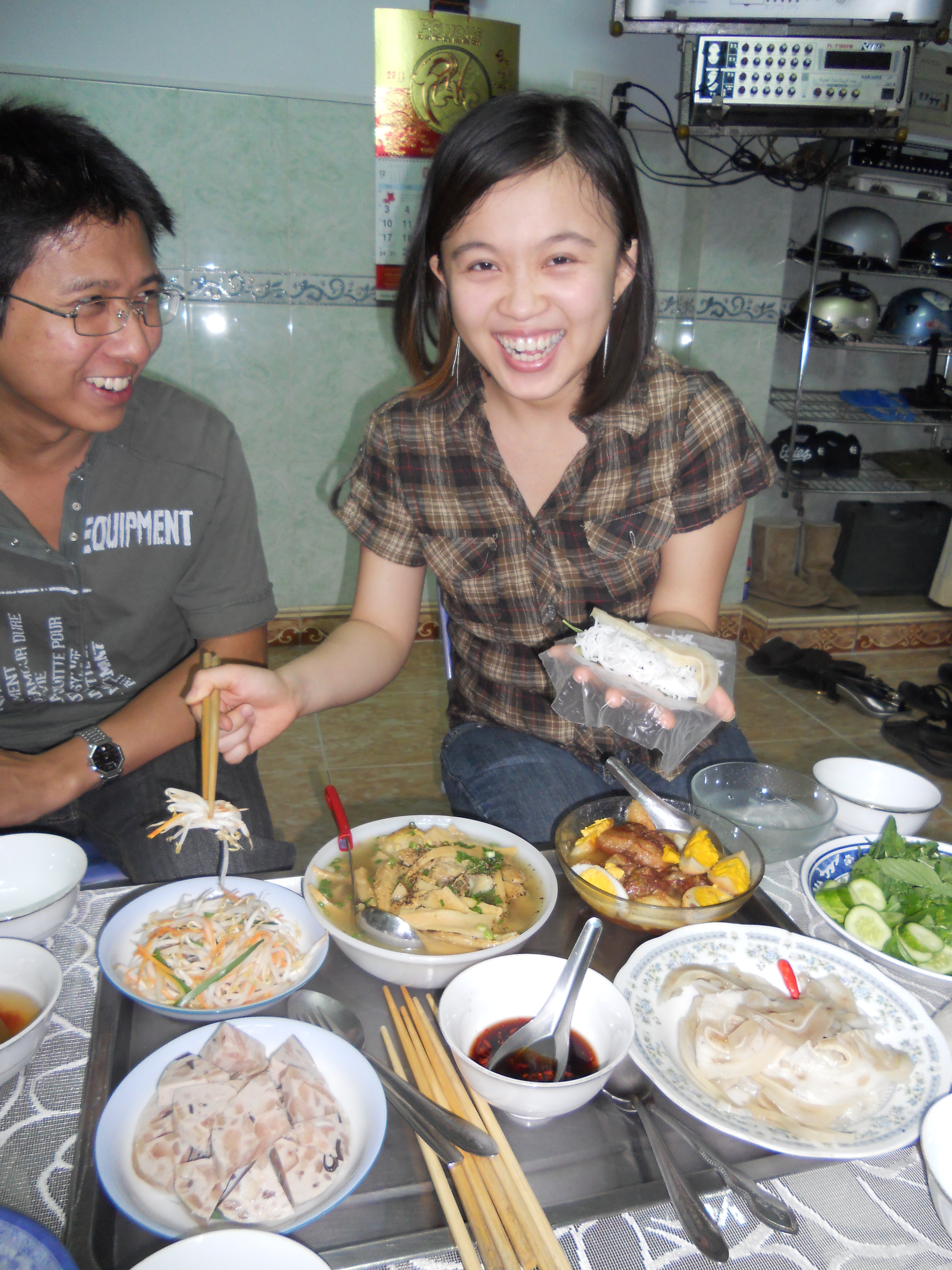
Michelle showing us how to eat Vietnamese food with rice paper
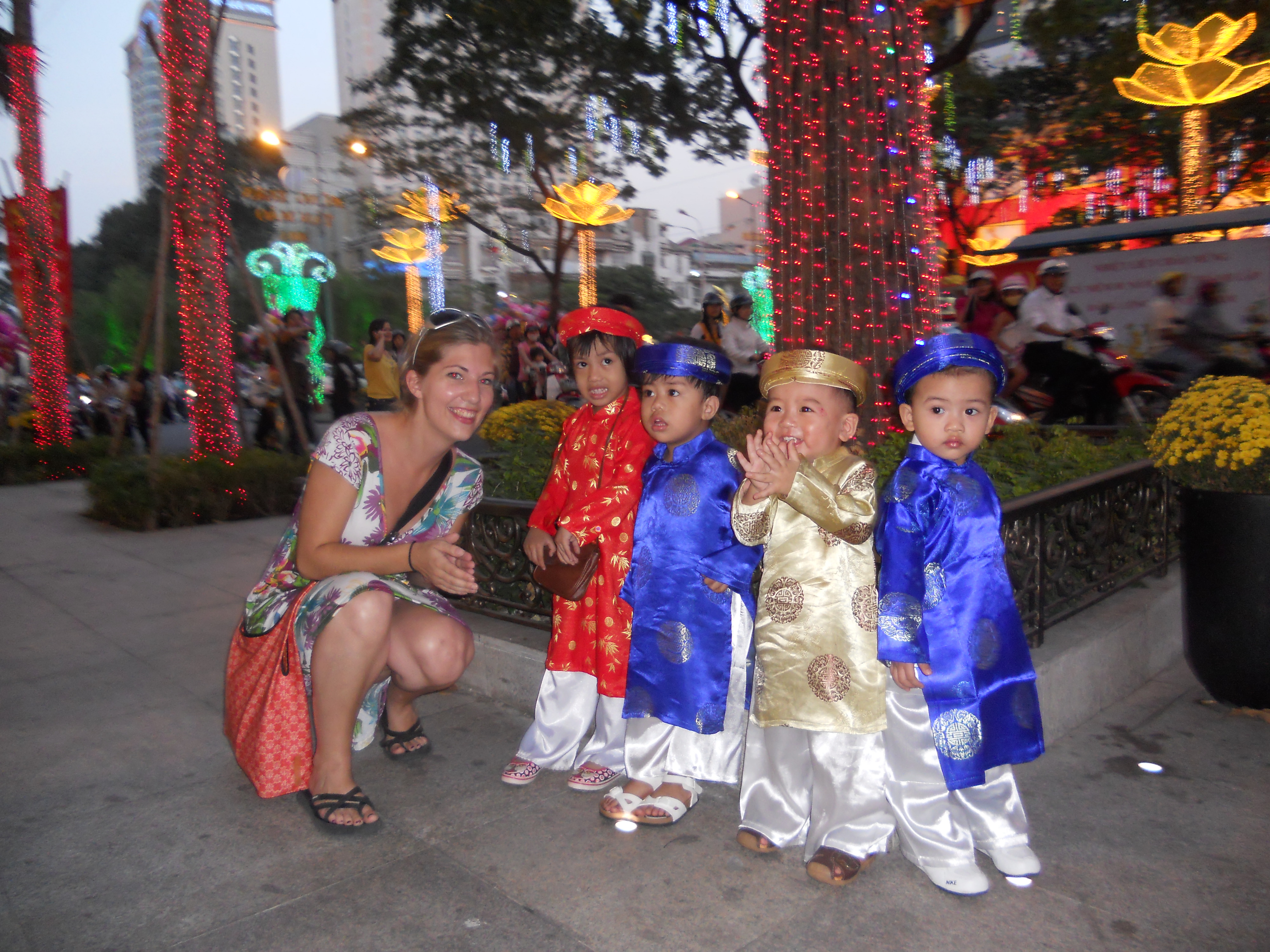
The whole evening was really fun. Aside from the rush of the motorbike ride (only a few near misses :)), we joined the rest of the city in an evening Tet promenade in the city center. The whole street had been blocked off and decorated, and people from all over got dressed up in their finest to stroll down it and meet each other. The atmosphere, though crowded, was extremely happy and festive, it was hard not to enjoy the positive energy. Afterward, Michelle invited us to her house for an authentic Vietnamese dinner. In front of us we found a spread of rice, sauces, meat and vegetables as well as this transparent paper-like food called rice paper. Michelle showed us how to dip the rice paper in water to make it clear and soft then wrap all the food inside of it to make a roll. Her rolls were definitely much tidier than mine, but in the end, they were still fun and yummy :).
Me and the Tet babies
Later that night, Karri and I decided to go to bed early, since he wasn’t feeling well and we wanted to be refreshed the next day. However, the spontaneous Lion Dance outside my window at midnight accompanied by a stream of never-ending firecracker sounds kept me awake well into the morning. Part of me felt bad for missing out on the fun, so at 1 a.m. I changed my clothes and decided to head out on my own only to find we had been locked in! Yes, as if it were a shop, our hotel had closed its doors with a big metal gate over the entrance. As I headed back to my room, stepping over the biggest cockroach I’d ever seen in my life, I just hoped there wouldn’t be a fire…
On the morning of day two, my friend Danielle flew in to join us for the remainder of the trip. Since we were planning on taking day trips outside the city the last two days, we decided to see as much of Saigon as possible while we could. Though many of the shops and restaurants were closed for the holidays, the three of us were actually able to see quite a bit. We walked all over, taking in the French colonial architecture, Notre Dame Cathedral, the Tet market and a cockfight on a sidewalk in broad daylight. By far the most interesting event, however, was the War Remnants Museum, where we spent most of the afternoon.
I must admit, before heading to Vietnam, I knew very little about the Vietnam War. I knew it was a very controversial war where many bad things happened that messed a lot of people up. I was really hoping to learn a lot at the museum. Boy was I wrong…
This was the most un-objective, propaganda-laden place I have ever been to! To start, the entire first floor is full of images of Vietnam War protests throughout the world and letters from American soldiers and political figures expressing their regret and sympathy to Vietnam. The second floor was basically a large exhibit on Agent Orange followed by dozens of pictures of deformed adults and children and their stories. I honestly can’t remember all that was on the last floor, I just remember seeing a lot of pictures of dead bodies and stories about the atrocities the “imperialist” Americans committed.
I know a lot of bad things went down in Vietnam and that history has a different perspective from the other side, but come on! From this museum, you’d think North Vietnam was some sort of angelic victim who was only defending its country. There was virtually no mention of the Cold War, the Communism/Capitalism struggle or anything else that led up to the war, nor was there any mention of the atrocities the North or the Viet Cong committed. The only real positive thing that I got from that museum was a desire to learn more about the war (objectively), and I am now reading up on it.
The whole experience was a real wake-up call for me. It scares me to think how much control a government can have over information and the power this control of knowledge has over its citizens. Though most of the people I met in Ho Chi Minh City were super nice and didn’t seem to have any anti-American feelings, it makes me nervous to think that this information is being shared with hundreds of people every day and spreading more hatred against us. The whole thing reminded me of “1984” which, if you’re read it, you know does not end very well…
I know I am getting very behind in my blogs here, but there are so many things I want to write about, and with all my recent travels, I have hardly had any time to catch up!
That being said, there was one holiday in January I got to experience that I would really like to share here: Thaipusam. Since my first visit to the Batu Caves in August, I have been looking forward to this event to witness first-hand the more than one million Tamil Hindu devotees who flock to the caves to pay homage to the deity Lord Murugan, to whom the cave’s shrine is dedicated.
What makes the event interesting is that the pilgrims show their devotion by carrying burdens called “kavadi” on their bodies, which generally include carrying large, heavy decorations on their shoulders and/or attaching small fruits and flowers to their bodies with hooks as they climb the 272 steps to the top of the cave. Others, especially women, carry jugs of milk. Each devotee has an entourage who accompanies him or her on the journey, and those who are especially hard core get a small band who help them get into and stay in a trance.
I gotta say, the whole experience was AWESOME! But I must admit, Thaipusam, for both the devotee and the gawking tourist, is not easy. First, it is hot! Since I work in air conditioning all day long, sometimes I forget how hot Malaysia really is (last time I checked the temperature it was 95°F, “feels like 106°F”), but being out in the open sun in a crowd (plus a sunburn) is a quick reminder that I am only 3° above the equator.
Second, it is crowded! More than a million people came out to the Batu Caves that day and within an hour, I had lost everyone in my 30-person group. At one point, the police were fighting to keep the non-participant crowds from going up the stairs into the caves, and I found myself constantly squished up next tons of sweaty, stinky strangers.
Usually, I hate crowds but for some reason, I actually didn’t mind them during Thaipusam. There was a really exciting energy in the crowds, and though I obviously wasn’t participating, I definitely felt like I was right in the event. At one point, exhausted, sweaty and dehydrated, I decided to head home, but then I found out they had opened up the stairs to the caves to the non-participants. Though part of me wanted to crash, my curiosity got the best of me and I managed to haul my butt up the steps to see what I could find.
All around, people were removing their kavadi and many of the devotees were passed out or lying down with their attendants rushing to cool them down and take care of them. Though all I saw was the actual carrying of the kavadi, these people undergo weeks of purification rituals to prepare, including fasting, where they eat only one simple meal a day. Though I know the act is gruelling, I was still surprised to see how strong of a physical toll it took on some of these people. Many perform it as a form of thanksgiving or penance to Lord Murugan to receive blessings from him, especially if there is an impending crisis like a severely ill family member. I suppose people can do anything with the right motivation!
With the different food, water and climate, everyone said I should expect to get sick when I came to Malaysia, especially in my first few weeks. I was very relieved to find my immune system working full force with not even a cold in my first few months here. In fact, the only sickness I did get was after eating at a high-end Chinese restaurant at the Hilton, not the local street food. So it was just my luck that I got a bout of bronchitis right before my four-day work/holiday trip to Kuching, Sarawak, East Malaysia.
I’d been looking forward to this trip for weeks, ever since I found out I was being sent for work with the chance to stay back and travel for a couple days after. When I started feeling a pressure on my chest and coughing a few days before, I thought it was a cold and my stance against encouraging a global immunity to antibiotics as a result of over prescription stupidly prevented me from going to the doctor beforehand. It wasn’t until my ear refused to pop for nearly a day after my flight and my voice started sounding like Barry White that I realized perhaps I was wrong…
After two days working, resting and drinking as much hot water as humanly possible, it was finally time for my weekend trip. Let me tell you, after waking up throughout the night with a hacking cough, feeling exhausted and feverish, I was not exactly in the best situation to go out exploring Sarawak. But I was also not about to give up my semi-free trip, so I loaded up on cold medicine, lozenges and tea and set out.
Let me just say, Sarawak is absolutely beautiful! It is much cleaner and less congested than KL, and there are green hills and jungles everywhere. Sarawak is one of two Malaysian states that make up East Malaysia on the island of Borneo, which also includes the country of Brunei and parts of Indonesia.
To start off our trip, Jullian and I rented a car and headed out to a crocodile farm where they have lots and lots of crocodiles, as well as cages of other cool animals. The farm was pretty cool. You get to see lots of crocs in cages, and at feeding time, you get to watch them jump in the air for their food. They also have cages of monkeys (like Rafiki), snakes and ponds of exotic fish to look at while you’re there. My highlight, however, was the baby monkey who escaped from her cage to give me and the rest of the tourists quite as a surprise as we were walking down to see the crocs…
Way better than the crocodiles, however, was the orang utan sanctuary at Semenggoh Nature Reserve. The reserve, along with another center, rehabilitates orphaned or displaced orang utans to send them back into the wild. At the reserve, you get to enter into the park at feeding times when the orang utans come back to eat (the plan is for them to eventually learn to get food on their own). It was amazing! I gotta admit, the first 50 minutes were a bit slow. The orang utans came down about 50 feet away to eat, and I was disappointed that they were so far. But in the last 10 minutes four orang utans came down to our side of the park, where they came within a few feet of us to get food from our park ranger. They were hilarious too, just swinging all over the trees and trying to steal food from our guide, even when he tried to turn them down. I absolutely loved watching them, and they had to practically drag me away from the park. It was definitely an incredible experience.
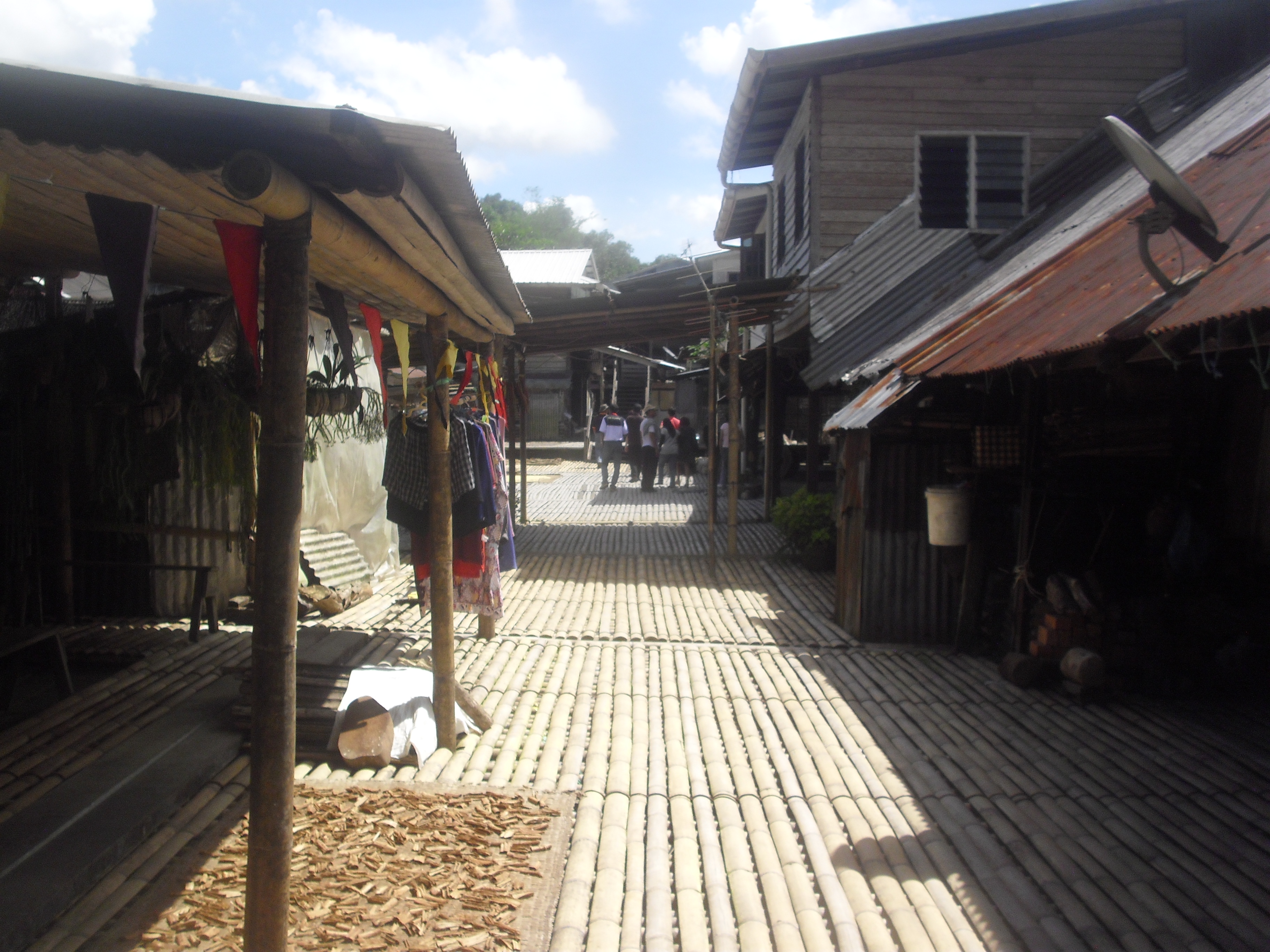
Aside from wildlife, Sarawak is also known as being a major cultural hub in East Malaysia, especially with lots of local aboriginal tribes that are different than the Malay-Chinese-Indian ethnic make-up of Peninsula Malaysia. In between the crocodiles and the orang utans, Jullian and I drove out to visit one of the tribes in a longhouse in the middle of the jungle. A longhouse is literally what it sounds like: a very long house, sort of. Mostly made from bamboo shoots, a longhouse is a very long community building where the
Longhouse
whole village lives. Individual families have their own doors and units, but the outside is like a very long porch which is a common area for everyone. We didn’t get to stay very long, but we got to walk along the building, chat with the people, and check out the skulls room (many tribes were known for headhunting, where it was a mark of honor for a man to take the head of another person. They then save the skull and get a tattoo).
The next day, we were able to learn more about the village we just saw at the Sarawak Cultural Village. Like Detroit’s Greenfield Village, the Sarawak Cultural Village is like a living museum where you get to walk through replicas of the homes of aboriginal tribes where characters dress in costume, perform local dances, traditions and crafts and talk to you about the history. It was fun, you get to see a very different kind of history than I’ve been exposed to and watch a very cool cultural dance show in the end.
Tree house
One of my favourite parts of the trip, though, was just swimming in the South China Sea. Aside from a short trip to the beach at Port Dickson (not known as a very nice beach in Malaysia) this was the first real beach I’d been too while I was here. It was gorgeous! The beach was right next to the hills (or mountains? Can’t really tell the difference) so you can swim while watching the clouds descend into the trees. The water was fun too. Not exactly crystal clear, but the waves were pretty rough making them extra fun to jump into! The resort we stayed at was also pretty unique, we actually stayed in a tree house! Technically, it was a cabin on stilts that sits among the trees, but it was awesome. It came with its own bathroom and shower, air conditioning and a beautiful view of the beach and trees. The fact that the hot water was fickle and there was a creepy crawly shell/crab thing sharing the bathroom with us only added to its charm (sort of).
Now I’m back in KL on a sick day with a full course of antibiotics waiting for my body to recover. Less than three weeks until Thailand!
Though I have met some really awesome people during my time in Malaysia, I must admit my circle of friends here is still pretty low. Consequently, I have been actively trying to make friends by accepting nearly every social invitation offered.
Last month, I attended my first Indian wedding of my friend Prakash, who had been one of my cab drivers when I first got here. Though we had only spoken a couple of times, Prakash not only invited me to his wedding, but to stay over at his family’s house the night before to see some of the ceremonies that take place during an Indian wedding.
Though at first I was a bit hesitant to stay with people I don’t know alone in a foreign country, I decided to take a chance. What’s life without a little risk anyway? So I packed up my new sari, matching shoes, a change of clothes and off I went, making sure to leave the address and phone number with a friend, just in case someone needed to locate the body…
At first it was a little weird. As the lone, blond white girl in a house full of Indians (all family too), I didn’t exactly blend in. Luckily for me, Prakash’s family took me right in and soon I found myself surrounded by a bunch of Indian children who kept asking me questions and fighting for my attention.
The whole evening was pretty exciting. The house was full of commotion with people all around eating, chatting and running around getting things ready for the next day.
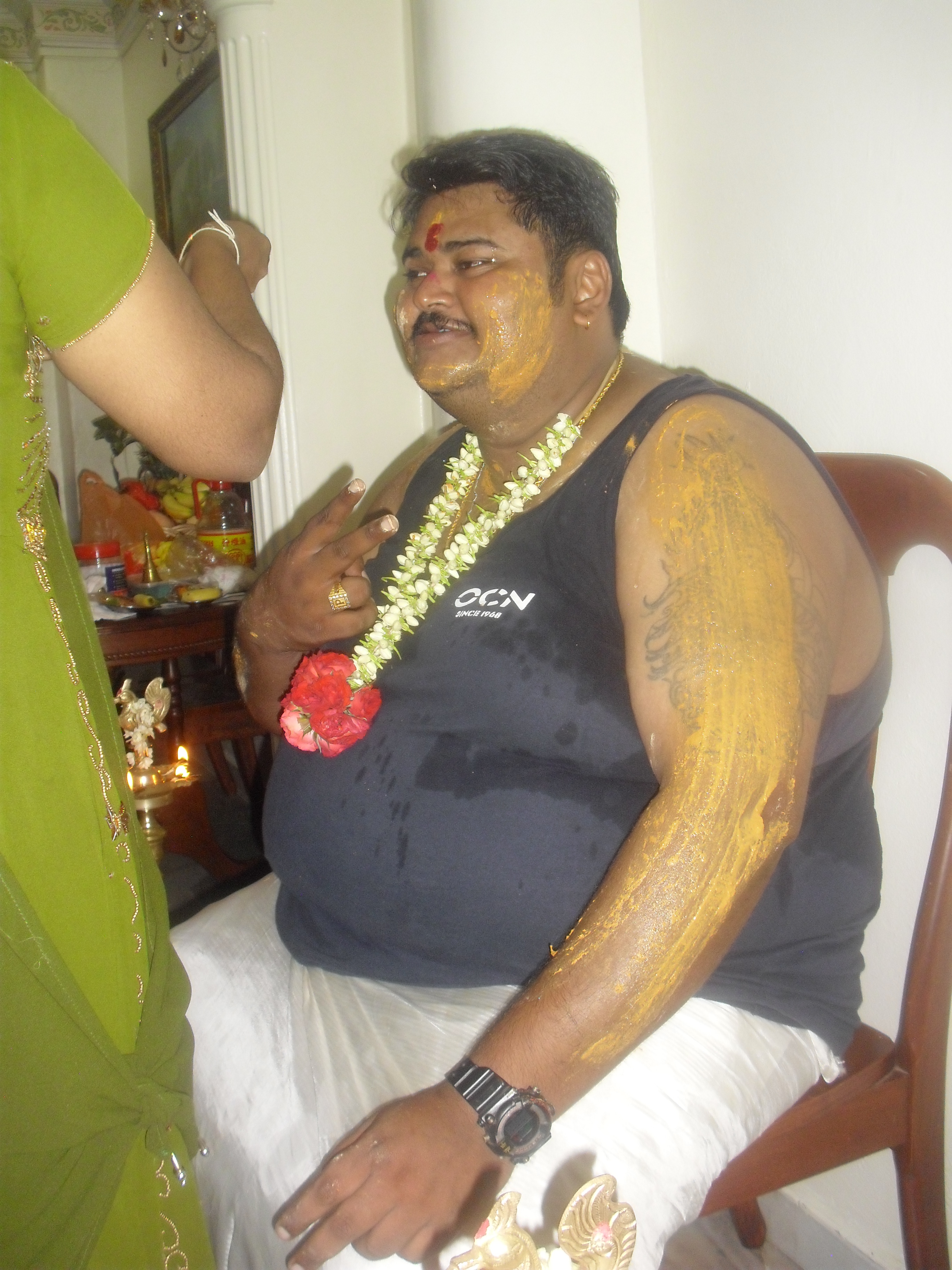
Prakash undergoing a Hindu cleansing ritual the night before his wedding.
One of the coolest parts of the evening was this pre-wedding Hindu cleansing ceremony. Though I am not exactly sure what was going on, Prakash sat in a chair while several of his aunts smeared this yellowish paste made of turmeric on his arms and face and sprinkled water on his head. They also had this thing which looked like a covered rock that they circled in front of his body and pretended to throw at him. Again, I had no idea what was going on, but everyone seemed to have a good time :).
Awhile later, I snuck away to the couch in one of the bedrooms upstairs to try to get some sleep. Though the wedding was at 7 a.m. the next day, no one else seemed too concerned about sleeping the night before. To me, 7 a.m. for a wedding is WAY too early to even think about attaching yourself to someone for the rest of your life, but apparently in Hinduism you consult an astrologist first who finds out the best time of day the couple should be married. From conversations with others Indians I’ve met, 7 a.m. isn’t too bad compared to some of the 2 a.m. or 4 a.m. ceremonies they have attended in the past!
The next morning is a kind of a blur. I remember waking up around 5 a.m. and scrambling with the other women to shower and get ready to be at the temple on time. Though I had been shown by the tailor how to tie my sari (and he had sewn it in a way to make it simpler) I was very thankful for Prakash’s aunts and cousins who made sure I was correctly put together before walking out the door :).
Once at the temple everyone rushed to get out of the car and start bringing things inside. Trying to be helpful, I offered to help carry something. The next thing I know, a tray is placed in my hands, and I find myself at the FRONT of the procession to the temple where the groom’s family offers gifts to the bride’s family. Somehow as I walked forward thinking, “What the hell am I doing? I don’t know where to go!” I managed to slink back further in the line before I before I embarrassed myself (and them) and eventually separated myself from wedding participant to spectator, which I was a lot more comfortable with :).
From what my sleep-deprived mind remembers from the rest of the ceremony, there was a lot of music, candles, flowers and rituals, most of which I didn’t understand. At some point, Prakash tied a necklace around the bride’s neck, everyone threw rice and Jullian told me they were married now.
Afterward, everyone ate at the temple then went back home to socialize, eat some more and rest before the evening reception. Though people mostly seemed happy during the event, I gotta admit, I’m not exactly sure if I would characterize the faces of the bride and groom as joyous… Prakash and Premla, like many Hindus, had an arranged marriage, and didn’t know each other well before the ceremony. At one point, Premla burst into tears while sitting on the couch at Prakash’s house. One of Prakash’s cousins then told me, as if it’s no big deal the bride is sobbing, that it’s normal for the bride to cry on her wedding day, because she has to leave her family’s home to move into her husband’s.
Though the idea of an arranged marriage is a completely foreign concept to most Westerners, a lot of thought is put into finding a compatible match for their children by their families and apparently there is a lot of success in arranged marriages. I haven’t spoken much to Prakash since the wedding, but here’s hoping they find happiness.
It’s one of Malaysia’s many holiday seasons this month, and let me just say, things have been crazy busy! After several weeks of fasting, Ramadan is coming to an end this week, which means lots of preparations and excitement in Malaysia. It’s almost like Christmas season here, with people sending gift baskets and greeting cards to each other and getting ready for Hari Raya, the Malaysian version of Eid ul-Fitr, to celebrate the end of Ramadan.
It’s really interesting being in a Muslim country during Ramadan. Though I usually noticed when it occurred when I was in the U.S., here the whole country changes for the month to accommodate the Malays, all of whom are Muslim and who make up the largest majority in the country. At work, Malays come in early and leave early to make up for the shortened “lunch” break and allow them time to go home and prepare for “buka puasa,” when they break the fast after dark. More than just a suggestion, all Malays are REQUIRED to observe Ramadan by Sharia Law. In fact, when I went out to lunch with some co-workers a couple weeks ago, my Malay friend (who was sick and therefore not fasting) had to hide behind us when we ate out in public for fear of getting fined by Sharia police. While the Chinese, Indians and other “obvious” non-Muslims have no problem during Ramadan, people who are half Indian half Chinese, known as “Chindians,” sometimes get into trouble, because they physically look Malay and Sharia Law is enforced through racial profiling. Definitely not in Kansas anymore…
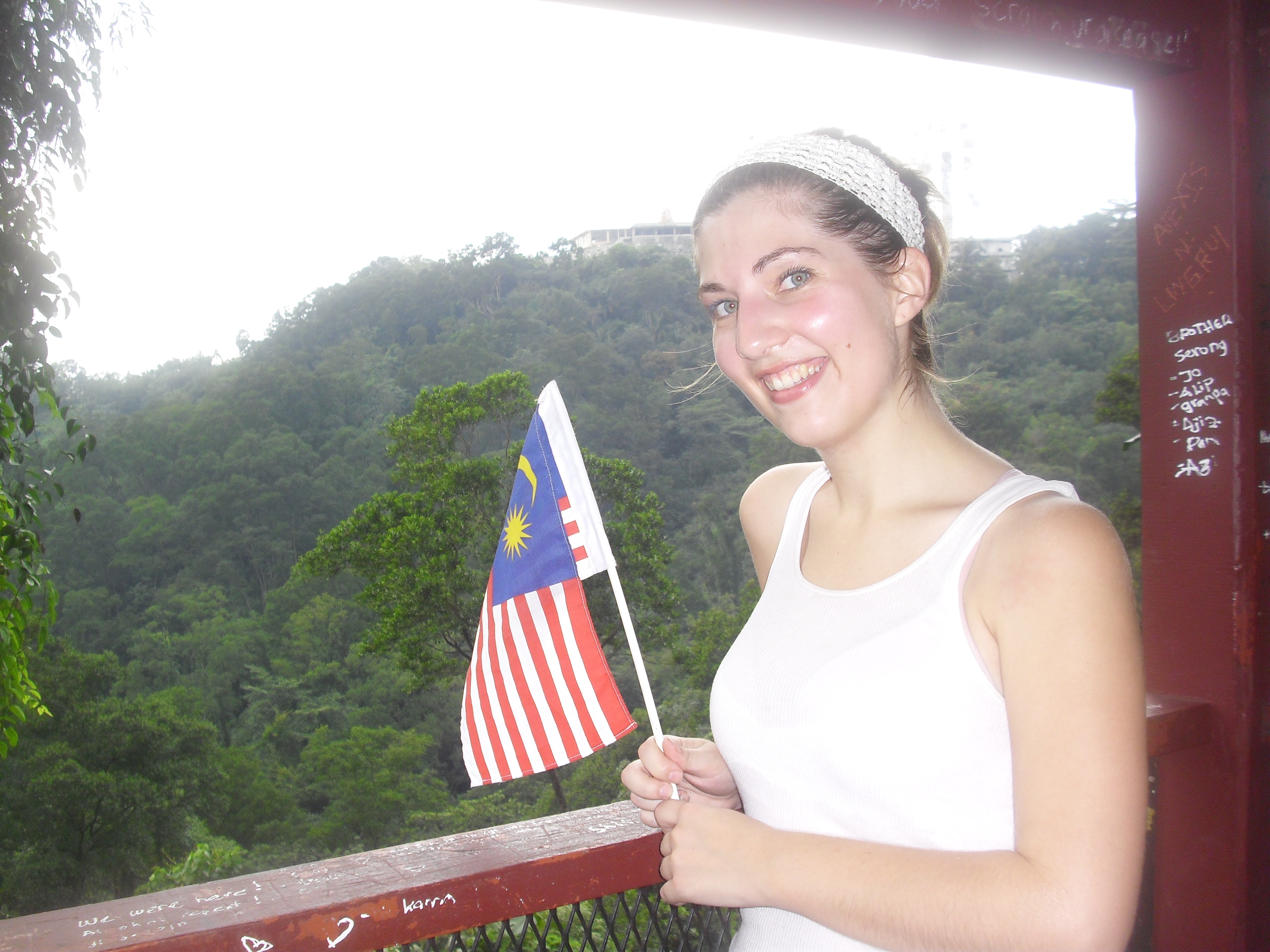
Aside from Ramadan, last week Malaysia also celebrated Merdeka Day to recognize the day it gained its independence from British colonial rule. I’m still not exactly sure what Malaysians do to celebrate, but it seemed to me everyone just enjoyed an extra day off from work. I decided to use my day off to go hiking with a friend in a local park called Bukit Gasing which, though not exactly the deep jungle, was still pretty cool.
Me holding a Malaysian flag on Merdeka Day while hiking in Bukit Gasing
Let me tell you, hiking on the equator is like hiking in a sauna! Though the park was relatively tame, after just a short distance I was completed soaked in sweat and my face was bright red. The huge rainstorm that poured down half-way through the hike was more than welcome and felt amazing after all the heat and humidity. All was fun and games until I realized that the rain had soaked through the backpack, destroying my phone and severely damaging my camera…yeah…not cool…
In addition to the national festivities, I have also been getting ready to go to my first Indian wedding later this week. The guy getting married, Prakash, was one of my cab drivers when I first got here who I made friends with. Though I don’t know him well, he was very excited that I come to the wedding, and there is no way I am going to pass up this opportunity!
Being an Indian wedding, I want to dress appropriately, so of course that means I had to get a sari! Unfortunately, I don’t know any Indian women here very well, so my Indian Malaysian friend Jullian offered to take me sari shopping, which, as a guy, he had never done either…
Jullian took me to an area in KL called Brickfields, also known as Little India, to shop. Though I didn’t exactly know what to expect, I was hoping to meet a nice, English-speaking Indian female at the shop who could help me pick out a sari and show me how to tie it. Unfortunately for me, the shopkeeper was a man, who though very nice, only spoke Tamil…
Somehow between me awkwardly pointing at things, Jullian translating and the shopkeeper wrapping me up like a doll (like I’m going to be able to repeat this!), I managed to find this beautiful dark pink and gold sari as well as matching bangles and jewelry. Then it was off to the tailor’s (another man) where I was measured for a custom-made sari shirt to wear under my new sari (fun conversation moment: tailor: “Do you want cups sewn in?” me: “I have no idea. This is awkward…”). After pointing out pictures in a book, some translating from Jullian and advice from the tailor’s wife (“Yes, get the cups…”) I think I picked out a really pretty design that I can’t wait to see when I pick it up on Wednesday!
Along with getting Indian dress, I also learned how to properly eat Indian food, with my hands! A couple weeks ago my co-workers and I were interviewing an Indian Malaysian family for a university ad and afterward took them out for an Indian banana leaf lunch. Though I had done this before, I have always used a fork, but this time, I had proper tutors :).
To start, a banana leaf is placed in front of everyone and the server comes around and puts rice and different ladles of curry and other sauces around it. You then use your hand to mix things together and put it in your mouth. Sounds simple enough, right? Wrong!
Turns out, eating with your hands is hard! You only use your right hand and you’re not supposed to get messy past your second knuckle. Much easier said than done… After several awkward, elbow-raising attempts with very little food getting into my mouth and much taunting from certain co-workers, Saha, the Indian Malaysian student we interviewed, told me the rule of thumb is not to use your thumb, except to push food into your mouth. Apparently the key is to scoop up the food with the tips of your fingers then use the back of your thumb to push it in your mouth.
In the end, I left with a full stomach and a sense of accomplishment. Next step, learning to use chopsticks!


 Erica in Wonderland