Category Archives: India

Buddhist Beginnings

Standard

When I started my India trip, my plan was to travel for the first few months then settle down in an ashram in the end to focus on yoga and meditation and, hopefully, learn more about Hinduism.

As I mentioned in my Mehandipur post, I have always had a fascination with religion, psychology and philosophy. I enjoy learning about different belief systems, their history and what motivates people to behave in ways that they do. Hinduism, in particular, has become religious fascination number one since I arrived in Asia, and I was dying for a chance to learn more about the Hindu gods, karma and all their rituals.

So when I heard about the eight-day “Introduction to Buddhism” meditation course being offered at the Tushita Meditation Centre in McLeod Ganj, I had mixed feelings. As home of the Dalai Lama and the Tibetan government in exile, McLeod Ganj is a magical place in the Himalayas full of Tibetan refugees, monks and lots and lots of Westerners, all there to enjoy the breathtaking views, peaceful atmosphere and positive energy. (McLeod Ganj was MY FAVORITE destination in India).
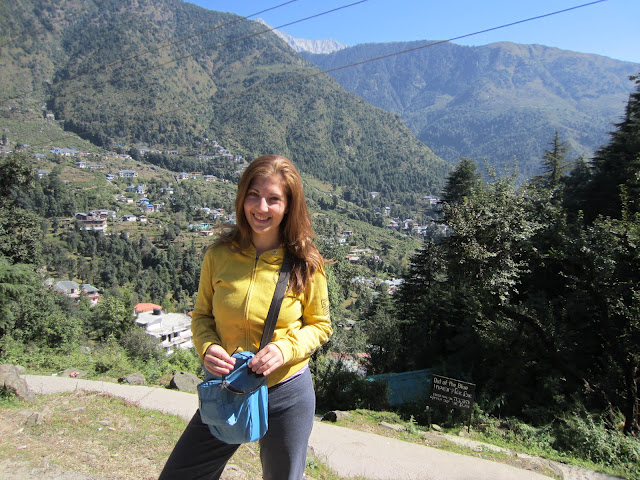
Me in front of the Himalayas in McLeod Ganj

However, a week-long introduction to Buddhism course was never in the plan. India was supposed to be learning about Hinduism, not Buddhism, and I was afraid my Buddhism course would cut into my ashram time in the end.

But something pushed me to stay. I don’t know if it was the desire to stay in McLeod Ganj, sheer curiosity or something more powerful, but in the end, I decided to embrace Tushita. And it ended up being one of the best decisions I’ve ever made.

Located about 15 minutes outside the city, the Tushita Meditation Centre is a Tibetan Buddhist center that hosts free daily meditation sessions and regular Buddhist courses and retreats. It is also home to several monks and nuns.

As the title suggests, the “Introduction to Buddhism” course is an intensive retreat focusing on the basic philosophy of Buddhism through a series of lectures and guided meditations.

The days were fairly routine. Every morning, a gong would sound at 6 a.m. to wake us up in time for our morning meditation session. The rest of the day followed in a sequence of breakfast, morning lecture, stretching, lunch, chores, discussion groups, afternoon lecture, dinner and evening meditation.

I’m not sure if I could pick a place more suitable to learn meditation. Situated right in the mountains, Tushita is completely surrounded by trees, fresh air and beautiful views of the woods below. The gompa itself, our hub for meditation and lessons, was also impressive. In front of the rows of cushions and tiny desks where we sat, a massive gold Buddha commanded the attention of everyone in the room, surrounded by walls of colorful paintings and a photo of the Dalai Lama.

The gompa at the Tushita Meditation Centre in McLeod Ganj

Our housing, however, was a bit more humble, consisting of basic single beds and shelves with shared toilets and showers on the outside (some can opt to pay more for their own room and bathroom, however). And as if you’re not removed from society enough, Tushita was quick to take away any distractions that may otherwise hamper our development, including our phones, cameras, laptops, etc. that got locked away for safekeeping. But I think the one thing that kept the distractions most at bay was one particular rule: no talking.

Yes, apart from asking questions during lecture time and group discussions, the entire retreat was meant to be in silence. No meal-time conversations, no chatting with your roommates, just lots of time to reflect on the day’s lesson, meditate or read Buddhism books.

Ok, I’m pretty sure the ones watching from home right now are laughing in astonishment at the idea of me being quiet for a week, but I’m proud to say, I did it! Better than many others in our group, I might add (you know who you are).

Surprisingly, it wasn’t as bad as I thought it would be. In fact, it was a bit of a relief at times to be able to sit quietly alone and not feel bad that my frequent anti-social self wasn’t participating in the seemingly-exciting discussions nearby.

Instead, I listened. I read. I watched the monkeys play in the trees (an endless source of entertainment). But most of all, I thought.

Buddhism, when you break it down, is fairly simple. Basically, it’s the idea that through aging, sickness and death (among other things), the human condition is one of suffering. But through meditation and awareness, one can learn to be unattached to temporary, material and emotional things (the causes of suffering) to attain peace, knowledge and, ultimately, enlightenment, an eternal God-like state of bliss and understanding.

On the surface, it’s an easy enough concept to grasp. Removing any sense of karma, reincarnation or beliefs in the spirit realms, even the most devout Christian or adamant atheist can find Buddhism a useful tool for coping through life or deepening one’s own, different, sense of spirituality. In fact, many argue that Buddhism is more of a philosophy than a religion anyway.

For me, who is often overly-emotional, irritable, and/or anxious, Buddhism, in its most basic form, promised a way to find peace, despite external circumstances. But learning to meditate is not easy, especially for one with the charming aforementioned characteristics. To start, just sitting upright, cross-legged for a prolonged period of time can be quite painful without proper strength, flexibility and practice (that’s where yoga helps). And then the really hard part: stilling one’s mind. In training, they teach you to watch your breath, sometimes counting, to help you focus. When thoughts come, as they inevitably do, the idea is to simply observe them and let them go, as if watching a still from a movie. No analyzing, no obsessing and no judgment (not even to scold yourself for thinking), just recognition and release.

If you’ve ever tried this yourself, you know how difficult it is. It’s amazing how many thoughts go through our heads each day, even more amazing when you consider how much of them are repetitious or useless, serving no purpose whatsoever for our ultimate well-being and oftentimes, causing more trouble.

When one gets really deep into meditation, some claim to get glimpses of enlightenment, sublime experiences that are out of this world. Others drudge up old or repressed memories or, sometimes, even past lives. And still, with intense concentration, some gain the ability to transcend human limitations of pain and endurance (so I hear). The whole process is, essentially, a massive clearing out of the junk inside your head that distract or otherwise prevent you from seeing things as they truly are and reaching enlightenment.

In my eight days at Tushita, I got nowhere near enlightenment, nor did I have any freaky out-of-this world moments. I did, however, have one strange experience that took me by surprise, a memory, actually, from the 10th grade.

This was not my first kiss, not some melodramatic teenage argument, nor some significant award or competition that was important to me then. Instead, it was a simple lunch with friends in my high school cafeteria. While I still can’t figure out why this image came to mind, I do remember the olive green color of the shirt I was wearing, the exact positioning of my friends at the table and the random 15-year-old thoughts going through my head at the time, happy to chat with my friends, nervous to talk to the boys I had a crush on. But that’s it.

I still insist this memory was rather trivial, but the one thing I do take from this scenario is how incredible the human mind really is. Maybe we don’t actually forget as much of our lives as we think we do, maybe it’s just a matter of training our minds to drum up the past and, with practice, we can relive the most amazing or even insignificant events that made us who we are today.

As for the rest of the group, we all seemed to have powerful experiences in some form or another. In addition to stilling our minds, our meditation guide, Rinchen, also took us through a series of intense, and at times painful, meditations where we focused on love, forgiveness and death. I tell you, nothing gets the emotions up like imagining what it would be like to say good-bye to loved ones if you only had six months to live or recognizing who you still have grudges against when forced to concentrate on forgiveness.

But, in one of my favorite moments in all of India, Rinchen says, with complete seriousness, “And if you’re older than 26, death is closer than you think.”

In a massive relief of tension, the entire room, made up largely of 20-somethings, bursts out laughing in a tremendous, gut-level release that even Rinchen partakes in. Apparently, there’s only so much gloom and doom we can take.

By the end of the week, despite not talking, we’d all found a deeper connection, not just with ourselves but with each other. In a massive show of unity and friendship, nearly all 100 of those in our group filled the rooftop of Carpe Diem restaurant in McLeod Ganj the day the course ended for dinner together, and I still continue to keep in touch with many of those people today.

I won’t go so far to say I’m a Buddhist just yet, but I will say that after Tushita, I have opened up my heart and my mind to seeing what Buddhism can do for me, and maybe those around me indirectly. Though still a beginner, I have started to meditate regularly and try to use Buddhist philosophy when I find myself frustrated or overcome with emotions.

Could Buddhism be the new Xanax? 😉
India and Spirituality

Standard

My Indian yoga teacher in Malaysia once told me that everyone with a desire to go to India is seeking something spiritual.

While images of the Taj Mahal, camels and temples came to mind, my Catholic-turned-agnostic self began to wonder if maybe he was right.

For the first 20 years of my life, I was deeply religious. I went to church every Sunday, prayed daily and was quite outspoken on what I believed to be right and wrong.

Then the questions and the doubts began to pile up, eventually becoming overwhelming, and I decided to take a break from God, a break that ultimately turned into abandonment.

It’s not that I didn’t want to believe. The idea of having an omniscient, omnibenevolent being always looking out for you, waiting for the day to take you away into eternal bliss is incredible, comforting and altogether a desirable thing. But, as I’m sure God would know, if you don’t really believe in it in your heart, you can’t force yourself.

And so, for the past seven years, I’ve sort of teetered the agnostic-atheist line, not quite confident enough to believe God doesn’t exist but not placing my bet on the fact that he does.

But to live with that sense of isolation, that life is ultimately futile, can be quite difficult. When things go wrong, “Maybe this happened for a reason” or “God will get me through it” just doesn’t work anymore and you only have yourself or chance to blame and, ultimately, to rely on.

Living this way does have its benefits. If you believe you only have one life to live, without any notion of a higher purpose, you are less likely to put up with undesirable circumstances in the present in the hopes of greater rewards in the future. Your life becomes your most prized possession and making yourself as happy as possible becomes the ultimate goal. (Note: pursuing happiness and pursuing pleasure are two different things. A hedonistic life does not necessarily bring happiness, and a person (including an atheist) can certainly achieve happiness by dedicating his or her life to helping others).

But despite my own doubts on the existence of God, one thing that has always perplexed me has been the conviction and frequency of other people’s experiences with the supernatural. While nothing has ever happened to me personally, I have known so many sane, intellectual and trustworthy people who have had anything from freaky ghost-story experiences to deeply enlightening spiritual awakenings that have caused me to reconsider my beliefs.

While I wasn’t quite sure what to expect, I decided to go to India with an open mind and dedicate time to learn meditation and yoga and see what happens. My goal was not necessarily to discover God, but rather, to learn how to control my mind and emotions instead of remaining a slave to them with my high-stress, anxious, mood-swinging personality (which has often been an obstacle in my happiness :)).

While I still haven’t figured everything out, I think my three-month trip to India may have inadvertently made me a believer again, though on a much different level than I believed before.

In the next segment of my blog, I’d like to share some of my spiritual experiences during my time in India and how they have changed my beliefs today.

The Ups and Downs of Riding a Camel

Standard

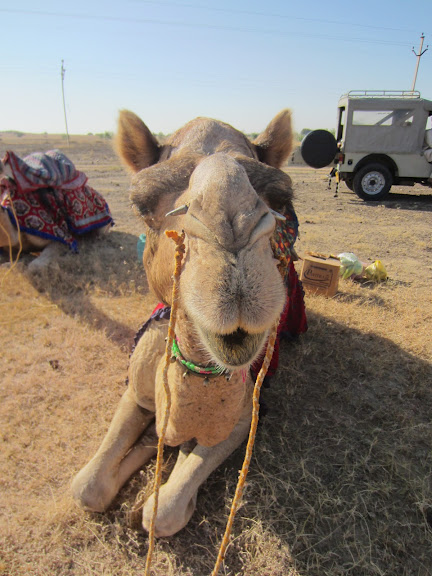
Riding a camel. Every girl’s dream.

Well, at least it became my dream after reading about the famous Rajasthan camel safaris in my guidebook.

Golden sand dunes swirling all around, my turban flowing gently in the wind behind me, I immediately pictured myself as some exotic Arabian princess crossing the desert on my noble steed in my search for an oasis (so what if princesses don’t wear turbans and probably don’t actually have to find their own watering holes, my dream ok?). A Rajasthani camel safari shot right to the top of my India “must do” list.

Turns out, riding a camel is not as glamorous as it sounds.

Now, don’t get me wrong, riding a camel is pretty awesome, but like a camel itself, no ride would be complete without its ups and downs.

The program is quite simple. You and your group are led on a journey throughout the Thar Desert by local guides on a camel. Some trips are true multiple-day safaris, sometimes spanning over several weeks, where others may be as short as a half a day to just get the overall feel. Though most of the time is spent passing through dry terrain and shrubs, most trips include at least a visit to the more “desert-y” sand dunes.

In our case, my friend Gloria and I opted for the ever-popular, two-day safari that included a visit to several local villages and an overnight stay in the sand dunes. Joining us were three other travelers who were also staying at our guest house.

Day one was great.

Clear blue skies, bright, shining sun overhead, Gloria and I could hardly contain our excitement as five camels appeared in the distance. Decked in bright blue and red blankets, two days worth of food and water balancing on either side of their humps, our crew was ready for adventure.

Up close, camels are fascinating creatures. Though ours did not spit, they certainly liked to chew a lot, offering a brutish contrast to their beautiful Minnie Mouse-eyelashes above. And, turns out, some camels just have one hump. But the things I found most interesting about camels were their legs. With long limbs, flexible knees and just two toes, camels have a certain gait as they walk, and the padding in their feet makes it look as though they’re melting into the ground with every step.

Hello.

As I slid on to Simon, my camel for the duration of the trip, I was also surprised at how tall camels actually are and how ungraceful they can be when standing up and sitting down. I learned to hold on tight real quick!

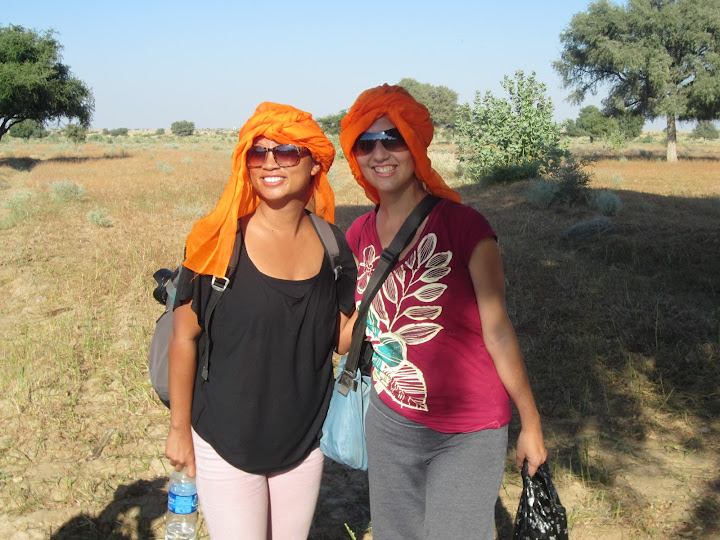
But as we glided throughout the desert, dry, open land for miles around, bars of “Alice the Camel” and “Jai Ho” alternating in my head, I found my stride. I even got to wear my turban.

Gloria and I in our turbans

Of course, one cannot travel across the desert alone, especially not five Westerners whose only experience with the desert has been through the likes of “Aladdin.”

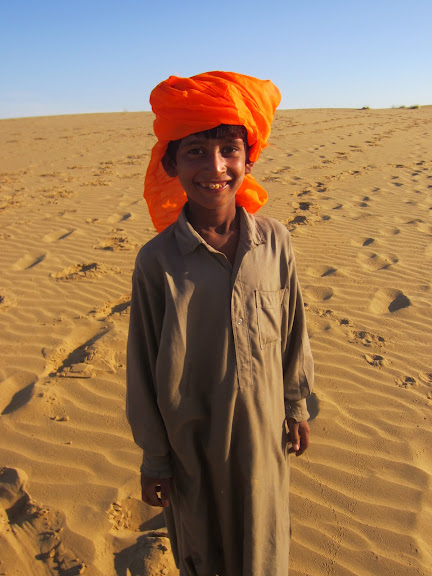
Leading our team were three guides who not only served as our leaders, but as our cooks and camel caretakers along the way. One special guide in particular will stay in all of our hearts: Mr. Gaji Khan.

Gaji Khan

At the ripe age of 11, Gaji Khan could do more things as a child than many of the people I’ve met can do
as adults. Though by far the youngest member of our entourage, Gaji led the camels like a pro, keeping them in line when they got out of hand and even leading them across the desert back to camp alone in the early morning.

Gaji was also an accomplished chef. Along with his two co-guides (luckily, actual adults), Gaji would sit down with them before meal times, peeling vegetables with his knife, cooking bread over the open flames and helping prepare our simple meals of chapati and daal.

But for all his praises, there was one thing that Gaji never could figure out: most of our names. In fact, the only name he could remember was Gloria’s. After a half a dozen conversations to a few of us beginning with “What is your name?” he eventually gave up and began addressing all questions or announcements directly to her. Camp and meal times often went something like this:

“Gloria, lunch is ready.”
“Gloria, do you want some more tea?”
“Gloria, it’s time to go.”
“Look at this, Gloria!”

Though the rest of us would, at times, try to speak with Gaji directly, we often found our responses channeled through her, as she became our involuntary, though proud, group representative.

And though my “I’m Erica from America” trick usually worked to help people remember my name, even the two adult guides had trouble figuring me out. Soon, I gave up and conceded to being addressed in unison with my camel, simply as “Simon.”

Answering to “Simon,” speaking to Gaji through Gloria, the day carried on to be mostly uneventful. Our group traveled across the desert, admiring the peacefulness of the vast open space with only a few shrubs to break up miles of hard, dry ground.

And then we saw them. The sand dunes. The climax of the entire trip.

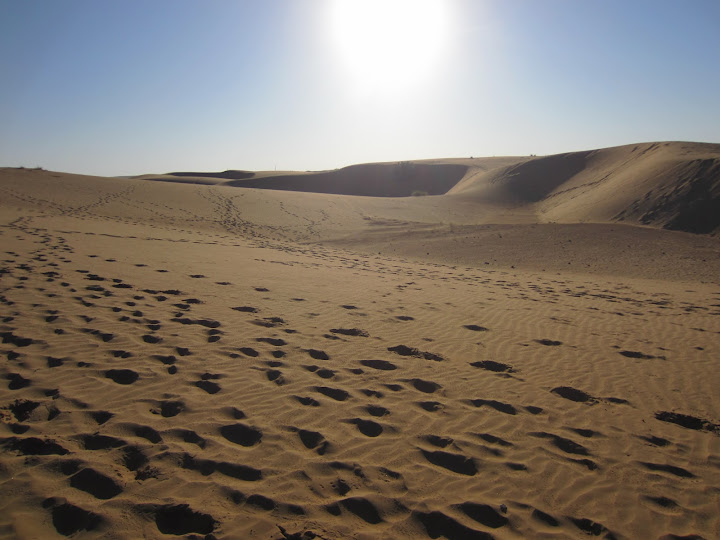
Large, calm and powdery, the dunes were every bit as beautiful as they look in pictures. But as both the sun and the temperature were going down, we only got a fleeting glimpse before it was time to make camp.

Our guides went to work preparing vegetables and chapati for dinner, as we helped unload the layers of mats and blankets from our camels, creating a little ring around the fire.

After dinner, as I lay tucked beneath my blankets, toasty and snug despite the cool night air, I looked up at the sky and was immediately fixated, enchanted by the magical dance above.

All around in endless blackness, no street lights or neon signs to dampen their glory, hundreds of stars shone proudly, proving to the distracted world below how insignificant they were in comparison. Vague memories of my eighth grade astronomy class came to mind as images of Hercules, Orion and all seven Pleiades sisters came into shape.

Together beneath the star-lit sky, my four companions and I relished in the calmness and the beauty of the night, amazed at how frequent shooting stars actually are, immersing ourselves in wish after wish.

Like a middle school campfire, we gathered round, sharing jokes and ghost stories. No phones, no Internet, no TV, just the sheer pleasure of natural beauty and human companionship.

I stared at the sky for what seemed like hours and never wanted to stop, but the day began to weigh on me, and I felt myself eyelids succumb to the pressures of sleep.

When I awoke the next morning, the soft light of the dawn transformed the dunes in a vast black sea of waves, silhouetted against the swirling pink, orange and purple sky. Still cozy under a weight of warmth, I admired the sunrise quietly in my makeshift bed as my friends continued to sleep.

Sunrise

As the sun changed from pink to yellow, my companions began to wake and the full glory of the desert shone before us. Mounds of swimmingly delicious golden sand dunes loomed around, begging us to climb them, jump in them, roll in them.

This was our chance.

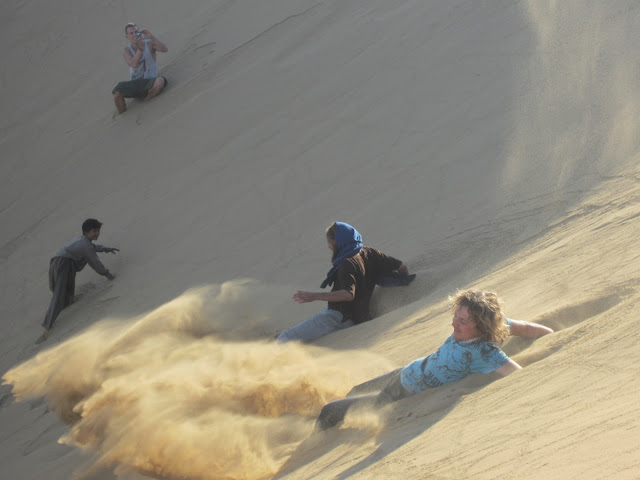
Like children, five 20-somethings joined Gaji Khan in an all-out play-fest, running through the sand, jumping over faded yellow cliffs, landing into a massive pile of soft dust below. (“Gloria, look at me!”) Day two was looking good so far.

Three hours later we were finally ready to leave. As we prepared to continue our journey, some of the members of our group began to ask about seeing the Pakistani border, something that had apparently been promised them by our guest house owner. Gloria and I had known nothing about this, and since I had already been to the border in Amritsar, it wasn’t a huge priority for me. But after much insistence from others, we soon found ourselves trotting along in what appeared to be the direction of India’s estranged brother.

After about an hour or so, our guides pointed to a vast area of desert to our right, claiming this was the Pakistani border. No fence, no guards, no patrols, but this was it, they tried to convince us. Our group, however, wasn’t buying it. Again, after much insistence, we found ourselves heading toward “Pakistan.”

After another hour or so, we were told, once again, that we had reached the long-awaited border. This time, it seemed a bit more convincing. Rows of small white houses, barbed wire and even a road, suggested some sort of camp, maybe a patrol. But as we continued past, a large white sign bearing “Oasis India Camp” revealed we had been duped. As we would find out later, the Pakistani border is more than 80 km away from Jaisalmer, an unrealistic distance to attain on a two-day camel safari!

Now, as much as I wasn’t overly concerned about returning to the Pakistani border, I do care about being lied to, specifically, I don’t care for it. But as we still had half a day left on our tour, I tried to shake it off and make the most of it.

Off again we trotted, this time, however, through a menacing-looking area full of thorn bushes. I felt a bit like Prince Phillip as he cut through the bushes to reach Princess Aurora in the tower, but since one of our (adult) guides was holding the reins behind me, I figured I need not worry.

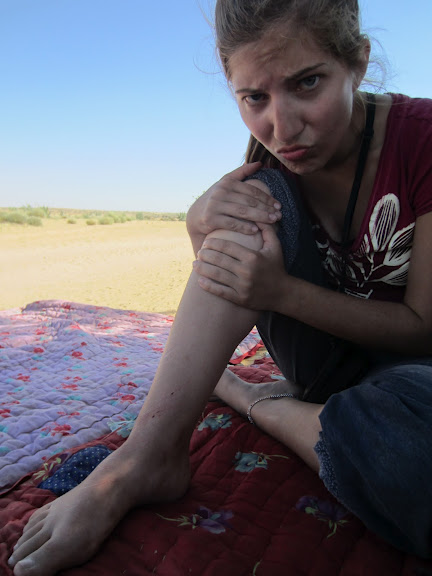
I was wrong. Despite my repeated requests to be careful, my guide allowed my camel to ride directly into a thorn bush, scratching up my foot and causing it to bleed.

My cut foot after my camel went through the thorn bushes

While injuries were minor, the cut was quite painful, and as we headed to our final destination, another problem that had been growing steadily got pretty bad: turns out, even without scratching your foot, riding a camel hurts.

For anyone who has ever ridden a horse you know that, unless you’re a frequent rider, your butt and thigh muscles get quite sore after riding for just an hour, leaving you with the very attractive “squat-walk” when you get off.

Now, add a few feet, a hump and, like eight hours, and you’ve got yourself, not only sore thighs, but what Gloria and I like to call “butt chap.”

As you can imagine, butt chap is what happens when the constant friction between your cheeks causes the skin to come off, leaving you another reason to do the “squat-walk” after riding. Originally, I had been quite excited to trot the camels, but after a day and half, the “clop” “clop” “clop” turned into “ow!” “ow!” “ow!” In one of the few unanimous decisions of our group, all five of us decided we would rather sit under a tree and wait for the jeep to pick us up instead of riding the remaining few hours of our camel safari. We had all had our fill of the camel safari.

While perfect it was not, I will say the Jaisalmer camel safari was one of the most interesting and magical experiences of my life, and I will carry the memories with me always. But just in case they begin to fade, I’m sure the scars on my feet will remind me forever :).

This slideshow requires JavaScript.

Tonsillitis.

Standard

When preparing to travel to a developing country, especially India, there are a number of precautions one must to take to prevent contracting disease. Vaccines usually begin with the basics: Hepatitis A, typhoid and cholera to protect against food and water-borne illnesses, a tetanus booster in case of cuts and a steady stream of anti-Malaria pills to keep the potentially fatal, mosquito-spread disease at bay.

But the longer you plan to stay in these countries, the longer the list of recommended vaccines becomes, and the nastier some of these diseases start to sound. Fun-filled infections like Japanese encephalitis or meningitis cause rapid brain degeneration, polio (didn’t we eradicate this decades ago?) can lead to paralysis, and who doesn’t know and love the foaming-at-the-mouth, race-against-the-clock associated with rabies?

So imagine my surprise when, after two months in India, I come down with…tonsillitis.

I’m sorry, WHO GOES TO INDIA AND GETS TONSILLITIS?! I don’t remember reading about a vaccine for that…

It all started in Mumbai. After my nasty bout with food poisoning and a restless week-and-a-half recovery, I was thankful that I was finally well enough to continue my journey throughout India, even with this new-found sore throat…

Now, traveling in the second most populated country in the world, constantly taking public transportation and eating out frequently, the common cold would seem inevitable at some point. I figured my sore throat would progress to a cold, and since my destination was the relaxed, sun-filled beaches of Goa, I figured I could handle it.

So I traveled to Arambol, a small, hippie-esque town in northern Goa, where I rented a small, but charming beach hut near the sea at Olive Garden guest house for about $7 a night. Though simple with a basic bed, desk and cold shower, the idea was to spend most of the time outside the hut, enjoying the sea and the sun. It should have been paradise.

Me and my beach hut at the Olive Garden guest house in Arambol, Goa

But when, days later, the cold never came, I began to worry. Not only had the cold not progressed, but my sore throat intensified, and I began feel a painful protrusion on the right side of my neck. I soon found myself in a round-the-clock paracetamol cycle, taking the maximum safe dose allowed and waiting impatiently for the time to pass before I could pop another pain reliever. When I finally woke up crying in the middle of the night calling my parents in a panic, I knew it was time to see the doctor.

The next day, I took a motorbike taxi ride to the nearest local doctor, where he confirmed my growing tonsillitis suspicions. I had never had tonsillitis before. To me, tonsillitis was something that occurred more frequently in my parents’ generation and usually involved surgery to remove the tonsils. Surgery, I thought, an operation that involves cutting open my throat. This was not good.

But when the doctor simply prescribed me a course of antibiotics and said I should feel better in three days, I felt relieved. Oh, he said, and no swimming in the dirty sea water, which might increase the infection even further.

Three days. Not great, but not terrible. I could last.

But when the pain refused to subside, I started to wonder if that was true. Barred from the sea with no TV or cinema to distract me from the pain (and no good bookshops in town), my little paradise hut turned into a little prison, mocking me with all the fun things I could be doing but couldn’t. And, I’m sorry, lying on the beach under the blazing sun trying to “relax” while your throat tries to explode is not my idea of a good time either.

Even attempts at making friends proved futile. As a solo traveler, you learn quickly how to make friends when traveling to a new place. But when you’re in pain, miserable and hating the world, “friendly” is not how I would have described my personality. Every time I did try to talk to people I just turned into an old lady, constantly complaining about my ailments. I don’t think I would have wanted to have spent much time with me either.

Lonely and miserable, I passed the days on the Internet and constantly watching the white formations in the back of my throat grow bigger, wondering if that was normal in the recovery process…

When my throat swelled up on day three and I began to have trouble breathing, I really began to panic. Any notion I had that the antibiotics were, indeed, working went out the window. Thoughts of all the fun things I would do after I recovered transformed into horrific images of throat operations, wondering if I would need surgery, if it was painful, if it was safe, would it bankrupt me and would I be all alone while strangers in a foreign country open up one of the most fragile parts of my body. And as my wheezing increased, I began to fear that I would not be able to breathe at all, and thoughts of my impending doom really began to freak me out.

At this point, my frequent calls to my parents repeating a more teary-eyed version of the above melodrama had put everyone on edge, ready at a moment’s notice to fly out to India in case things got really bad.

But when I went back to visit the doctor (a different one this time), I was surprised when he prescribed me another two courses of antibiotics. The one I had been on before, he explained, doesn’t work with everybody and the next two were stronger. I think he sensed my skepticism and fear, though, when I started to cry and quickly reassured me that my throat was not at serious danger-level yet. He said to give the antibiotics some time to work, and if I did not see any improvement by tomorrow, then I should go to the hospital.

Now, one of the great things about traveling, especially alone, is you really get to know yourself well, especially your breaking points. Like my experience at Mehandipur exorcism temple, I realized in Goa where exactly my bravery ends: at throat surgery. As much as I love traveling, I’d be lying if I said I didn’t fantasize about coming home when I was sick. While lying in my hut, alone, scared and in pain, all I wanted more than anything was to be back at home in Coldwater (or Ann Arbor, or Detroit), watching copious amounts of crappy American television, eating delicious, fattening Western food and sleeping in my own bed, all with the comfort of knowing exactly where I am and that someone would always be around to make sure I don’t die.

When I left the doctor’s office, I tried to look at the situation as a win-win: either my throat gets better and I continue traveling, or I get throat surgery and make it home for Christmas.

In any case, it was out of my hands, all I could do was wait.

And as I am still overseas, you can guess what happened. I was very relieved when I awoke the next morning to find, not only had the swelling gone down in my throat, but the massive white formation had begun to break up and subside. The worst was over.

I’m happy to report that once the tonsillitis/surgery/death scare had finished, I was finally able to enjoy a little bit of Goa, swimming in the sea, taking advantage of the natural mud baths and admiring some of the old Portuguese churches.

This slideshow requires JavaScript.

I’d like to think that this little episode has made me a stronger person, but catching something as seemingly innocuous as tonsillitis alone in a foreign country scared the wits out of me. I just hope to God that I don’t have to go through anything like that, or worse, again.

Why You Shouldn’t Jump Out of Trains

Standard

If cinema has taught me anything, it’s that when you’re in a hurry, especially when running away from a bad guy, it’s perfectly fine to jump on or off a moving train. Especially in India.

Think about it.

Jumping on the train is what allowed Jamal and Salim to escape from the evil gangsters in Slumdog Millionaire. James Bond managed to prevent a major war by jumping on and off trains in Octopussy. Hell, even those three brothers in The Darjeeling Limited managed to catch their trains with an entire collection of Louis Vuitton suitcases!

So when I arrived at the Churchgate train station in Mumbai, semi-lost, I didn’t think twice that jumping out was a bad idea…

Now, to begin with, the day had started off pretty bad. After days feeling restless and frustrated waiting to recover from my food poisoning, I forced myself out of the house to finally do some sightseeing.

Despite still feeling weak, I had made plans to meet a friend that afternoon to show me some of the city’s major sites. But after two hours of my friend’s work-related delays, my sick, frustrated and impatient self decided to head to South Mumbai on my own.

As I took the hour-long train ride into the city, I tried to remember where exactly I was supposed to get off. While I couldn’t recall the exact name of the station, I did remember my friend saying it was the last stop on the line, so I figured I would just wait until they announced the last stop.

When we arrived at Churchgate Station, I vague bell went off in my head, but since they had not mentioned that this was the last stop (as they obviously would), I figured I’d just hold my place. But when the train started moving backwards, I began to panic.

After already losing a number of days to illness and the delays in the afternoon, I was determined to not waste any more time by having to travel all the way to the previous station and back again.

So I decided to jump.

Now, if I had had time to actually think about the consequences of jumping off the train, I probably would have imagined a light, graceful Erica leaping off the train like a doe before landing softly on my feet and casually walking to the nearest exit. Actually, given my imagination, I might have thrown a few turns and a toe-touch into the landing.

But in the few seconds between when the train started to move and when I decided to jump, any notion of thought, and certainly any notion of physics, went out the window.

The next thing I know, I’m lying face down on the Churchgate Station platform, gawked at by what I imagined to be hundreds of Indians laughing at me from the train.

As I wobbly stood up, examining the damage on my throbbing, scraped knee and elbow, I forced myself not to cry. Though the damage was minimal, days of frustration at my body now added with a sense of stupidity and humiliation, and it took every ounce of strength to hold back.

Once I left the station, a few tears slipping out, my pride vowed never to tell anyone, especially my parents, about this incident, not if I wanted to retain any strand of self-respect or prevent my mother from personally coming to fetch me home to stop me from doing anything more stupid.

But the massive red welts on my arm and knee weren’t in on the secret. The next thing I know, I’m on the receiving end of a series of lectures by my hosts, Geeta and Suresh, and all of their friends on how dangerous jumping off trains is and how tons of people die every year from falling in between the train and platform. Even Ananyah, their 15-year-old daughter, took on the Mom role in telling me how stupid it is to jump out of trains.

But I think the best reaction came from my doctor, affectionately deemed “Dr. Handsome,” who noticed the welts during my food poisoning check-up. His lecture started with, “The problem with Americans is they never get properly yelled at as children…”

As appreciative I was of all the helpful advice, I’m pretty sure eating the pavement in front of hundreds of strangers is as effective as any to prevent me from jumping out of any more trains.

And, sorry Mom, cat’s out of the bag :).

The 18-Hour Train Ride From Hell

Standard

One of my worst fears in preparing for India was getting sick. Alone. On a train.

Everyone hears the horror stories of travelers getting sick before going to India: diarrhea (a given), sometimes vomiting and, worst of all, some bad tropical illness like malaria or dengue fever that leaves one incapacitated for days, sometimes forcing the person to return home, or worse.

And then there are the trains. Though not consistently bad, you never know what you’re going to get. Air conditioned classes are exponentially better. Aside from the cleaner, softer cushions, freshly laundered sheets, blankets and pillows are a guarantee for every traveler, and the fewer number of passengers provides at least a little privacy, at least fewer creepy stares.

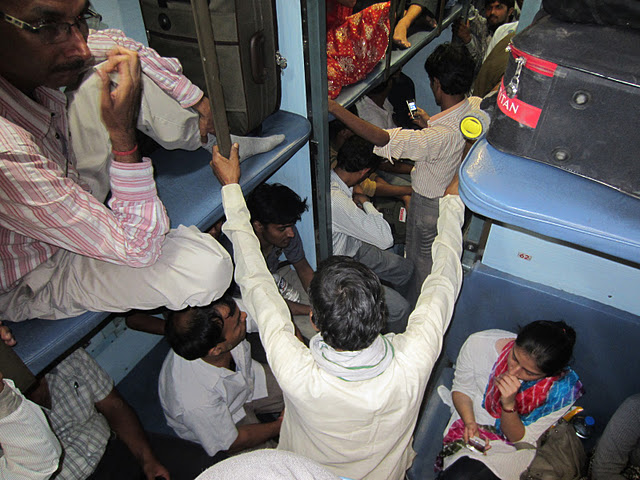
A particularly crowded train during Diwali

The sleeper class, on the other hand, is a different story. Being significantly cheaper than the A/C classes, these compartments are usually chock full of passengers, entire families of seven crammed onto one berth in a space meant for three or four. Creepy men also tend to fill these compartments, sometimes lounging on the top berths, gawking intently at the random white women, no sense of shame when caught in the stare. The constant layer of grime (no sheets) that covers the berths, combined with the sight of an occasional cockroach or mouse, makes the sleeper class the most uncomfortable traveling class by far, second only to the general standing ticket or the equally bad non-A/C’d “chair “class. (Side note: nearly all train compartments carry “sleeping berths” unless otherwise stated, “sleeper” denotes the lowest class while first, second and third class A/C are the higher ones).

But fairly universally, all Indian train bathrooms are pretty bad (to be fair, I never traveled in first class). I’m not exactly sure how Western train toilets work, but in Indian train bathrooms, the excrement goes directly from the toilet to the tracks below. In fact, signs reading “Do not use toilets while train is stopped” are meant to prevent massive loads of crap from piling up at the train stations. Add that to the fact they’re rarely cleaned (especially the lower classes), and you’ve got yourself a pretty unpleasant situation.

Throughout my three months in India, I took at least a dozen train rides, and while I generally preferred the third class A/C, often took the sleeper class when I was with others, feeling particularly budget-conscious or there were no other options available.

So when planning my last-minute trip to Mumbai, I was lucky to land a seat in the third class A/C that should have made the 18-hour, mostly night journey from Jodphur fairly comfortable.

After mostly good health luck in my first six weeks in India, I wasn’t too worried. I’d taken tons of night trains before and was actually looking forward to a long, relaxing train journey alone before meeting up with my friend Geeta, an Indian woman who I met at the beginning of my trip, who had offered to host me during my stay in Mumbai.

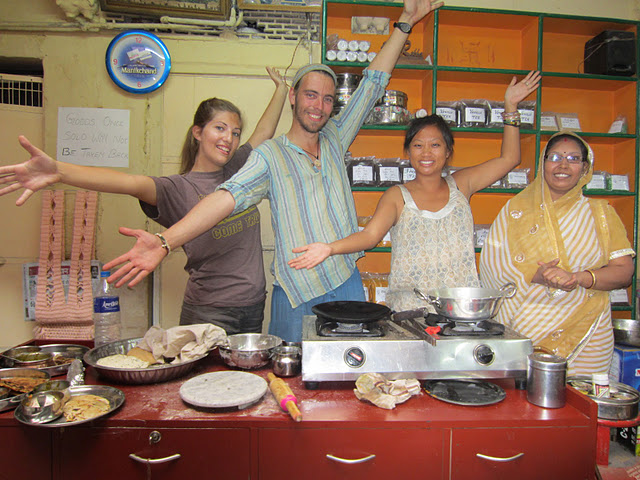
I spent my last day in Rajastan enjoying a day-long cooking course with my two friends, Gloria and Tom, and together, we stuffed ourselves as we learned to make biryani, chapati, naan and two types of curries. It wasn’t until the course was over and my stomachache turned to general aches and a fever that I started to get concerned… Still, as I forced myself to run to catch my 6 p.m. train, I figured I’d pop a couple paracetamol, go to bed early and be fully recovered in 18 hours.

Me before the train ride: happy and proud after finishing a cooking class with Tom and Gloria

My body had other plans.

Soon after I got on the train, I climbed up to the top berth, made up my bed and attempted to sleep. But the longer I lay there the more I began to ache, and my first aid kit and medicine were buried deep in my backpack, which lay chained underneath the lowest berth, six feet down. As the pain continued, I felt helpless, lonely and scared, and I began to cry. Luckily, the kind Indian family below me gave me some paracetamol and, again, I tried to sleep.

A few hours later, I woke from my doze to find the rest of the train had also gone to bed, but the cramping in my stomach told me I’d need to be awake real soon. I groaned at the prospect of getting down. The three bars that made up the ladder that led to my berth were far from adequate for providing an easy way up and down. Additionally, I had been wearing my bulky, Keen sandals (instead of flip flops) and the dirty train corridors required I take the time to put on my shoes before any venture into the bathroom. And the fact that I was alone meant there was no extra pair of eyes to guard my purse, my most valuable and necessary possession in India, while I dashed to the loo. But in the end I had no choice but to go. I shoved my purse in the corner behind my pillow, pulled on my shoes and awkwardly shimmied down the ladder in a move I would come to perfect throughout the night.

As I ran to the bathroom, just making it, I was grateful the toilet and the sink were located right next to each other. Almost immediately, whatever poison that was in my body began making its way out, using every orifice it could find.

As I sat there after the first round, too exhausted to be disgusted, I was thankful I had had the sense to buy both water and wet wipes before the train ride, two tools that would keep me somewhat clean and hydrated throughout the rest of the night.

When I headed back to my berth, I thought the exhaustion from being sick would let me sleep the rest of the night. And though I felt weak, I found I could still use my arms to push off the bars and jump (yes jump) back on the ladder before collapsing on my bed.

But sure enough, a couple hours later, I felt that uncomfortable cramping in my stomach and found myself, once again, doing the diarrhea dash as I rammed on my shoes, shimmied down the ladder and ran to the bathroom, a routine that would repeat itself at least a half a dozen times throughout the night. But despite my body expunging everything in both my stomach and my intestines, I somehow managed to find the strength to jump back up to my berth.

Somewhere around 5 a.m., however, the jumping stopped. I just couldn’t do it anymore. I looked up longingly at my berth, my bed, my temporary little safe haven, but I just had no further strength to jump. So I did the only thing I could do. I sat. In the middle of the corridor.

Shortly after, the conductor came by and asked what I was doing. After explaining that I was sick and could no longer jump back to my seat, he pointed to a side berth that had recently been vacated. I immediately collapsed, grateful to have an easier trek to the bathroom, no longer caring about my hidden purse, which was no longer accessible to me.

By mid-morning, the trips to the bathroom were becoming less frequent, but by this point I was so weak I could barely sit up. The train was scheduled to arrive at 11 a.m., but every time I set my alarm to wake up in time to gather my things, I found myself forcing myself up for about a minute, before groaning, hitting snooze and laying back again, thankful the train was running late.

At this point, more people were noticing the random blond girl, even whiter than normal, laying helplessly in the side berth alone, and several helped me to retrieve my things from the top berth and unlock my backpack (luckily, my purse had also survived the night).

I had originally told Geeta I would take a rickshaw to her house, but given the fact that I could barely sit up, I finally called her and asked if she could come and get me. When we finally arrived at the train station, it took every ounce of willpower I had to haul my 30-pound bag on my back and get off the train, where I immediately collapsed onto an empty platform seat and waited.

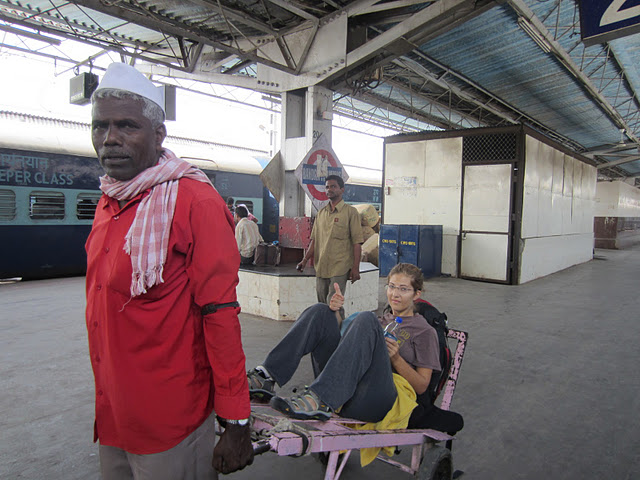
But even sheer willpower couldn’t help me once I arrived on the platform. When Geeta found me, she barely recognized the pale, half-dead creature weakly waving at her and soon found a porter to carry my bag for me. But as I got up to walk, quickly falling back on my platform seat, determined to try again in a few minutes, I hear her speak to the porter in Hindi. The next thing I know, I’m seated in the trolley, being pulled with my backpack by the porter to Geeta’s car. I’m sure the sickly blond girl being carried on a trolley throughout the Bandra railway train station must have been quite a sight, but I was so exhausted I didn’t care and grateful to not be on that train alone anymore.

Me after the train ride: feeling half dead

In the end, the doctor said it was not necessarily one instance of food poisoning that caused my illness, but rather, an accumulation of bacteria from multiple sources that were probably triggered during all the food in my cooking class (In fact, neither Tom nor Gloria had any reports of food poisoning). Whatever it was, it took me nine days and two courses of antibiotics before I fully recovered.

Despite having been alone and sick on that train, I was lucky enough to spend my recovery time staying with Geeta, her husband Suresh and her daughter Ananyah, who not only gave me a place to stay, but took care of me, making sure I went to my doctor check-ups, rested up and avoided all of the delicious deep fried, sugared or cheese-loaded Western food I so desperately longed for in Mumbai (the doctor had put me on a strict diet of rice, yogurt, dahl and fruit, in what I coined my “food prison”).

In an ironic twist, after weeks of drinking only bottled water, avoiding raw fruits and vegetables and eating only carefully examined restaurant food, it was my own cooking that essentially brought me down :).

India: Illnesses and Injuries

Standard

When traveling for a long time, especially in a developing country, illnesses and injuries are basically a given, and I was no different.

Over the course of the three months I was in India, I suffered from the following ailments:
– Severe food poisoning
– Tonsillitis
– A cyst
– Plantar Fasciitis
– Cuts and scrapes on both my knees, elbow and foot (which are scarring nicely)

I’m not kidding when I say I literally used EVERY part of my first aid kit and more, including six courses of antibiotics, all of my painkillers, an entire tube of antiseptic ointment and copious amounts of paracetamol, as well as the regular use of my thermometer, ace bandage, Imodium tablets and band aids.

In short, India kicked my ass. The only good things to come from these events were (hopefully) a stronger immune system, but more importantly, a few good stories :). In this part of my blog, I plan to share the more eventful moments of my ailments in the hopes that now, they can at least have some sort of entertainment value. Enjoy.

Side Note: If you ever go to India, don’t be scared. A significant part of these ailments were due to my own bad judgment (um, apparently you’re not supposed to jump out of moving transportation…) and I probably would have gotten sick less if I had eaten more Indian food (which they are excellent at preparing) and insisted less on Western food, which I ultimately prefer (one can only eat so much curry).

High Kickin’ it in Amritsar

Standard

When people think of the relationship between India and Pakistan, not a lot of positive things come to mind: rivalry, religious dispute, violence, threat of nuclear war… You’d think the border crossing would perhaps not be the wisest place to visit.

But despite all the conflict between these two countries, there are certain places where they can let their rivalry out peacefully, like in Amritsar…

Popular on the tourist trail, Amritsar is most well-known as the home of the famous Sikh shrine, the Golden Temple or Harmandir Sahib. But also worth visiting is the nearby India-Pakistan border in Wagah where, once a day, hundreds of people gather to watch the dramatic border closing ceremony.

This fun-filled event involves the border officers marching one after another to salute the corresponding officer on the Pakistani side. That would be tame enough, except that this is no ordinary march. The officers must first begin with a series of high kicks then, looking as angry and fervent as possible, march as fast as they can to the border gate where they continue another series of high kicks, as if to show the Pakistanis who’s boss. Add a funny hat and a long mustache and you’ve got yourself a real performance here.

What makes this event even more incredible is the show of patriotism that surrounds it. As far as I know, the show never changes, but people come to this ceremony EVERY DAY, walking the long distance to the gate, waiting in line smushed against hundreds of others, all for the chance to sit in the stands and cheer for their homeland. It’s like some kind of sporting event, complete with popcorn and drinks. Definitely a fascinating sight to see.

In addition to the border closing ceremony, James, Daniel and I made sure to visit the Golden Temple, priority number one in Amritsar. Now, I’m not going to lie, Amritsar is every bit as noisy, dirty and stressful as Delhi, though less corrupted by tourism (I actually had a pedi rickshaw driver tell me the fare was only 10 rupees after I offered him 20…). But situated among the dirt, the crowds and the cows is this diamond in the rough that makes Amritsar worth all the chaos.

More than just a shrine, the Golden Temple is actually in the center of a holy lake surrounded on four sides by these large beautiful white buildings. With the gold of the temple gleaming against the contrast of the blue of the sky and water, the whole complex is simply stunning. And like the intensity of the border crossing, Sikhs come from all around to pray with fervency, bathing in the lake, chanting prayers in small rooms or, like us, waiting in an endless line to get a glimpse of the temple’s inside…

Just our luck, James, Daniel and I had decided to visit the temple during one of Sikhism’s holiest holidays and found ourselves in a THREE-AND-A-HALF HOUR line to enter the inside of the temple (it was impossible to see how long the line actually was for the first two hours, otherwise I’m not sure I would have done it :/). And this line was crazy. People squished together like sardines and stampeded forward the minute the bar was lifted to allow the next group to advance. The crowd, plus the heat, made the wait almost unbearable and it took every ounce of determination I had to last (James gave up after one hour, I could hardly blame him).

When I finally saw the inside, it was a really beautiful, with multiple floors, covered in multicolored stones and gold with a large chandelier on the ceiling. But after more than four hours in the heat and crowds, the three of us booked it out of there, retreating into an air conditioned restaurant then hiding in our guest house the rest of the afternoon.

After that morning, I was pretty over the Amritsar experience and was ready to leave as soon as possible. But after hearing about how beautiful the temple looks at night, I somehow dragged myself away from my hideaway and returned. And I was glad I did.

The evening, though still busy, was much less chaotic and cooler than the morning. The entire complex was lit up with the golden temple reflecting in the water, and all around the lake people lighted candles, which gave the atmosphere an extra sense of enchantment.

This slideshow requires JavaScript.

I had returned to the complex with a friend I had made at the guest house, and we decided to try out the free meal the Golden Temple serves all its guests. Though a very simple dinner of mostly chapati, dahl and chai, the food was pretty good and clean. Somehow, we befriended one of the temple volunteers and found ourselves on a very thorough tour of the Golden Temple kitchens, including where they prepare the massive pots of dahl and tea as well as the chapati room and the cellar where they keep all the vegetables (I tried to ignore the rat that ran past the back).

We also got invited to dine in a special part of the cafeteria, where I sat cross-legged on a dirty mat, eating with my hands, while half a dozen Indian women asked me a hundred questions in broken English and took pictures with me.

Though not my most comfortable moment, I smiled and stayed as long as I could before politely bowing out.

In the end, Amritsar was definitely one of my more challenging cities, but well worth the effort :).

Mustaches and Water Pots: the Pushkar Camel Fair

Standard

One of my favorite experiences in all of India was my visit to Pushkar.

Located in the state of Rajastan on India’s west side, Pushkar is a charming little town full of old homes, narrow streets and a beautiful lake said to contain holy water full of medicinal properties that make it a popular destination for religious pilgrims.

Those things alone makes Pushkar a travel-worthy destination, guaranteed to fill your heart with happy feelings. But what the city is really famous for, is its camel fair.

This slideshow requires JavaScript.

Now, at first glance, an event where people go to buy and sell camels might not seem that exciting. But throw in a week of quirky games, traditional performances, cultural exhibitions and several hundred thousand people, and you’ve got yourself one of the most popular and renowned fairs in the world.

When I arrived on the second to last day, I was determined to participate in something. Unfortunately, I arrived five minutes too late for musical chairs and my registration for Tug of War (Indians vs. Tourists) was revoked when too many people joined the list.

I finally got my chance to play, however, in the water pot contest during the closing ceremony. Limited only to women, the water pot race (I’m sure it’s officially called something else) involves carrying a large pot of water across the field to the other side – on your head. Think of the last scene in The Jungle Book when Mowgli falls in love with the Indian girl who is collecting water for her family, then walks away with the pot on her head.

I was like that girl. Only much slower.

All over India you see women, sometimes men, carrying ridiculously heavy loads of food, building materials and Lord-knows-what-else on their heads, as if it was the most natural form of transportation ever. Clearly, there was no way in hell I was going to win this competition.

My friend Gloria had done the contest two days previously and had warned me that you will get very wet. I have always been more of a fan of slow and steady wins the race, so instead of running to the finish line awkwardly trying to keep this heavy, liquid-filled pot from falling off my head, I took my time, careful not to spill, and gracefully arrived in last place. Though I did not win the competition, I like to think I arrived with the most style :). (Side note, an IRISH girl won the event. Go Team Tourists!)

Aside from the water pot contest, the closing ceremony in itself was spectacular. In addition to the games, the ceremony included a camel racing contest, a massive Indian dance performance and, my favorite, a closing parade around the stadium.

This spectacular sight featured traditional musicians, dancers and lots of long-mustached, highly-decorated camel riders, parading in front of the stands like kings. The costumes and make-up were amazing, full of bright colors that just shimmered as they danced in the sun. Best of all, everyone just seemed so happy, and it was hard not to smile when the Indian men with the long mustaches, swords and swirly skirts skip by you without a care in the world.

Definitely one of the coolest experiences ever :).

Ghostbusting in Mehandipur

Standard

After my experience at the Taj Mahal, I was hard-pressed to believe there might actually be another city even more disturbing than Agra.

And then I went to Mehandipur.

Located between Agra and Jaipur, Mehandipur (Listed under “Balaji” in Lonely Planet) is a remote village known for one thing: exorcisms.

I have always had a fascination with religion, philosophy, psychology etc., so when I read about Mehandipur in my guidebook, it was instantly put on the “must-see” list.

Now, if images of crazy people, chanting or any number of horror films comes to mind, you are absolutely correct to think of Mehandipur.

I arrived mid-morning with two Australian women I had met at my guest house in Jaipur and was instantly grateful to not have been in this town alone .

My new Australian friends crammed in the back seat of the rickshaw to Mehandipur. We managed to fit 20 people in a vehicle designed for nine...

Clearly off the tourist trail, the people in this village appeared to have never seen a white person in their lives, and we were instantly stared at by what seemed to be the entire town. Shortly after, we were approached by child beggars who followed us for at least 10 minutes, grabbing our arms every few minutes to get our attention.

Lonely Planet and the Internet had provided very little information on how and where the exorcisms were conducted, but soon we found Mehandipur Balaji Mandir, a large temple in the town center with a line about five blocks long of people waiting to get in (and also a large sign saying “Photography strictly prohibited” unfortunately:/).

Lonely Planet had said they screened the exorcisms from inside the temple onto monitors outside, but I saw no evidence of this anywhere and our attempts at communicating with the locals was proving futile.

Somehow, this elderly man with semi-decent English approached us and offered to help. When we asked us about the exorcisms, he led us to a park nearby where people had gathered around another temple-like structure, where they were either circling it fervently in dedicated prayer or standing around in groups swaying their heads wildly or caring for those swaying their heads wildly.

Now, I can’t speak for all countries, but in the United States, “crazy” people seem to exhibit their mental illness by either talking to themselves or speaking incoherently. In India, there is apparently just one move to tell the world you’re possessed: the head sway.

There are several variations of the head sway, but more or less, it involves sitting cross legged (Indian style ;)), closing your eyes and swaying your head from left to right, making a “V” sort of motion. In some cases, you can take it to a more advanced level by sitting on your knees, leaning forward on your palms and adding a few chest thrusts while whipping your hair back and forth.

As fascinating as this all was, after a two-hour bus ride plus two cups of chai each, my friends and I were desperate for a bathroom and the elderly old man led us to the community bathrooms in his apartment building. After finishing our business (the bathrooms were actually fairly clean), we got to visit his apartment and meet his family, where we learned his sad tale. Apparently, the elderly old man, his wife and their daughter-in-law travel to Mehandipur every year for a few months to take their son/husband to the temple to release his demons. The four (plus a baby) live in a small 12 x 15 room together with two single beds (no mattresses), no kitchen and no attached bathroom and every day, the mother takes her son to the temple.

It was never clear to us what sort of mental illness/possession their son suffered from, but when we met the son in town, we were surprised at how “normal” he seemed. Instead of the head sway, their son just seemed to have a dopey grin on his face. Though free to walk around, their son had both his arms chained to a rod that he sort of leaned on against his shoulders as if it was no big deal, neither to him nor to those around him.

But despite the fascination of just the town itself, I was determined to see an actual exorcism, so I continued to ask the elderly man about how we could see the actual rituals (FYI, nobody in Mehandipur actually understands the word “exorcism” so I had to be a bit creative when asking my questions). He then led us the back entrance of the main temple, where he told us repeatedly we’d have to remove our shoes if we wanted to go inside. At first I thought this was no big deal, I had gotten used to taking off my shoes for a lot of Indian places. But as we climbed up the stony, sludge-covered hill, I started to have serious reconsiderations.

We weren’t allowed to enter the temple from the back side, but I was able to get a glimpse of what was going on on the inside. While I didn’t see any actual exorcisms occurring, I did see a lit fire in the corner and a few men squeegeeing a massive pile of water, sludge and God-knows-what-else outside the temple. Apparently, the exorcisms in the temple are quite dramatic, involving fire, water, chanting and even beatings.

At this point, my two companions began to reach the end of their comfort levels and wanted to go back to Jaipur. I was still determined to see an exorcism, but after much contemplation, I learned the limits of my bravery. There was no way I was going to stay in this town alone and certainly not enter that temple alone.

I finally managed to reach a compromise with them to make one last trip to the park to see what we could find there. And sure enough, as we arrived, we caught a group of people clapping and chanting fervently near the temple-like structure. Among them, a woman lay wriggling on her stomach, eyes rolled back, arms stretched out, grasping desperately for something that got increasingly more intense with each chant of the group.

When the woman got too far inside the crowd to be seen, I noticed the others in the area. One woman, seemingly catatonic, hung upside down from a bar, legs crossed, head in the dirt, eyes rolled back, oblivious to those around her. Another woman, maybe a teenager, circled around the temple on her stomach, appearing to swim in the sand with her arms and legs. I don’t know if this girl was possessed or undergoing some fervent prayer ritual, but at one point she looked up and began to stare back at me. This was not a “crazy” stare but the “oh-look-at-that-strange-white-person” stare that I had grown accustomed to in India. Hmm… (Unfortunately, I was not allowed to photograph or video anything, though apparently it was perfectly acceptable for them to photograph me…).

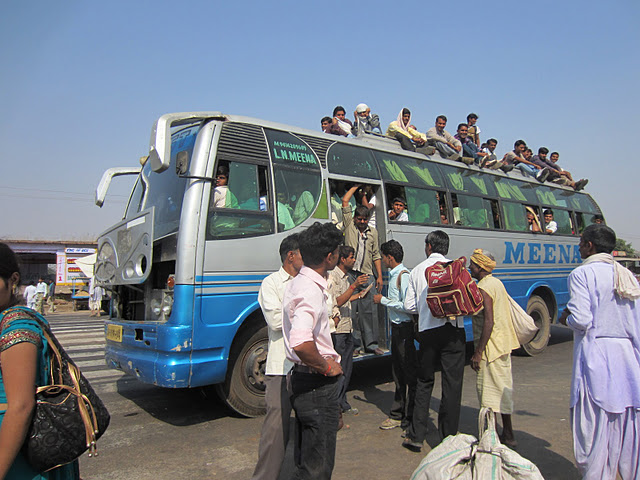
Finally, my Australian friends said it was time to go, and when our bus finally came, this is what we found:

The bus that arrived to pick us up in Balaji...

In the end, we took a taxi ;).