Tag Archives: mishaps

Cambodia and Vietnam: Part 2

Standard

After much deliberation, Karri and I decided not to pursue more temples on day two. It was a really tough decision to make, but we were a bit “templed-out” after having spent an entire day looking at ruins, and there were a few other things in Siem Reap that I wanted to see.

The main event on day two was the Cambodia Landmine Museum, what would become the first of a series of heart-wrenching museums that made up the majority of our trip to Cambodia. The museum was quite a ways outside the city and near Banteay Srei, another temple that was described in my guidebook, so Karri and I decided to do both. It wasn’t until our tuk tuk driver took us to the lone ticket counter for the archeological park that we realized Banteay Srei was part of the whole ruins complex and required another $20 full-day ticket. Reluctantly, Karri and I decided to pass on the second ticket, convincing ourselves that we had seen enough temples and would now have more time to see the city.
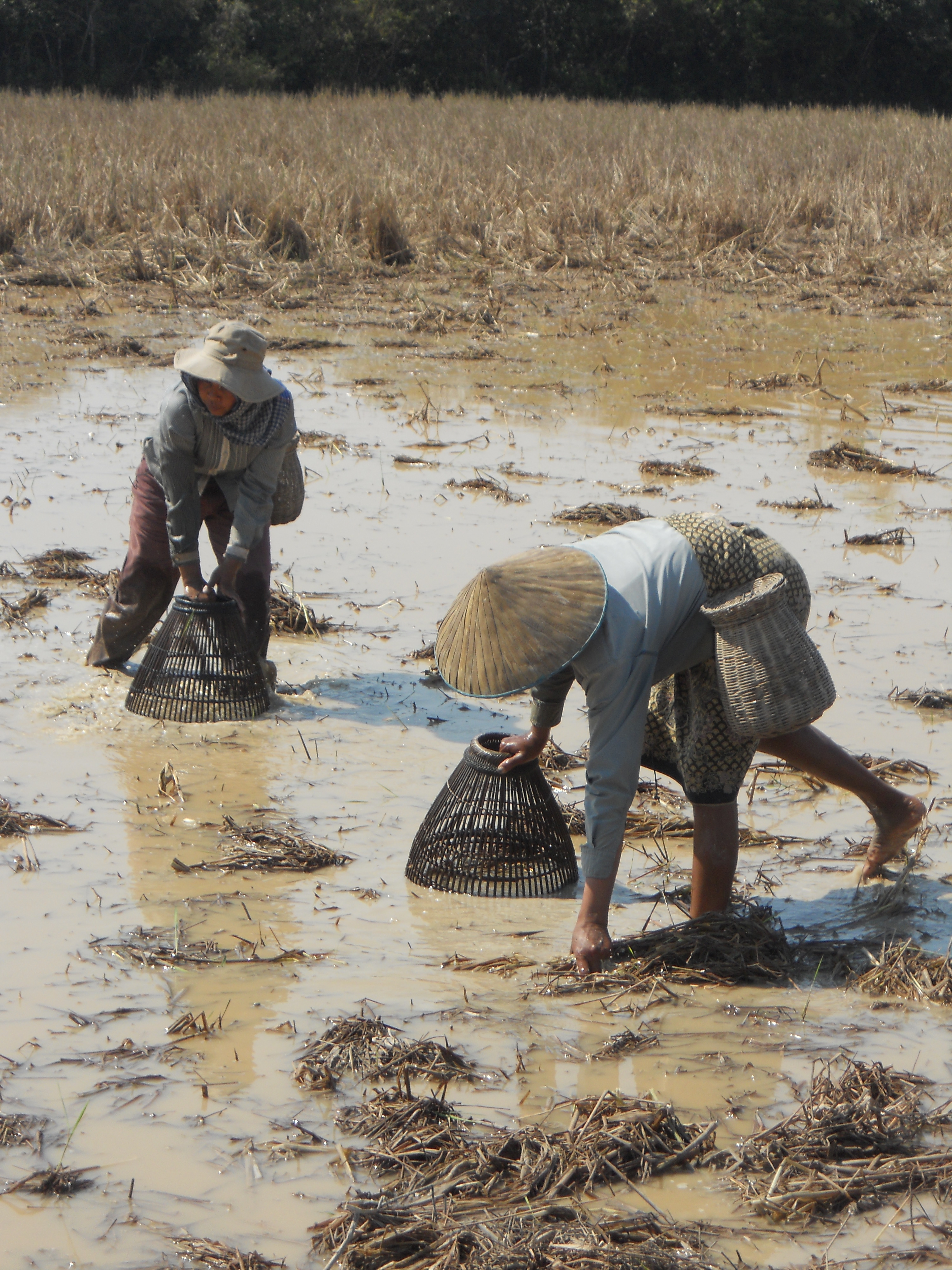
People fishing off the side of the road in Cambodia.

Our driver, however, didn’t get the memo and somehow Karri and I found ourselves at Banteay Srei anyway, and I quickly began regret not purchasing that second ticket… Banteay Srei, from a distance, looked really incredible, and unlike other temples in the area, had information available to read about the temple’s history and architecture before going in. At this point, we’d already driven more than a half hour to get there and going back to the original ticket counter was not an option. Unfortunately, we soon found out that individual temples don’t sell their own tickets. It’s all or nothing, and if you want it all, you have to go to the lone temple ticket counter just outside Siem Reap.

But after such a long drive I was determined not to give up, so I decided to approach the guards and see if there was anything I could do to change their minds… At first I just played dumb and asked politely if there was any way we could buy just one ticket to get into this one temple. I tried to explain to the officer that we had already seen the main circuit the day before and had traveled a long way just to see this one temple today. He said he couldn’t but referred me to his supervisor, where I repeated my story. Again, I was told to go back to the ticket counter. At this point, I asked the guard if maybe we could pay him to see the temple. At first I offered $5 (well more than one temple is worth comparatively) but went all the way to the full $20 just to see this damn temple. But what do you know, a guard in a country where corruption is rampant still REFUSED to let me in! In fact, he made sure to tell me that people found at the temples without tickets get a $100 fine, despite the fact that he and his comrades were the only point of defense for the ruins and letting us in would be easily unnoticed.

(For the record, I do not support bribes and corruption and all that, but seriously, accepting a few dollars to let some tourists into a temple far away from the city center is not that big a deal, and he could have put that money to back into some preservation fund for all I cared, the whole thing was just ridiculous. Furthermore, the whole system seems like a bad business move. You could make a lot more money off the temples by charging for entrance at individual sites in addition to offering the all-inclusive ticket to accommodate the stupid tourists who find themselves stranded far away from the ticket counter and regretting not buying a second ticket…)

Anyway, with our tails between our legs, Karri and I left the temple site and headed off our original destination, the Cambodian Landmine Museum. Like it sounds, the museum is full of information regarding land mines, especially their presence and history in Cambodia. It also contains an orphanage/school for victims of landmines and other disadvantaged children. The founder was a child soldier under the Khmer Rouge and was forced to lay landmines as a child, watching many of his friends get blown away in the process. He eventually realized the harm he was causing and dedicated his life to removing landmines throughout the world and educating people about their danger.
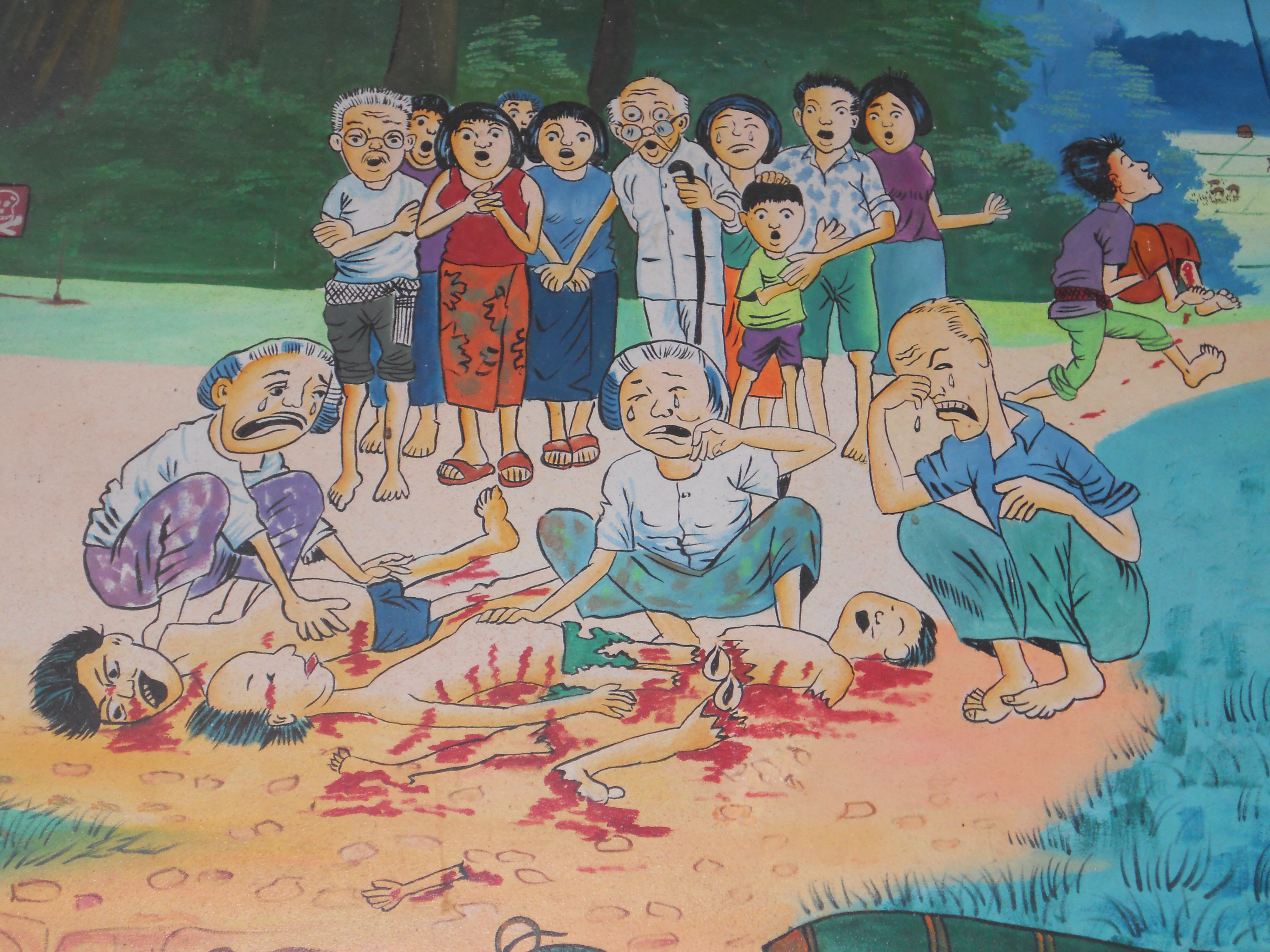
Close-up of a painting on display at the Cambodian Landmine Museum

Though small, the museum is really powerful. There is a large collection of landmines and weapons on display, but what is more interesting is actually reading about the history of landmines and their presence throughout the world. There is also a really interesting documentary video on just how they work and how powerful they are. What is most impactful, however, are the stories of the child landmine victims who now live at the museum’s orphanage. An entire wall is covered with their little biographies, and you find yourself addicted to reading each one, never ceasing to be shocked by their stories. There is also an art therapy project on display where the kids were asked to take a box and paint their aspirations on the outside of it while painting what happened to them on the inside. Today visitors can find four boxes hanging from the ceiling, all with pictures such as teachers, doctors and office workers on the outside, with colorful visions of smoke, fire and missing limbs on the inside. Sadly, there are an estimated 6 million unexploded landmines remaining throughout Cambodia :(.

After that emotional rush, Karri and I decided to relax a bit and just enjoy the streets of Siem Reap during our remaining time there. Next stop: Phnom Penh!
Singapore!

Standard

After four months of going stir-crazy in Malaysia, I was finally able to do some traveling last weekend and took a short, three-day trip to Singapore.

A huge part of my decision to come to Malaysia was the prospect of traveling throughout Asia, and though I had the time and money to travel, I was growing increasingly frustrated struggling to find travel buddies. Luckily, my friend Gina, a former colleague of mine who now works in India, contacted me out of the blue one day and asked if I was interested in traveling with her. Two days later, our tickets were booked, and we were set to explore this small, Asian country!

Singapore was very…pleasant. As a former (and briefly-lived) Malaysian state, Singapore is very similar to Malaysia in terms of culture, ethnic make-up and food. Had it not been for the fact that I had already spent several months in Malaysia, I might have been more impressed. Singapore is, however, much more developed and cleaner than Malaysia and is Chinese-dominated (as opposed to Malay-dominated) and, therefore, not a Muslim country. From what I understand, it is also one of the most “westernized” parts of Asia. I’m not going to lie, it was refreshing to be in a country with proper sidewalks and “normal” traffic with cars that stay in their lanes and don’t make me want to run for cover.

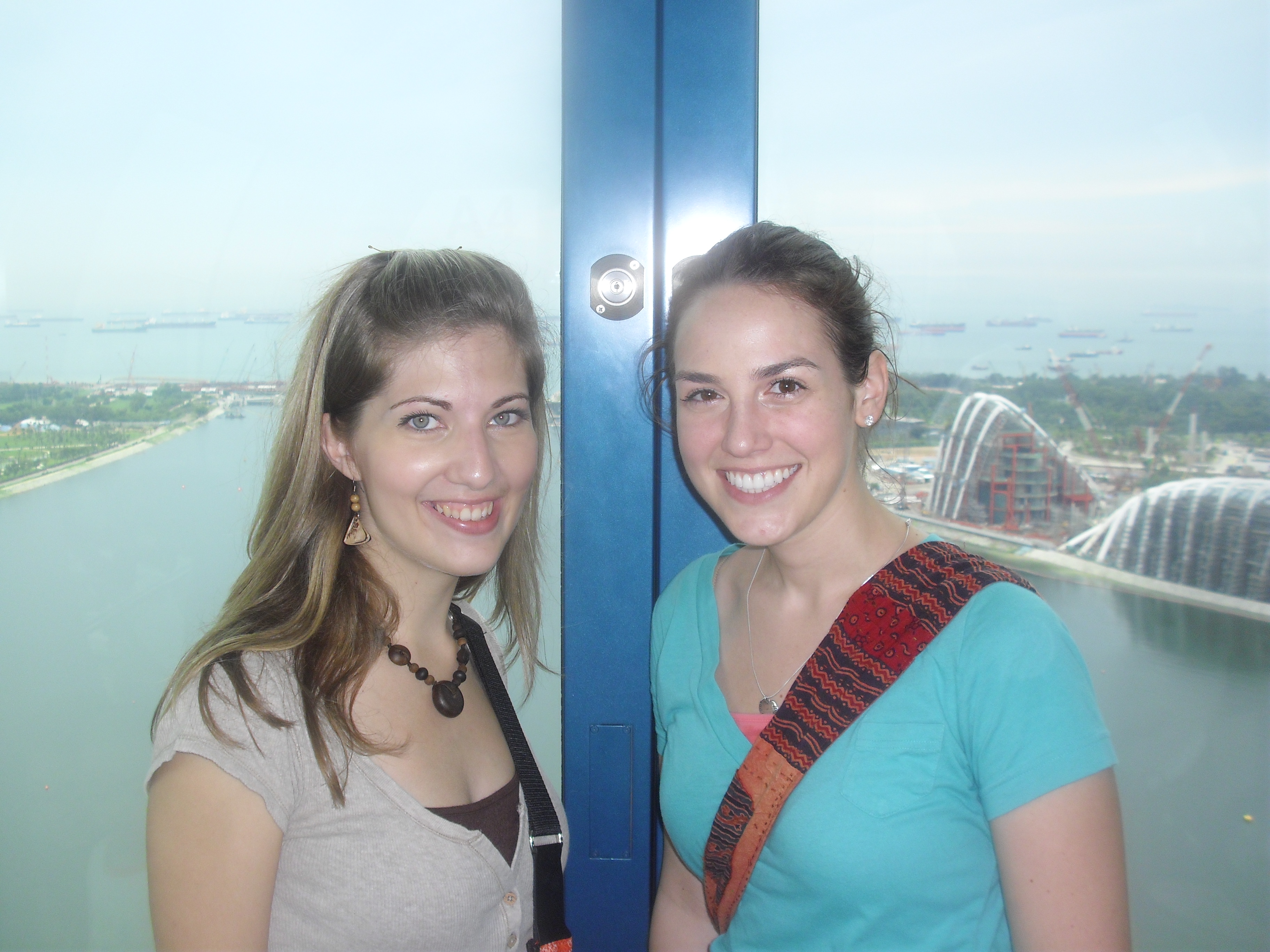
Me and Gina aboard the Singapore Flyer, the world's largest Ferris Wheel.

On day one, we decided to explore the city by foot, hitting some of its famous sights on the way. We started our journey checking out the business district before taking a trip on the Singapore Flyer, the world’s largest Ferris Wheel (much like the London Eye). We then hit up Arab Street where we had an awesome Middle Eastern lunch and checked out the very Aladdin-esque Sultan Mosque. As we headed back to our hotel near Little India, I was determined to find this one particular temple in my guidebook that was supposed to grant wishes and tell fortunes after a somewhat complicated-sounding procedure involving joss sticks, bowing and shaking a cylinder. Of course I wanted to go! As I soon learned, however, messing with Eastern gods is not always a good idea…

As we walked toward the corner of Waterloo and Middle Streets, the general vicinity of said temple, I suddenly looked up and saw this beautiful Hindu temple before my eyes with a group of people bowing and lighting joss sticks in front. Delighted at our find, Gina and I set out to make our wishes, lighting our joss sticks and bowing very carefully to make sure they came true. As we entered the temple, things got a bit more confusing. I’m not sure if it was because it was Friday afternoon or Deepavali, one of Hinduism’s biggest holidays, but there was a lot of activity going on inside the temple, though none of it seemed to be fortune-telling… As we watched the priests make their offerings and the visitors line up to receive blessings (I think), I began to wander around the temple thinking, “Where are these damn fortune-tellers?” I sheepishly asked one of the men at the counter if there was fortune-telling going on, where he gave me a strange look and said no. Apparently, not only was there not any fortune-telling but there never had been…

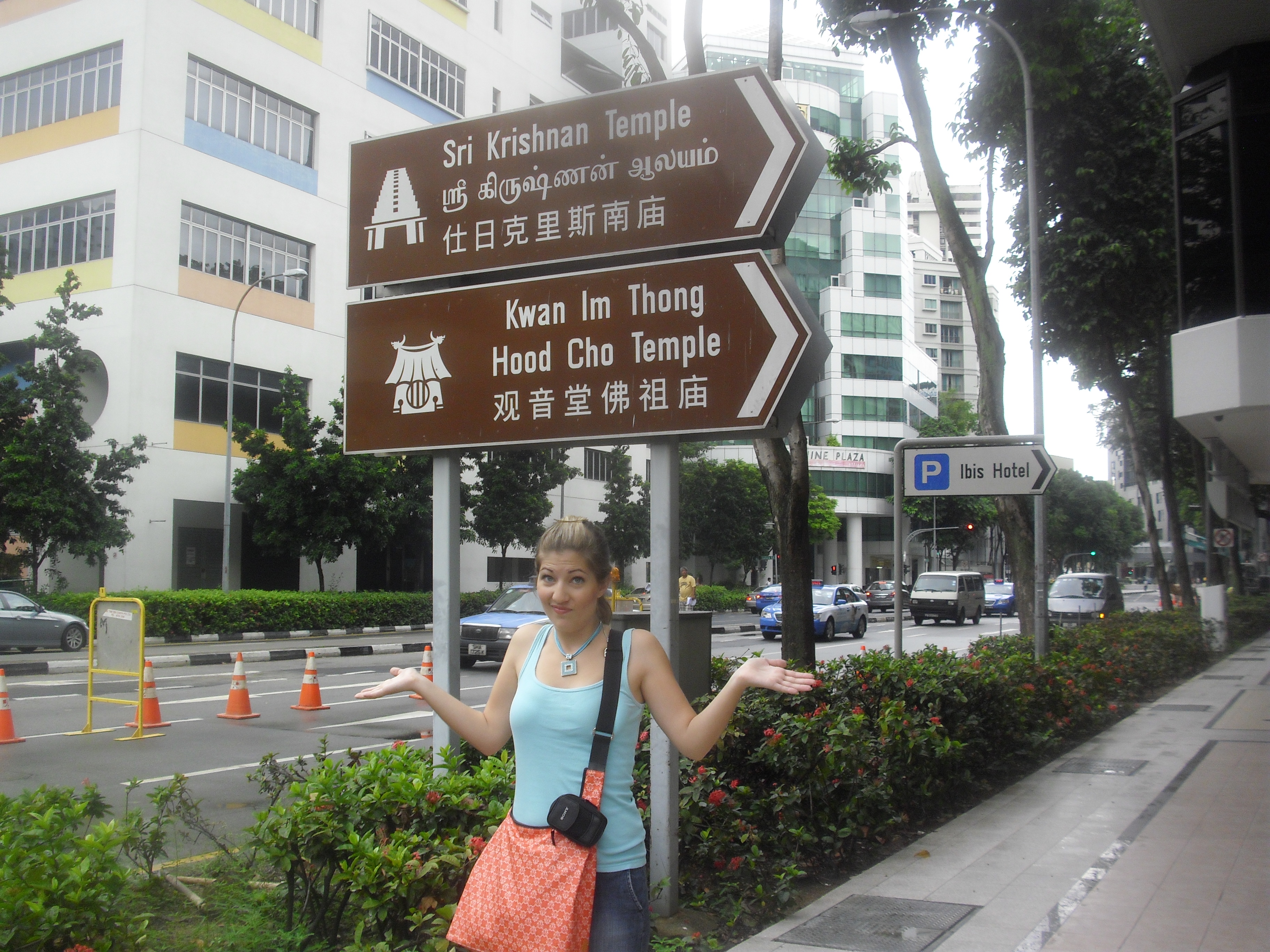
Confused, Gina and I stepped outside where I re-opened my guidebook to find out what happened. As I read the words “Kwan Im Thong Hood Cho Temple,” I began to feel really stupid as I realized we were supposed to be at the BUDDHIST temple next door! Whoops…

Unfortunately, the Buddhist temple had just closed for the day, so we decided to head over to Chinatown to see another famous Buddhist temple, the Sacred Buddha Tooth Temple. Just our luck, my guidebook was three hours off on its “opening hours” and the temple had just closed. Buddha clearly was not interested in seeing us that night.

The next day, we set off to see some of Singapore’s natural elements with a visit to its Botanic Gardens, the Singapore Zoo and the Night Safari, with the Sacred Buddha Tooth Temple squeezed in-between. I must say, the gardens were lovely. There were acres of paths that led around beautiful trees, plants and flowers before surrounding a romantic lake full of swans and turtles, a lovely setting in which to read a book if you could just ignore the sweltering heat…

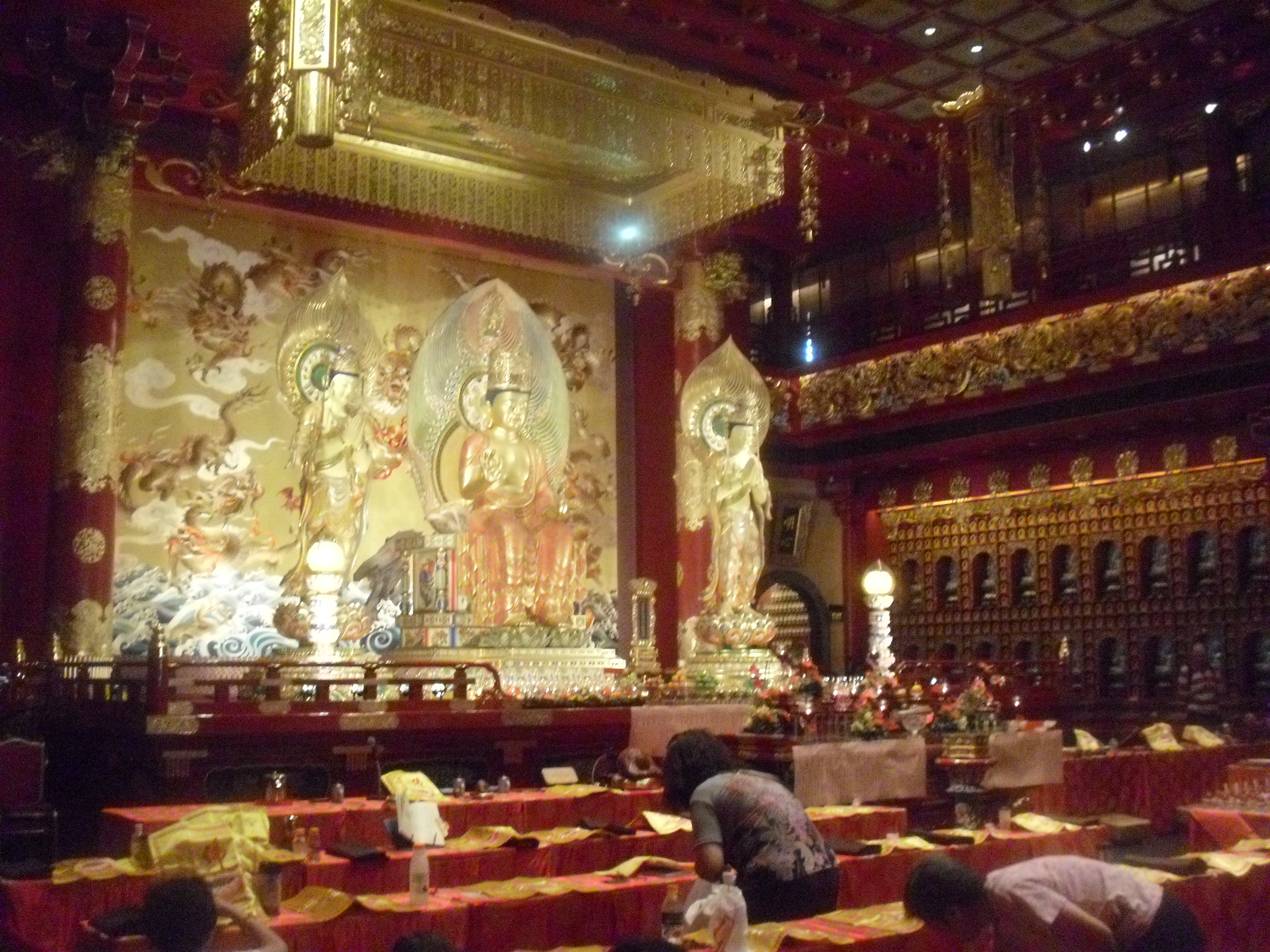
Inside the 100 Dragons Hall at the Sacred Buddha Tooth Temple in Chinatown, Singapore.

Next, we finally made it to the Sacred Buddha Tooth Temple, which was really quite impressive. The whole thing is four stories tall, with the temple on the ground floor, a Buddha museum on another floor, a rooftop garden, and a separate temple on the fourth floor containing the well-protected, beautifully-encased relic of one of Buddha’s teeth. Just entering the ground floor alone is a pretty spectacular sight with a huge golden Buddha at the back of the room surrounded by 100 Buddhas around the walls. I thought it was very cool and very interesting.

After that, we decided to head out to the north of the island for the much-acclaimed Singapore Zoo and Night Safari. Though neither Gina nor I are big zoo-people, the Singapore Zoo is supposed to be one of the best in the world, so we decided to check it out. For a zoo, it is pretty awesome, but at the end of the day, it’s still a zoo. What does make it special is the fact that the animals are contained with mostly hidden or natural barriers, such as moats, that make it appear more as though you’re actually experiencing them in the wild. My biggest draw to the zoo was the chance to get a photo with an orang utan. I was soon disappointed, however, when I found out you don’t actually get to hold one, you just stand in front of them while the guy snaps a picture. Still, I was mere inches away from three of them during the photo, close enough that people started shrieking at me, because one nearly peed on me! (It was still super cool!) The Night Safari next door was decent. It’s basically a zoo at nighttime that lets you observe nocturnal animals while you ride around in a tram. Again, pleasant, but not life-changing.

Me after mixing up a Hindu temple with a Buddhist temple. Whoops!

On day three we decided to try our luck again at the Kwan Im Thong Hood Cho Temple and get our fortunes told before checking out one of Singapore’s smaller islands. Despite my genuine interest in Eastern religions, I apparently had not yet been forgiven for my original temple mix-up by either the Hindu or the Buddhist gods… After lighting our joss sticks, Gina and I went inside the temple and were given a cylinder full of wooden sticks. You’re supposed to kneel before the Buddha statue, make your wish and shake the sticks until one comes out. Then, you shake these two, red semi-circles. If one lands face up and the other face down, your stick is a winner. If not, you have to try again.

Ok, simple enough. I knelt down on the carpet, made my wish and began to shake…and shake…and shake… the darn things were not coming out! I looked around the room to see if anyone else was struggling and watched my fellow templers shake out a stick with ease. Even Gina, a fellow foreigner, managed to shake out a winning stick on the first try. This was not a good sign.

So I shook more vigorously. This time, three sticks came out. Again, not a good sign, but I was not giving up. Finally, after much patience and one “false” stick, I managed to drop one (just one) and have the two semi-circles fall in opposite directions.  I raced up to get my fortune, and given the events of the past two days, I shouldn’t have been surprised at what I found:

“Interpretation: Bad. Best to do what you’re doing now. Be quiet and experience peace. Do not hope for good results. Best to forget your problem.”

Then, after looking up my fortune number in the fortune book (66, of course) I soon read that my marriage was going to fail, my crops were going to die and if I get sick I should make offerings to the gods to expel my demons. Moral of the story, apparently Eastern gods don’t appreciate it when you mix them up…

After that uplifting morning, Gina (who got a semi-decent fortune, by the way) and I headed over to Pulau Ubin, a small island off Singapore’s northeast side and the only part of the country that has not yet been touched by urban development. Pulau Ubin was BEAUTIFUL! After days of well-organized tourist attractions and over-commercialization, it was refreshing to find a small part of Singapore that just seemed a little more down-to-earth. That being said, the minute you reach the island you’re immediately approached by locals competing for your business to rent you a bike to cycle around the island…

A house on Pulau Ubin in Singapore.

Anyway, Pulau Ubin really is charming. To get there, you head to Changi Village on the east side of Singapore and wait until there are at least 12 people to fill a rickety old ferry to take you to the island. Once arrived, you’re greeted by a quaint little village of bicycle rental shops, seafood restaurants and friendly locals, eager to help you on your adventure. Minus the fudge, horse poop and no-car rule, the island was a bit a Mackinac-esque, which I found delightful. Gina and I quickly rented out bicycles (warning, they’re really not in that great of shape) and set to explore. Let me tell you, it was AMAZING! Despite being undeveloped, the island is covered in well-paved roads with very little traffic and is amazingly peaceful. It’s like you get to leisurely ride around the jungle enjoying palm trees, banana trees, old Singaporean homes built on stilts, without any of the stress of mosquitoes or dangerous animals. The only drawback (for me) was it was a bit hilly, and after two and a half days of walking non-stop, my butt was not really into any more physical exertion. Though we had originally wanted to explore the tougher mountain bike trails, Gina and I decided to hit the mossy 1 km trail and call it a day.

Now I’m back in KL, recovering from an intense but very enjoyable weekend and starting to plan my next trip. My work is sending me to Kuching, the capital of East Malaysia, in two weeks and soon after, I’ll be heading to Bangkok to meet a friend for a two-week trip throughout Thailand and Malaysia. Life is good!