Cambodia and Vietnam: Part 3

Standard

Our day-and-a-half stay in Phnom Penh was marked by two distinct sites that caused our hearts to further bleed for the country: the Tuol Sleng Genocide Museum and the Killing Fields of Choeung Ek. The two places hosted a significant amount of the horror that occurred under the Khmer Rouge and are now open to visitors to share that history with the rest of the world.
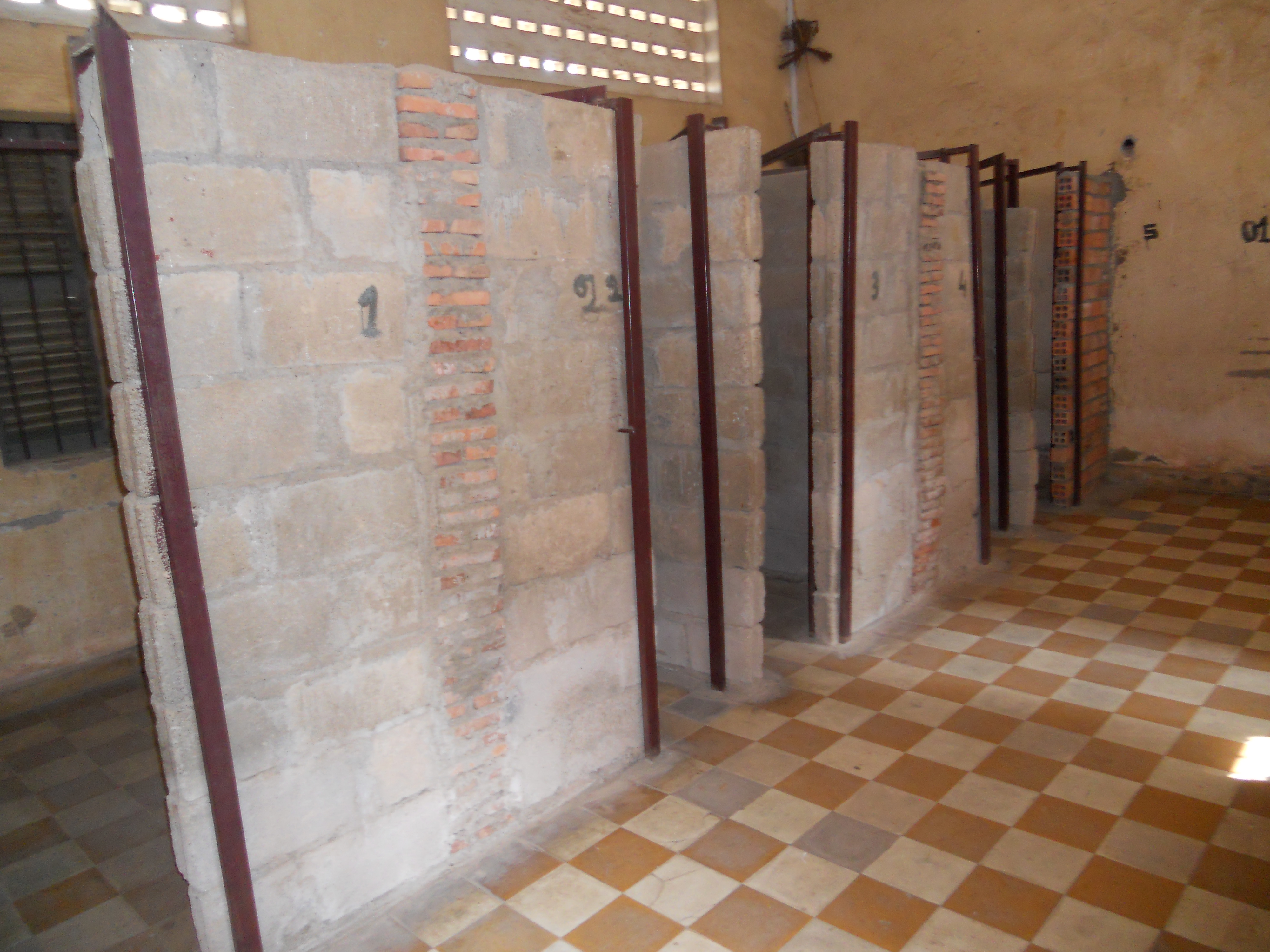
Holding cells in Tuol Sleng prison

Also known as Security Prison 21 (“S-21”), Tuol Sleng is a former high school-turned political prison that was a massive site of death and torture under the Khmer Rouge between 1975-79. The prison housed a number of political “threats” including officials from the previous government, academics, teachers, students, monks, factory workers, engineers, and eventually, suspicious members of the Khmer Rouge itself and their family members. When brought in, prisoners were either housed in tiny cells (like bathroom stalls) or shackled with other prisoners in larger rooms and were forced to stay under the most inhumane conditions. They were fed four spoonfuls of rice porridge twice a day, forced to sleep on the bare floor and forbidden to talk to each other. Breaking any of these rules, even drinking water without permission, would result in severe beatings or other punishments. Ultimately, however, the prison was an interrogation center and the victims were electrocuted, hung up by their arms, nearly drowned or had their fingernails ripped out as some of the methods of torture used on them. Many ended up selling out their friends and family members (who often then suffered the same fate) before being killed.

Photos of victims after their death in Tuol Sleng

Today, visitors can roam around nearly the entire complex, which includes several blocks of buildings used for interrogation and holding cells. The rooms are eerily simple, holding remnants of the bed frame, shackle and metal box (for going to the bathroom) that made up most of the interrogation rooms. Nearly each room in the interrogation block, however, also contains a photograph of a dead body after it had been tortured, putting an eerie perspective on the whole place. Nearby, the holding cells block contains three floors of wooden or brick cells, all about the size of a bathroom stall. Each level has barbed wire covering the outside balcony to prevent the prisoners from committing suicide. In some cases, you can still see blood stains on the floor.

Topping off the whole museum, however, is the victim’s memorial in the last complex. The ground floors are full of photographs of the prisoners, remnants of the torture devices used on them and the stories of the seven lone survivors (out of 17,000) who were found when the prison was liberated in 1979. In the very last room is a large monument full of skulls and clothing remnants. It was quite an emotional museum, to say the least.

On the morning of day two, Karri and I visited Tuol Sleng’s sister site, the Killing Fields of Choeung Ek, where most of the prisoners were killed and buried after their interrogation. The site is a ways out of the city at the former site of a Chinese graveyard. The prisoners had to be killed and buried there when the Khmer Rouge ran out of space at Tuol Sleng. To save bullets, they were bludgeoned to death with basic farm tools and buried in mass graves throughout the fields.
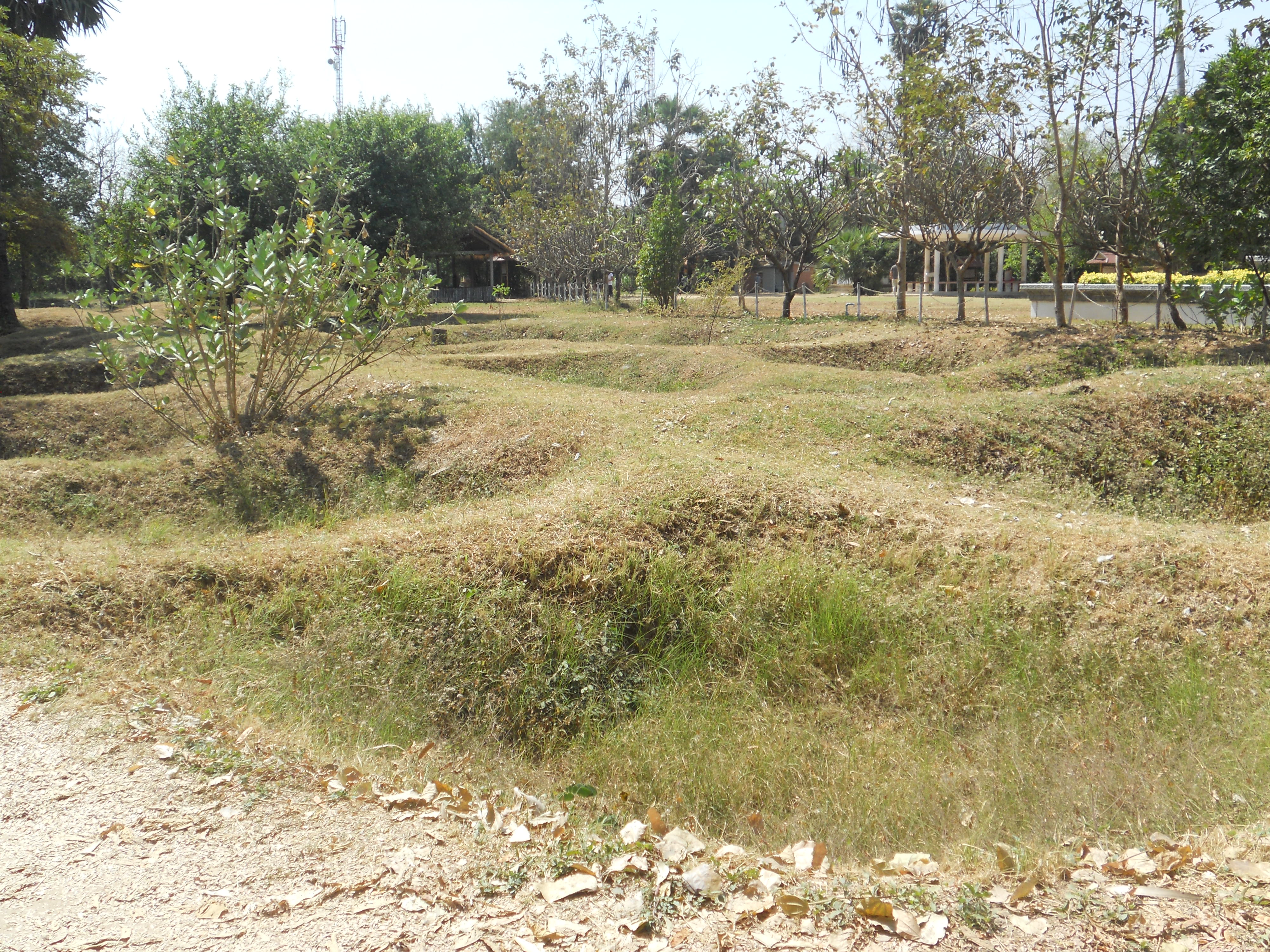
Empty pits at the Killing Fields of Choeung Ek from where thousands of bodies of Khmer Rouge victims were excavated

Today, people can still see the huge pits that fill up the grounds from where the bodies have been excavated. In fact, the site is set up so visitors can walk from the entrance around the grounds at different stop points to read about different aspects of the fields, including the grave of the headless bodies, a tree against which the Khmer Rouge smashed babies and several cases containing the clothes and bone fragments of the victims’ remains. What is still eerie, however, is they say they still find bits of clothes and bones coming up from the grounds after it rains…

Inside the Killing Fields Memorial, where the remains of some of the Khmer Rouge victims are held

The site also has a museum containing clothes from the Khmer Rouge, tools used in the killings, a video on the Khmer Rouge and photos from the excavation. One of its biggest draws still, however, is the large memorial located in the center of the fields. The monument is 17 stories high and contains the victims’ remains in open, glass display cases. The first few levels are full of human skulls while the upper levels contain different other bones and clothing remnants. The whole thing is really open, you can go right up to it and touch the skulls if you want (though probably not recommended) since the glass cases aren’t always closed…

Though we’ve all grown up learning about horrible atrocities that have occurred throughout history, especially things like the Holocaust, it’s very different experiencing the sites first hand. What was especially scary to me was the fact that this all happened in the late 70s, less than a decade before the year I was born… After these museums I kept staring at all the Cambodians I encountered, especially the older ones, wondering what they were thinking about, what memories they had and what their lives are like now. I just feel sometimes Iike I’ve grown up in a bubble, one for which I am very grateful, and I hope I never have to endure anything like they did during my lifetime.
Cambodia and Vietnam: Part 2

Standard

After much deliberation, Karri and I decided not to pursue more temples on day two. It was a really tough decision to make, but we were a bit “templed-out” after having spent an entire day looking at ruins, and there were a few other things in Siem Reap that I wanted to see.

The main event on day two was the Cambodia Landmine Museum, what would become the first of a series of heart-wrenching museums that made up the majority of our trip to Cambodia. The museum was quite a ways outside the city and near Banteay Srei, another temple that was described in my guidebook, so Karri and I decided to do both. It wasn’t until our tuk tuk driver took us to the lone ticket counter for the archeological park that we realized Banteay Srei was part of the whole ruins complex and required another $20 full-day ticket. Reluctantly, Karri and I decided to pass on the second ticket, convincing ourselves that we had seen enough temples and would now have more time to see the city.

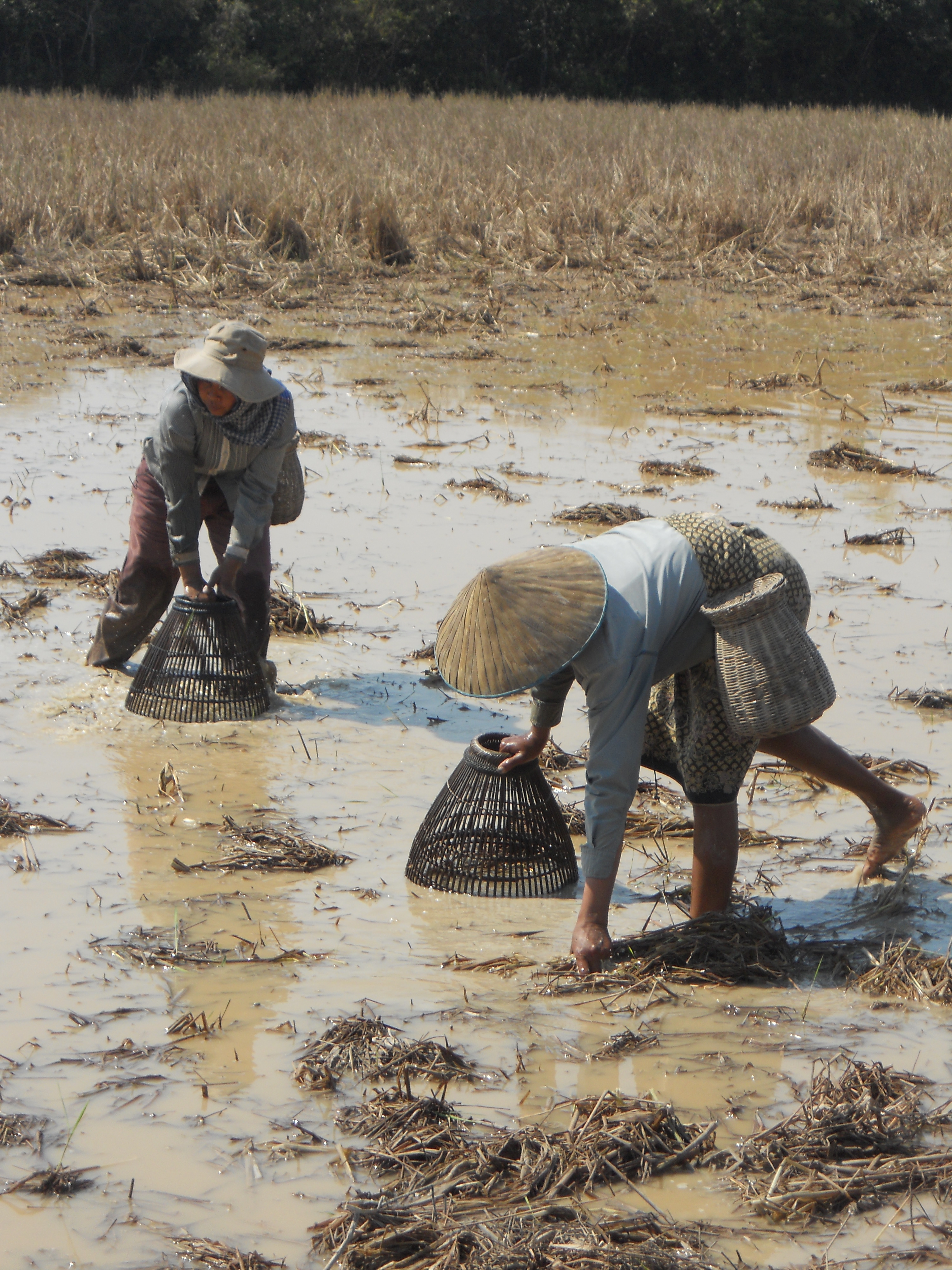
People fishing off the side of the road in Cambodia.

Our driver, however, didn’t get the memo and somehow Karri and I found ourselves at Banteay Srei anyway, and I quickly began regret not purchasing that second ticket… Banteay Srei, from a distance, looked really incredible, and unlike other temples in the area, had information available to read about the temple’s history and architecture before going in. At this point, we’d already driven more than a half hour to get there and going back to the original ticket counter was not an option. Unfortunately, we soon found out that individual temples don’t sell their own tickets. It’s all or nothing, and if you want it all, you have to go to the lone temple ticket counter just outside Siem Reap.

But after such a long drive I was determined not to give up, so I decided to approach the guards and see if there was anything I could do to change their minds… At first I just played dumb and asked politely if there was any way we could buy just one ticket to get into this one temple. I tried to explain to the officer that we had already seen the main circuit the day before and had traveled a long way just to see this one temple today. He said he couldn’t but referred me to his supervisor, where I repeated my story. Again, I was told to go back to the ticket counter. At this point, I asked the guard if maybe we could pay him to see the temple. At first I offered $5 (well more than one temple is worth comparatively) but went all the way to the full $20 just to see this damn temple. But what do you know, a guard in a country where corruption is rampant still REFUSED to let me in! In fact, he made sure to tell me that people found at the temples without tickets get a $100 fine, despite the fact that he and his comrades were the only point of defense for the ruins and letting us in would be easily unnoticed.

(For the record, I do not support bribes and corruption and all that, but seriously, accepting a few dollars to let some tourists into a temple far away from the city center is not that big a deal, and he could have put that money to back into some preservation fund for all I cared, the whole thing was just ridiculous. Furthermore, the whole system seems like a bad business move. You could make a lot more money off the temples by charging for entrance at individual sites in addition to offering the all-inclusive ticket to accommodate the stupid tourists who find themselves stranded far away from the ticket counter and regretting not buying a second ticket…)

Anyway, with our tails between our legs, Karri and I left the temple site and headed off our original destination, the Cambodian Landmine Museum. Like it sounds, the museum is full of information regarding land mines, especially their presence and history in Cambodia. It also contains an orphanage/school for victims of landmines and other disadvantaged children. The founder was a child soldier under the Khmer Rouge and was forced to lay landmines as a child, watching many of his friends get blown away in the process. He eventually realized the harm he was causing and dedicated his life to removing landmines throughout the world and educating people about their danger.

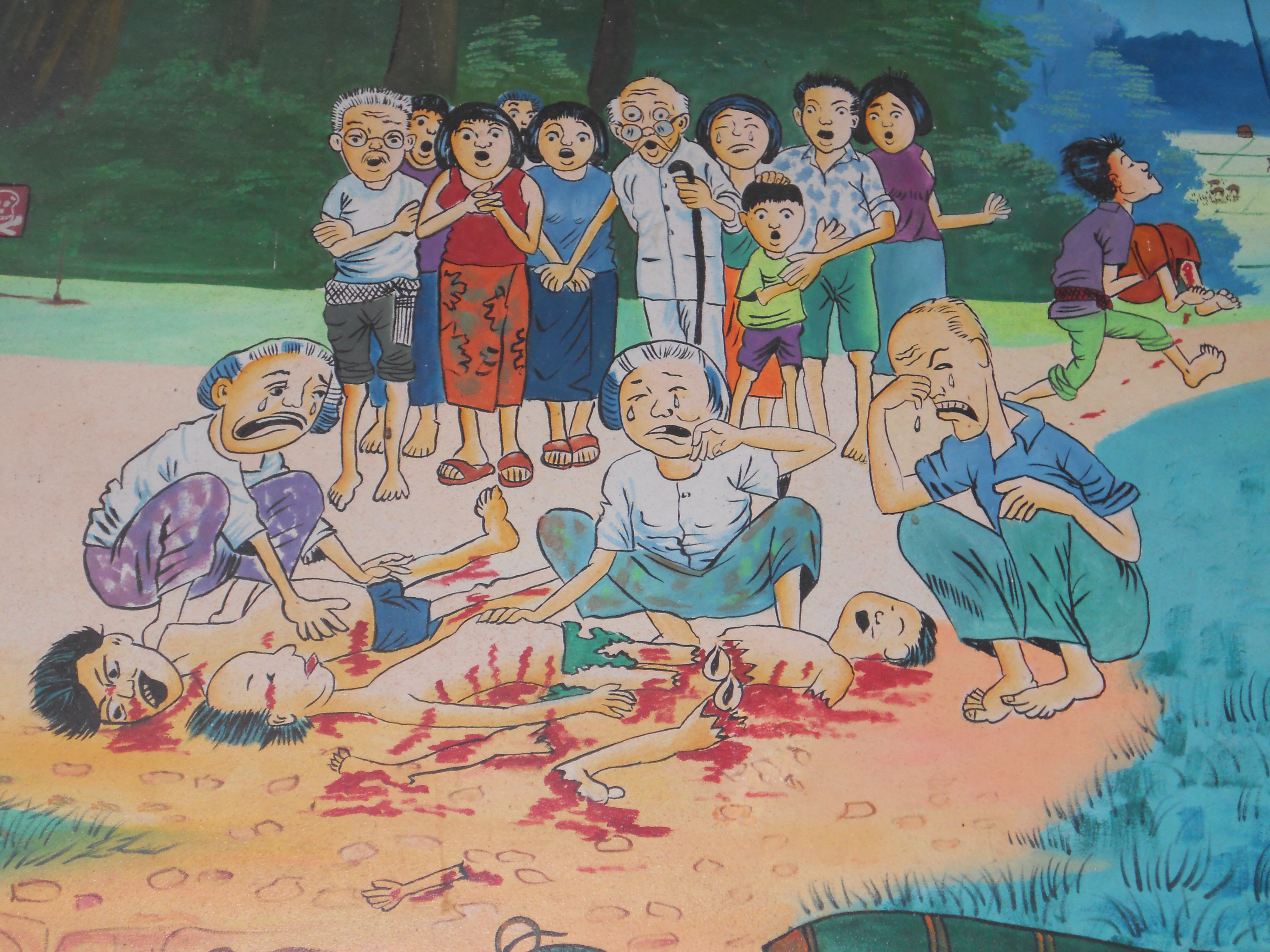
Close-up of a painting on display at the Cambodian Landmine Museum

Though small, the museum is really powerful. There is a large collection of landmines and weapons on display, but what is more interesting is actually reading about the history of landmines and their presence throughout the world. There is also a really interesting documentary video on just how they work and how powerful they are. What is most impactful, however, are the stories of the child landmine victims who now live at the museum’s orphanage. An entire wall is covered with their little biographies, and you find yourself addicted to reading each one, never ceasing to be shocked by their stories. There is also an art therapy project on display where the kids were asked to take a box and paint their aspirations on the outside of it while painting what happened to them on the inside. Today visitors can find four boxes hanging from the ceiling, all with pictures such as teachers, doctors and office workers on the outside, with colorful visions of smoke, fire and missing limbs on the inside. Sadly, there are an estimated 6 million unexploded landmines remaining throughout Cambodia :(.

After that emotional rush, Karri and I decided to relax a bit and just enjoy the streets of Siem Reap during our remaining time there. Next stop: Phnom Penh!

Cambodia and Vietnam: Part 1

Standard

As I sit here, just a couple weeks after returning from my one-week trip to Cambodia and Vietnam, all I can say is that this trip was one of the most eye-opening experiences of my life. Cambodia, a country that has been through so much political unrest, genocide and famine, was one of the most fascinating yet heartbreaking places I have ever been to. Likewise, Vietnam, the first communist country I have visited, also proved to be a reality check, as I saw firsthand how much control the government exerts on information. Additionally, both of these countries were the two most polluted I have ever been to (especially Ho Chi Min City), and I’m still recovering  from the cough I picked up from the three straight days of congestion I suffered as a result of the pollution aggravating my allergies.

So the trip came about after I found myself with nearly an entire week off work with the celebration of both Federal Territory Day and Chinese New Year in one week (gotta love the many cultures of Malaysia)! Since it was only a few weeks after the massive preparations for Thailand, I decided to join my Finnish friend Karri on his pre-planned trip, which included four days in Cambodia and four days in Vietnam, with my friend Danielle joining us for the second half.

I must say, in the (rushed) weeks planning my trip to Cambodia, I was pretty terrified and extremely anxious of what was to come. After receiving a typhoid vaccine and accumulating a mini-pharmacy including anti-malaria pills, anti-diarrhea pills, stomach medicine, anti-histamines and rehydration salts, I turned my worries more to the country’s lack of infrastructure, unsafe traffic and crime. Plus the image of the nasty scars on the legs of a New Zealand girl I met in Thailand due to a sink and mirror falling on her in her guest house in Cambodia left quite an impression on me.

But as we arrived at the Siem Reap airport and headed to the city, my fears mostly began to melt away. Cambodia is fascinating! To start with, it’s a lot like Thailand, except poorer and “Frencher.” Like Thailand, we rode around in tuk tuks, though the ones in Cambodia are simply motorbikes dragging the carriage as opposed to one, connected (stable) vehicle. Similarly, the food in Cambodia is like that of Thailand, though less spicy and with more French influence, like baguettes and croissants. Additionally, the country has a history of Buddhism and Hinduism with beautiful palaces and temples built with architecture similar to those of Thailand.

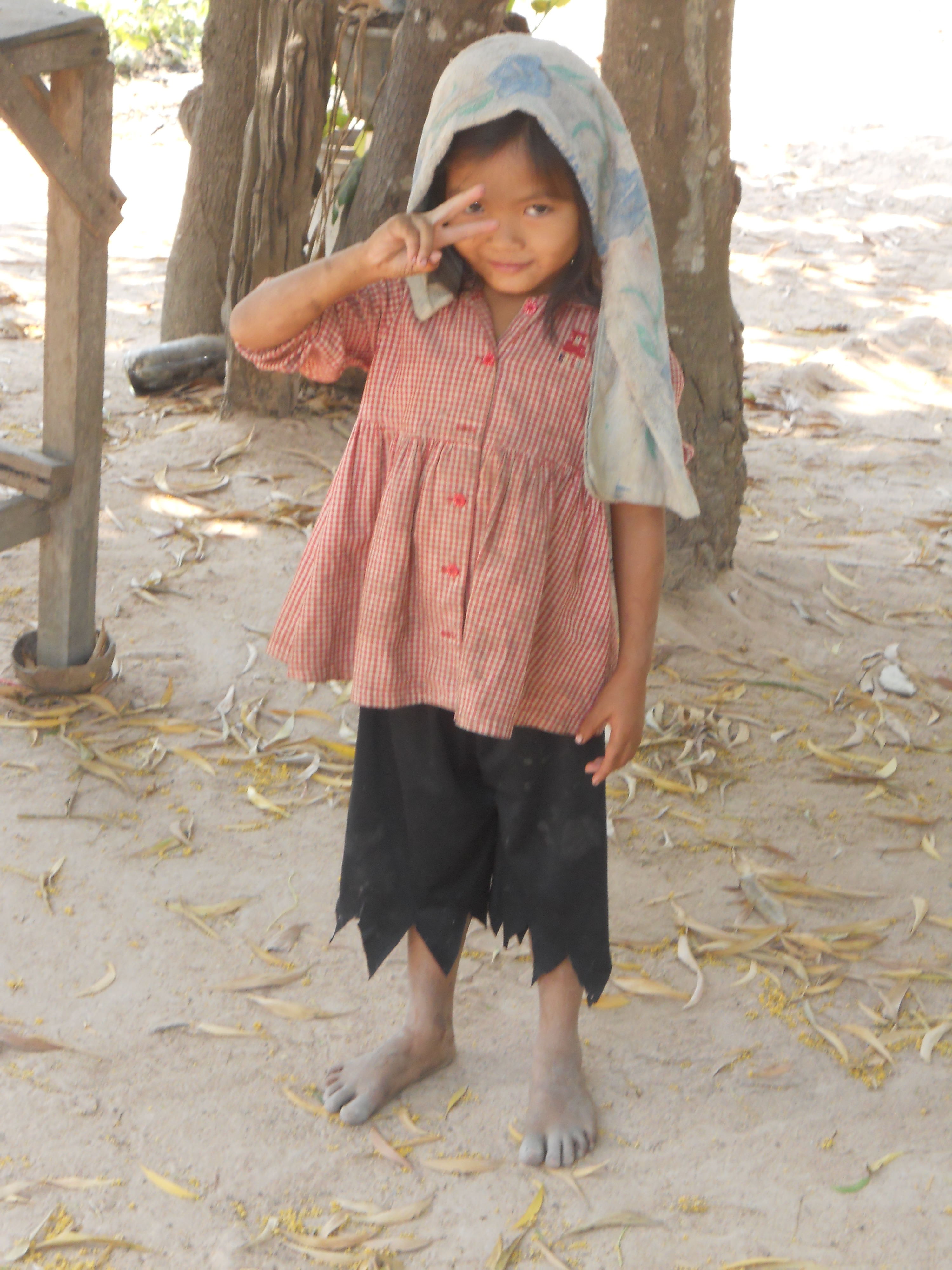
Cambodian Child

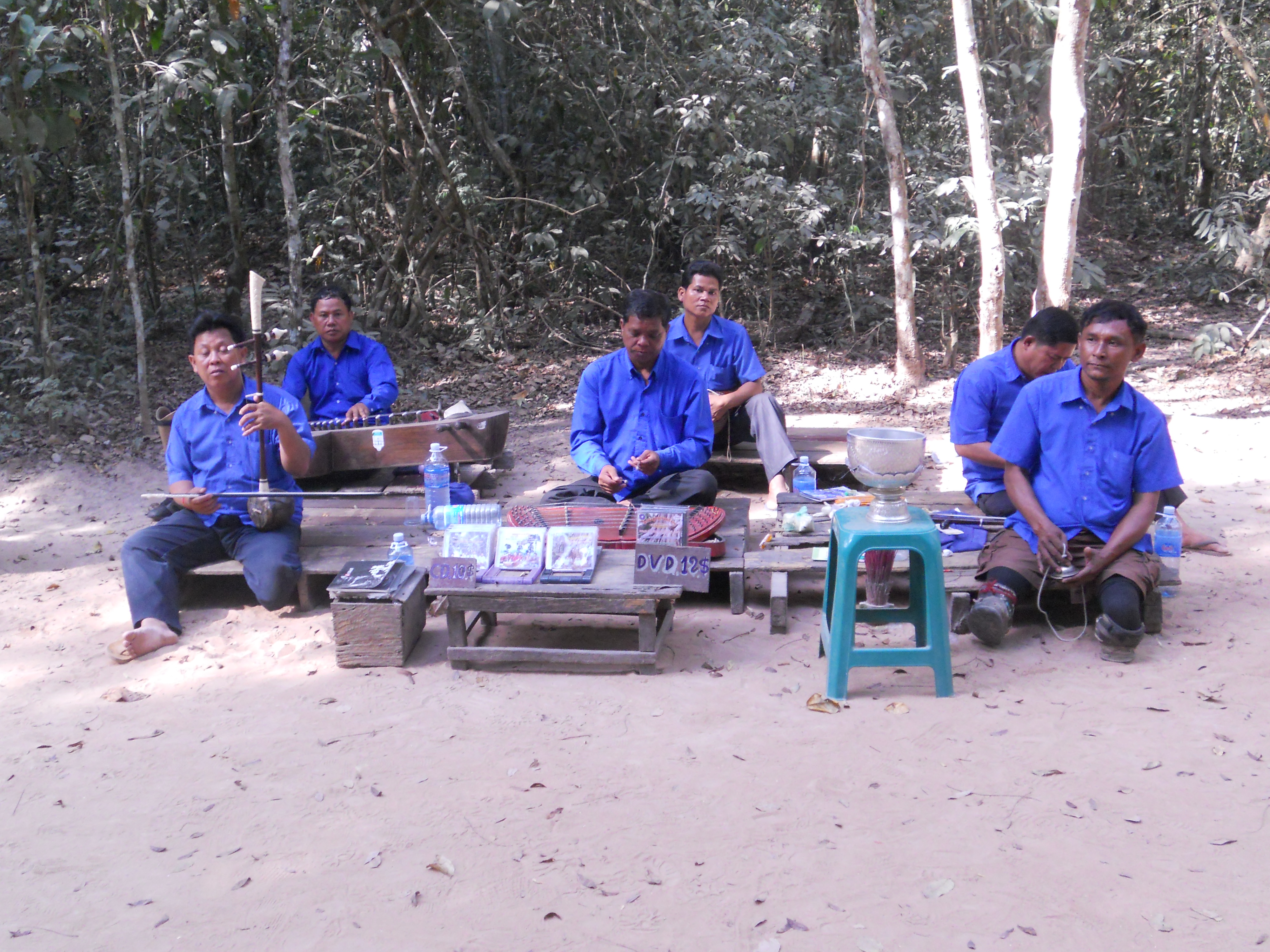
The country is, however, EXTREMELY poor. I’m not kidding, as we looked at all the children running around, some naked, nearly all barefoot, playing in the dirt and the dirty water in the ditches, I felt like I was looking at a Sally Struthers infomercial to adopt a child. Beggars are everywhere, especially in the city’s capital, Phnom Penh, where one child followed me for two blocks, begging me to buy a pirated book, while another waited for more than 15 minutes next to my dinner table at a restaurant to try to get me to buy one. In addition to the children, the country is full of land mine victims, some who beg on the streets and others who have formed a musical band where they play at tourist places and collect money in a basket.

Landmine Victim Band

Though I normally don’t give money to beggars, it was especially hard to refuse in Cambodia after seeing and reading about all the hardship these people  have endured during the past few decades,  especially under the Khmer Rouge communist government from 1975-79 where between 20 and 25 percent of the population died or was executed under the brutal regime. I found myself, instead, doing quite a bit of shopping, including buying two skirts, two books, earrings, a painting and a t-shirt, always justifying my spending that I was supporting this NGO or the local economy. (Plus, some of the stuff was really cool).

So the whole trip started in Siem Reap, Cambodia home of Angkor Wat, one of the most spectacular temples in the world, and an entire complex of ruins spread out outside the city. As some of the ruins are quite far away from each other, many guidebooks recommend spending at least three days to view everything, but since we only had two days, Karri and I decided to hit the ground running on day one and try to see as much as possible.

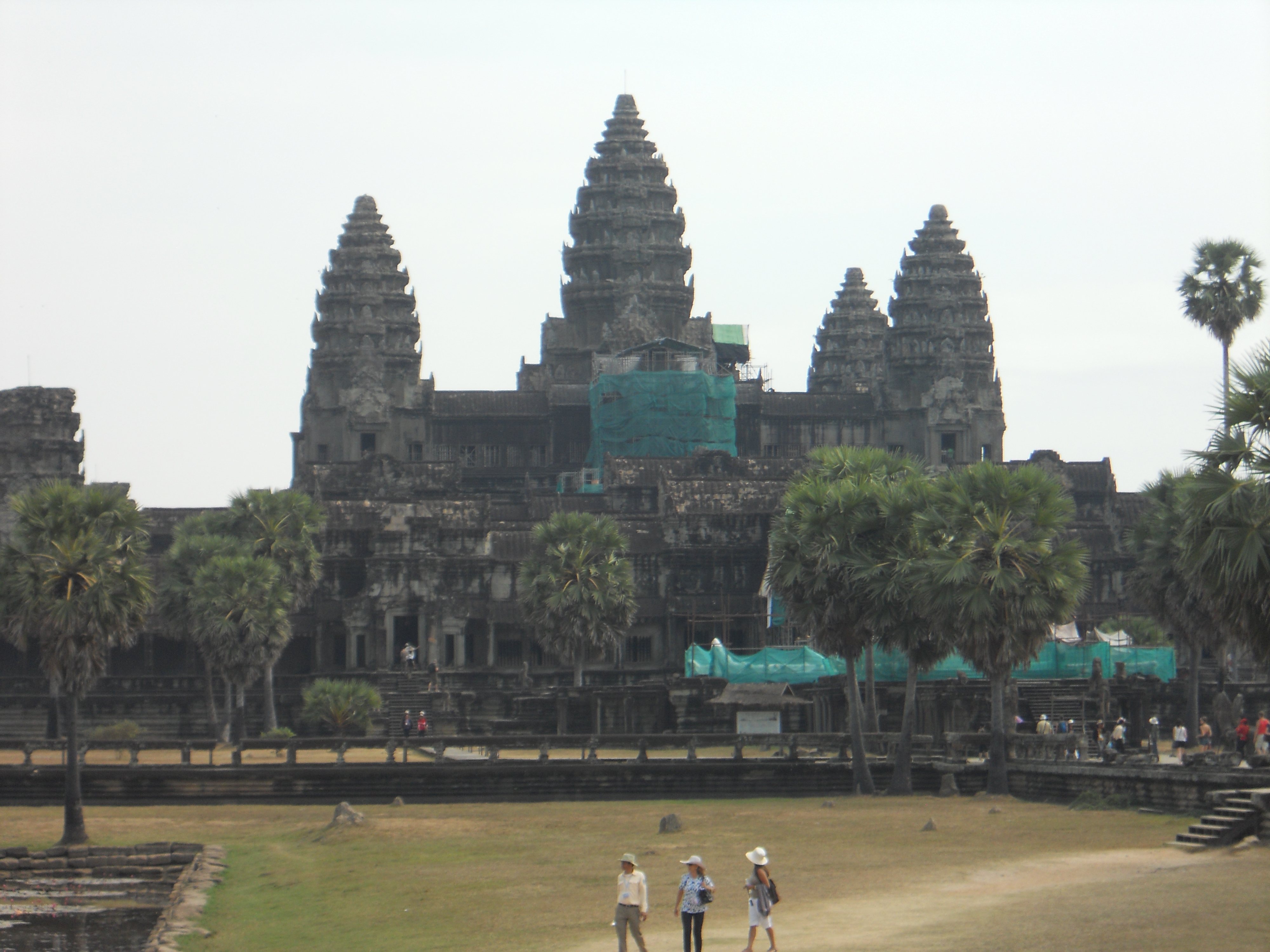
Angkor Wat

Our first stop was Angkor Wat, the crown jewel of the entire archeological park. The temple and its surrounding complex were built in the early 12th century for King Suryavarman II. Though now a Buddhist temple, it was originally a Hindu temple dedicated to Lord Vishnu and built to resemble Mount Meru in Hindu mythology, including a massive moat that surrounds the whole thing. Though under some reconstruction at the moment, Angkor Wat was beautiful. The complex is quite large and contains several buildings including a few large entryways, two libraries and the temple itself (side note: make sure to cover your shoulders and legs before you visit, otherwise you will be forced to wait to borrow the temple’s lone scarf for visitors).

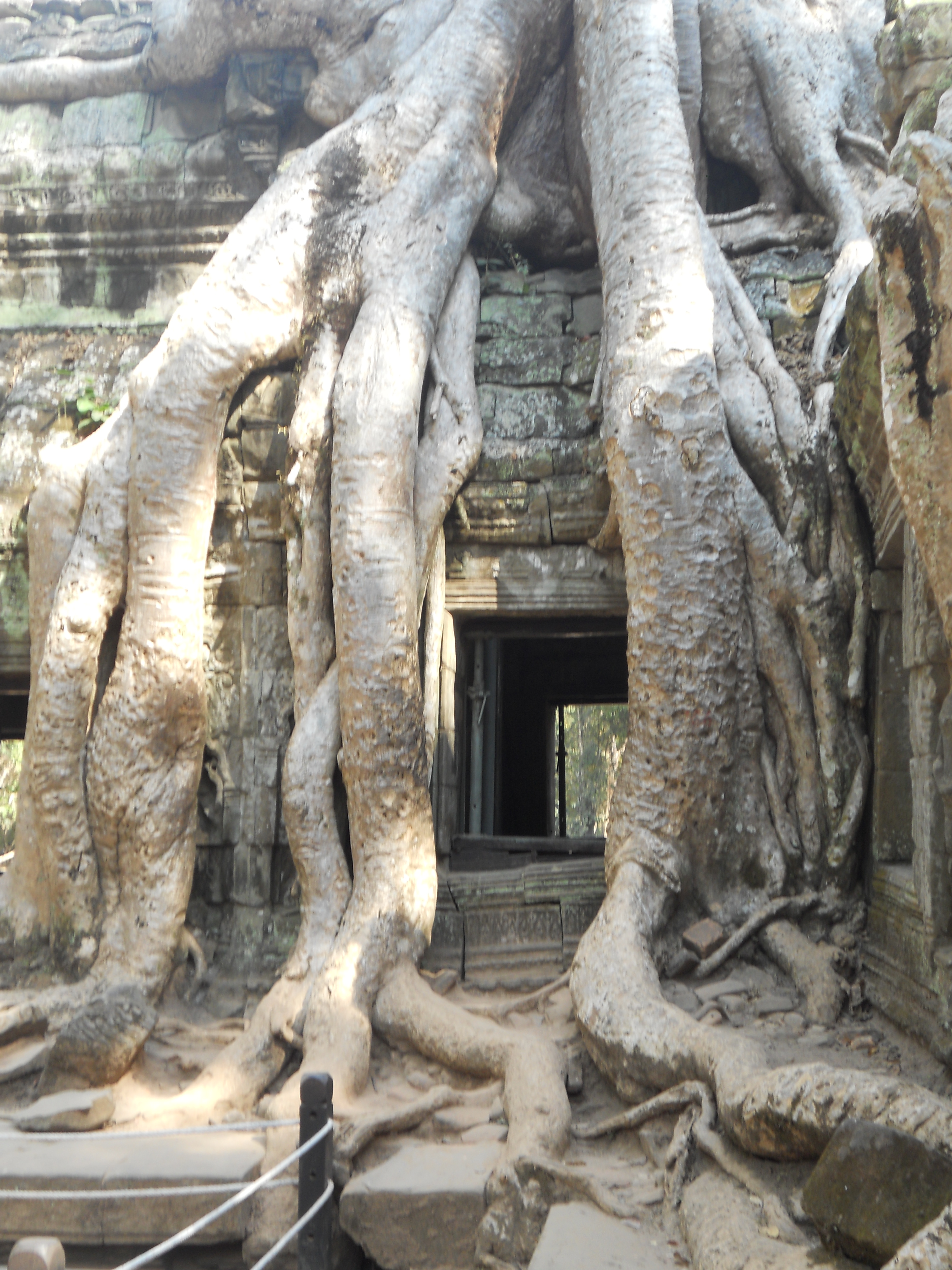
Ta Prohm

After Angkor Wat, Karri and I managed to see the rest of the park’s main circuit, and though exhausting, is quite incredible. Actually, despite the national icon that is Angkor Wat, I think I prefer some of the other ruins we saw that day. Ta Phrom, another 12th century temple nearby, was amazing. Most of the temple has already fallen apart and what remains doesn’t look like it will last much longer. What is really beautiful, though, is that the temple is full of huge, old trees which have grown around the ruins, sometimes framing them with their roots.

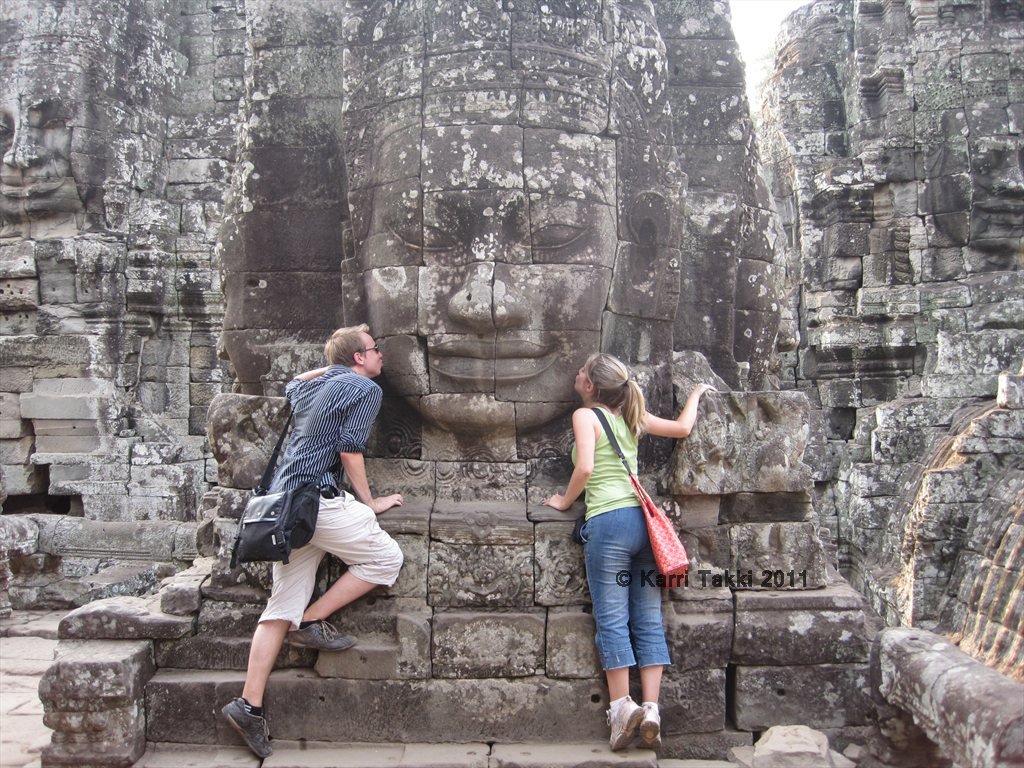
Karri, Me and the Bayon

Perhaps my favorite ruins, however, were those of the Bayon temple, which were definitely the most unique of all the buildings we saw. The entire thing is covered in FACES! I mean, really, it’s COVERED in actual faces carved into the stone, and they’re all the same face! There are 216 of them, which face all four directions of the building’s 54 towers. Some say the face is of King Jayavarman VII, who commissioned the building in the late 12th or early 13th century, while others say it is supposed to be the Buddhist essence of compassion, the Avalokiteshvara, while others say it is a combination of the two. Whatever the case, the faces are really interesting, albeit, a bit creepy. I’d hate to be stuck there at night…

After more than seven solid hours of ancient ruins, thus ended day one in Cambodia.

Thaipusam

Standard

I know I am getting very behind in my blogs here, but there are so many things I want to write about, and with all my recent travels, I have hardly had any time to catch up!

That being said, there was one holiday in January I got to experience that I would really like to share here: Thaipusam. Since my first visit to the Batu Caves in August, I have been looking forward to this event to witness first-hand the more than one million Tamil Hindu devotees who flock to the caves to pay homage to the deity Lord Murugan, to whom the cave’s shrine is dedicated.

What makes the event interesting is that the pilgrims show their devotion by carrying burdens called “kavadi” on their bodies, which generally include carrying large, heavy decorations on their shoulders and/or attaching small fruits and flowers to their bodies with hooks as they climb the 272 steps to the top of the cave. Others, especially women, carry jugs of milk. Each devotee has an entourage who accompanies him or her on the journey, and those who are especially hard core get a small band who help them get into and stay in a trance.

I gotta say, the whole experience was AWESOME! But I must admit, Thaipusam, for both the devotee and the gawking tourist, is not easy. First, it is hot! Since I work in air conditioning all day long, sometimes I forget how hot Malaysia really is (last time I checked the temperature it was 95°F, “feels like 106°F”), but being out in the open sun in a crowd (plus a sunburn) is a quick reminder that I am only 3° above the equator.

Second, it is crowded! More than a million people came out to the Batu Caves that day and within an hour, I had lost everyone in my 30-person group. At one point, the police were fighting to keep the non-participant crowds from going up the stairs into the caves, and I found myself constantly squished up next tons of sweaty, stinky strangers.

Usually, I hate crowds but for some reason, I actually didn’t mind them during Thaipusam. There was a really exciting energy in the crowds, and though I obviously wasn’t participating, I definitely felt like I was right in the event. At one point, exhausted, sweaty and dehydrated, I decided to head home, but then I found out they had opened up the stairs to the caves to the non-participants. Though part of me wanted to crash, my curiosity got the best of me and I managed to haul my butt up the steps to see what I could find.

All around, people were removing their kavadi and many of the devotees were passed out or lying down with their attendants rushing to cool them down and take care of them. Though all I saw was the actual carrying of the kavadi, these people undergo weeks of purification rituals to prepare, including fasting, where they eat only one simple meal a day. Though I know the act is gruelling, I was still surprised to see how strong of a physical toll it took on some of these people. Many perform it as a form of thanksgiving or penance to Lord Murugan to receive blessings from him, especially if there is an impending crisis like a severely ill family member.  I suppose people can do anything with the right motivation!

This slideshow requires JavaScript.

Thailand Part 4: Chiang Mai

Standard

The final leg of our trip to Thailand was Chiang Mai…14 hours on the OTHER side of the country! And despite being forced to spend the night “sleeping” on the chairs in a freezing cold train cabin (all the sleepers were full), Josh and I were determined to go.

Way up in the north near the mountains, Chiang Mai is known for its beautiful scenery, culture and jungle treks. Though the city itself was nice enough (it did have some interesting temples), Josh and I quickly signed-up for a two-day tour, which included an elephant ride, trek, white water rafting, bamboo rafting and visits to local mountain tribes, including a one-night stay with them.

Now, for me, the main attraction of the whole thing was the elephant trek. Instead of a short, once-around-the-ring circus ride, we actually got to ride the elephants for an hour through a trail in the jungle, and I was delighted to get the chance to ride on the elephant’s neck without a seat! But the part that left the most impression on me (and my body) was the three-hour jungle trek up the mountain to the tribe.

I hate hiking.

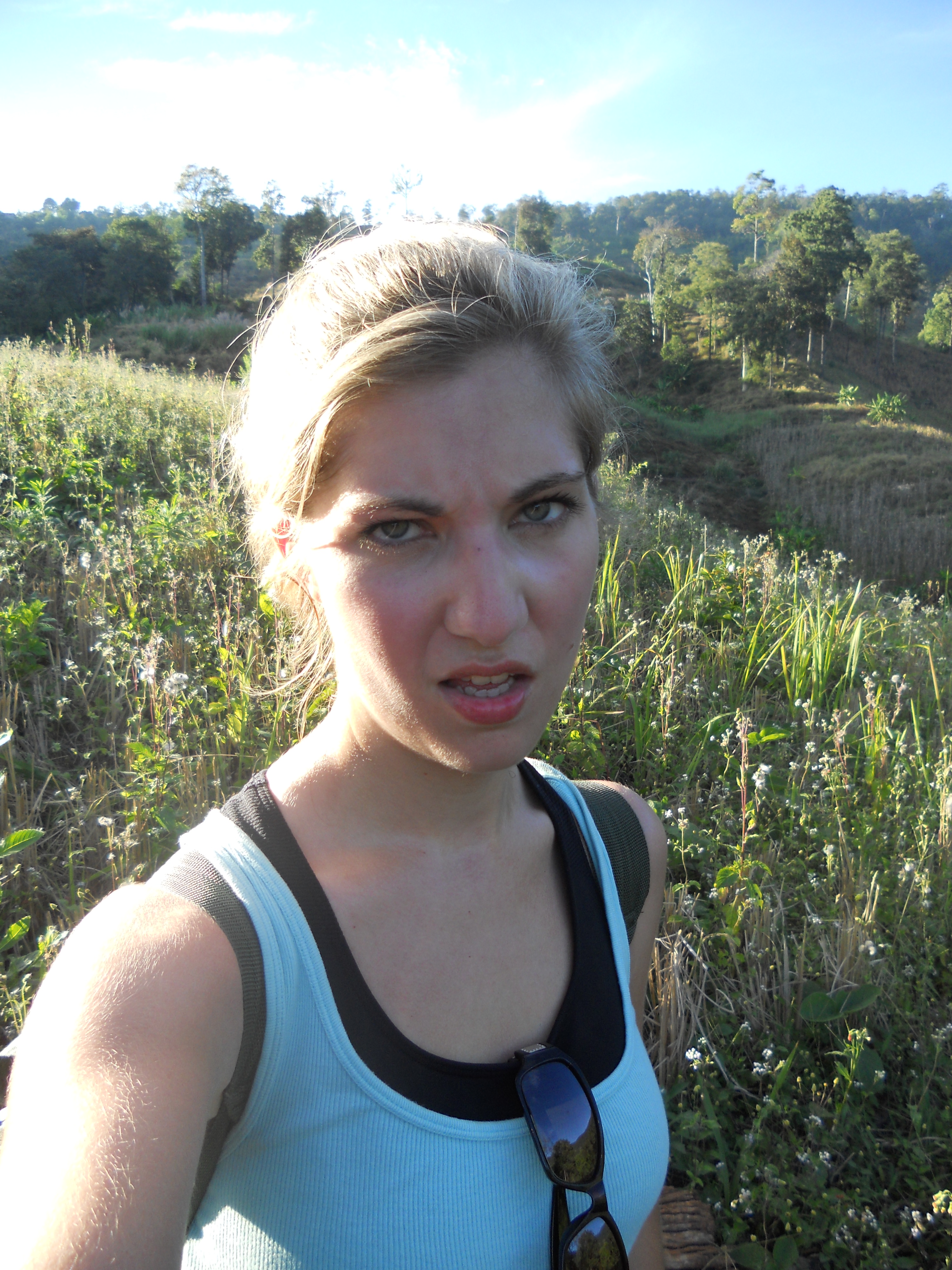
For many on our trip, the trek was the main event, a chance to really get in the jungle and experience the wildlife of Southeast Asia. But after more than six months in Malaysia where banana trees and exotic plants are everywhere, the jungle trek to me was more like three hours of Stairmaster Hell in a sauna. Did I mention it was three hours UPHILL? And I learned a valuable lesson that day: yoga does not make you physically fit!

I stupidly thought a commercialized, group package tourist trap tour would take us through easy trails designed to suit those of all levels of fitness, but somehow I found myself climbing over rocks, uneven terrain and really steep hills. Frankly, the only thing I wanted to see in the jungle were wild animals or exotic bugs, but all living creatures appeared to be on vacation that day, which meant it was just us and plants. I know this whole rant sounds terrible and many people loved the trek, but who are we kidding? I am NOT a nature girl.

So after a long day hiking, sweating and building buns of steel, we finally made it to our destination: the hilltop tribe. I gotta say, it was pretty cool. Despite the pain flowing throughout my legs and feet, the mountains and the view from the top were beautiful, and the location is so remote you actually feel as if you’re on some real adventure and not some carbon copy tourist tour.

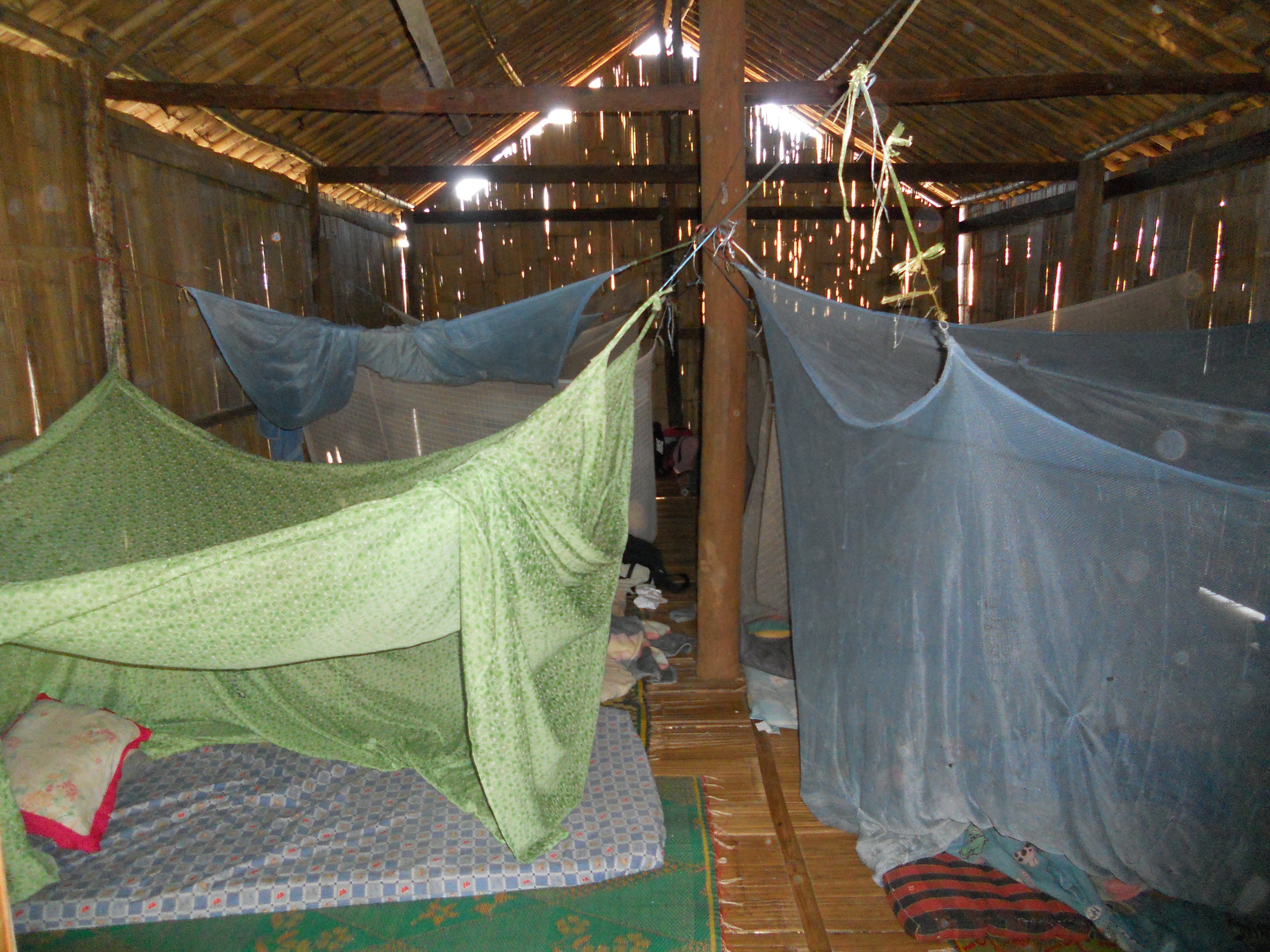
Our accommodation

Our guide led our group to a separate cabin at the top next to the village where we’d be staying: a two-room house full of thin mattresses, blankets and mosquito nets. Delightfully rustic! Then it was time for showers. I swear to you, if it wasn’t for the fact that I was covered in sweat and dirt, I’m not sure I could have done it. Even Josh, Mr. I-Don’t-Mind-Cold-Showers-They’re-Refreshing, found the liquid ice coming from the outdoor, wooden stalls to be a bit too refreshing. I think they were the quickest showers anyone in our group had ever taken! 🙂

After changing, we all enjoyed a really lovely evening together, sharing a nice local meal on the floor of the cabin then just relaxing and chatting. It was so dark outside, the stars were just gleaming. I don’t think I’ve ever seen so many in my life. It was beautiful.

At one point, some of the village children came to visit us and sing us some local songs. Somehow, we found ourselves forced to return the favor and ended up singing “Rudolph the Red-Nosed Reindeer,” the only part of Christmas Day that actually resembled the holiday. It was all great fun, definitely my most exotic Christmas ever!

Thailand Part 2: Ayutthaya

Standard

So after our stay in Bangkok, Josh and I hopped on the train for a day-trip to Ayutthaya, Thailand’s fallen kingdom that dominated the region from 1350 to 1767. Originally I was a bit hesitant to go there, since I hadn’t heard much about it and was not that interested in seeing old ruins, but I am so glad that I did!

Ayutthaya just might be my favorite city in Thailand. It had the feel of a quaint, friendly small town that just happened to be covered with old ruins. In a welcome contrast from Bangkok, our guest house was friendly, charming and had hot water!  And despite having some of the country’s most interesting sites (in my opinion) it wasn’t yet destroyed by tourists.

Wat Phra Mahathat

One of the best ways to explore Ayutthaya is by bicycle, which can be rented cheaply at any of the shops around town, and we found them to be in pretty good condition. You just bike around the city and you’ll see ruins everywhere, and the best part is, you can go right in and walk all over them! You could spend days exploring all of them, but honestly, many of the ruins looked quite similar to me. When the Burmese took over the kingdom in the 1700s they burned and destroyed everything. What remains today are crumbling piles of bricks and chedis (big bell-looking things) that still hold some of the majesty and glory of their golden days.

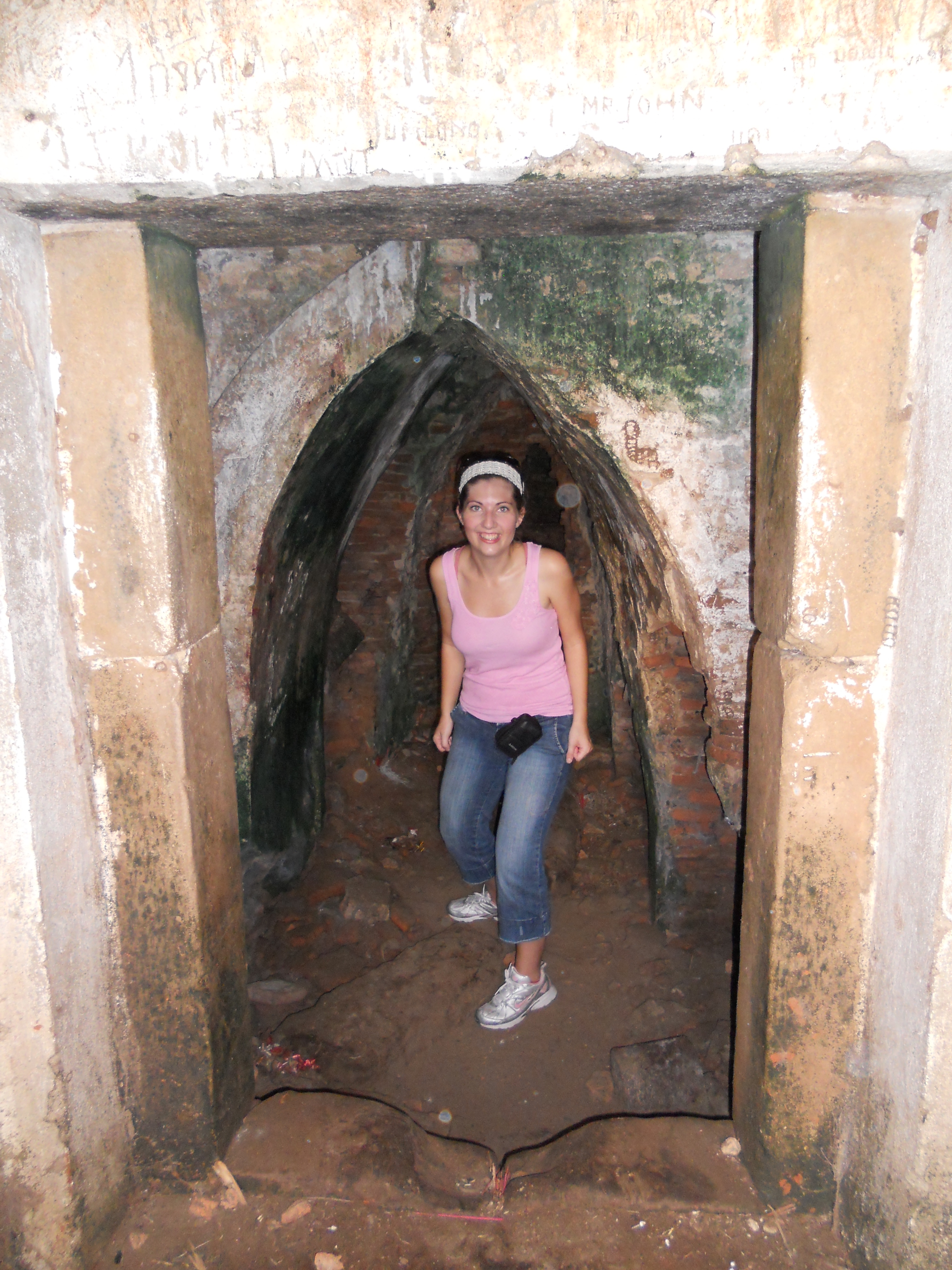
Inside one of the chedis of Wat Phra Si Sanphet. Holding my breath, but smiling :).

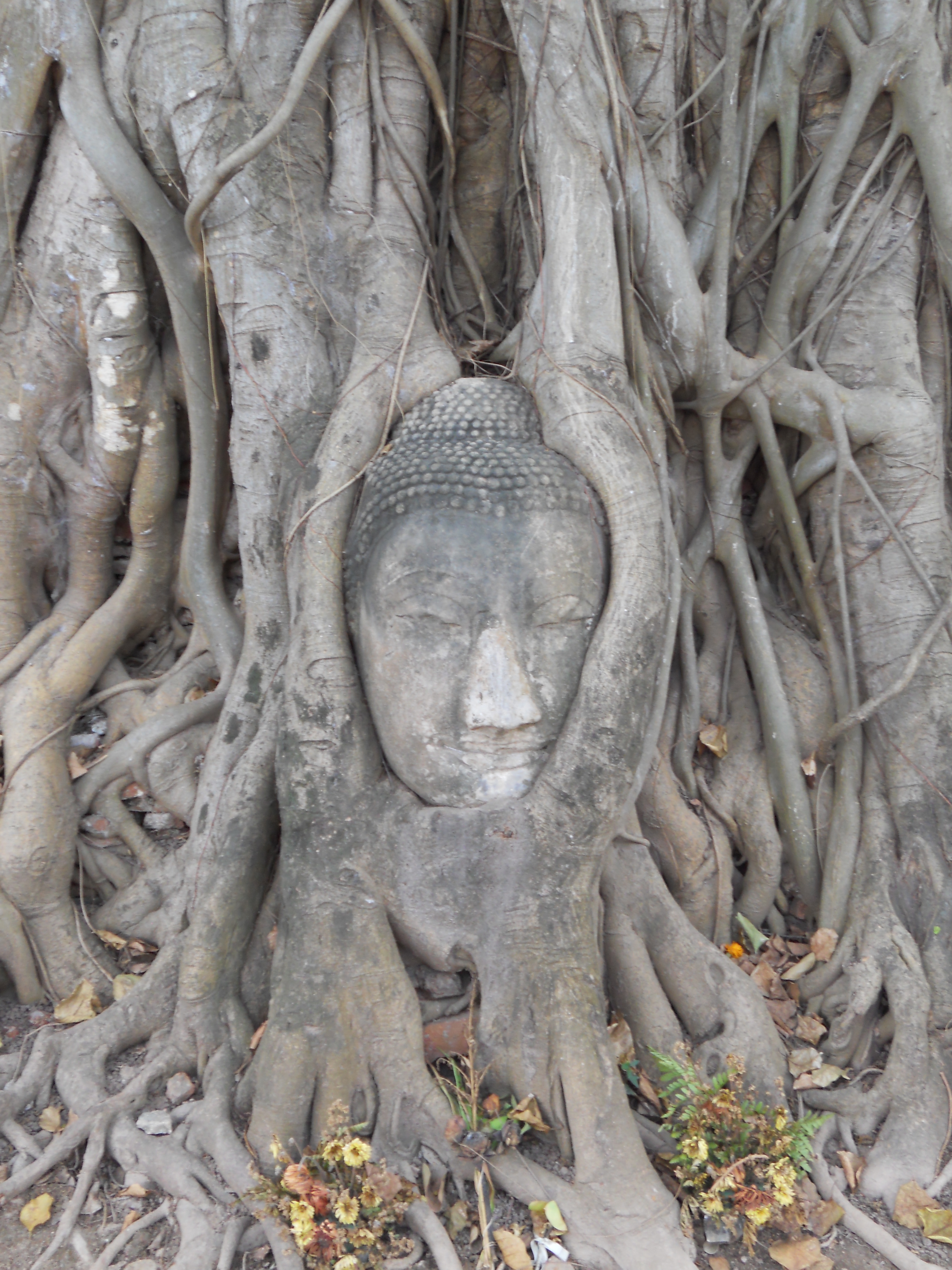
In the interest of saving time, Josh and I just selected a few of the main ones. Our first stop was Wat Phra Mahathat, a beautiful temple with iconic images such as a peaceful Buddha face surrounded by tree roots that just happened to grow around it. Next was Wihan Phra Mongkhon Bophit, home of Thailand’s largest seated Buddha (yet another awe-inspiring moment) and next door to Wat Phra Si Sanphet, the former site of the ancient royal palace when it was located in Ayutthaya. This palace/temple has three massive chedis that hold the ashes of former kings. One of chedis had this little entryway in it, and though I tried to convince Josh to join me to check out the inside, he refused (something about not wanting rabies, whatever). Luckily, I found some braver tourists around to join me and managed to enter into the little dirt hole long enough to grab a photo, ignoring the creepy-crawly noises around me and the overwhelming smell of excrement.

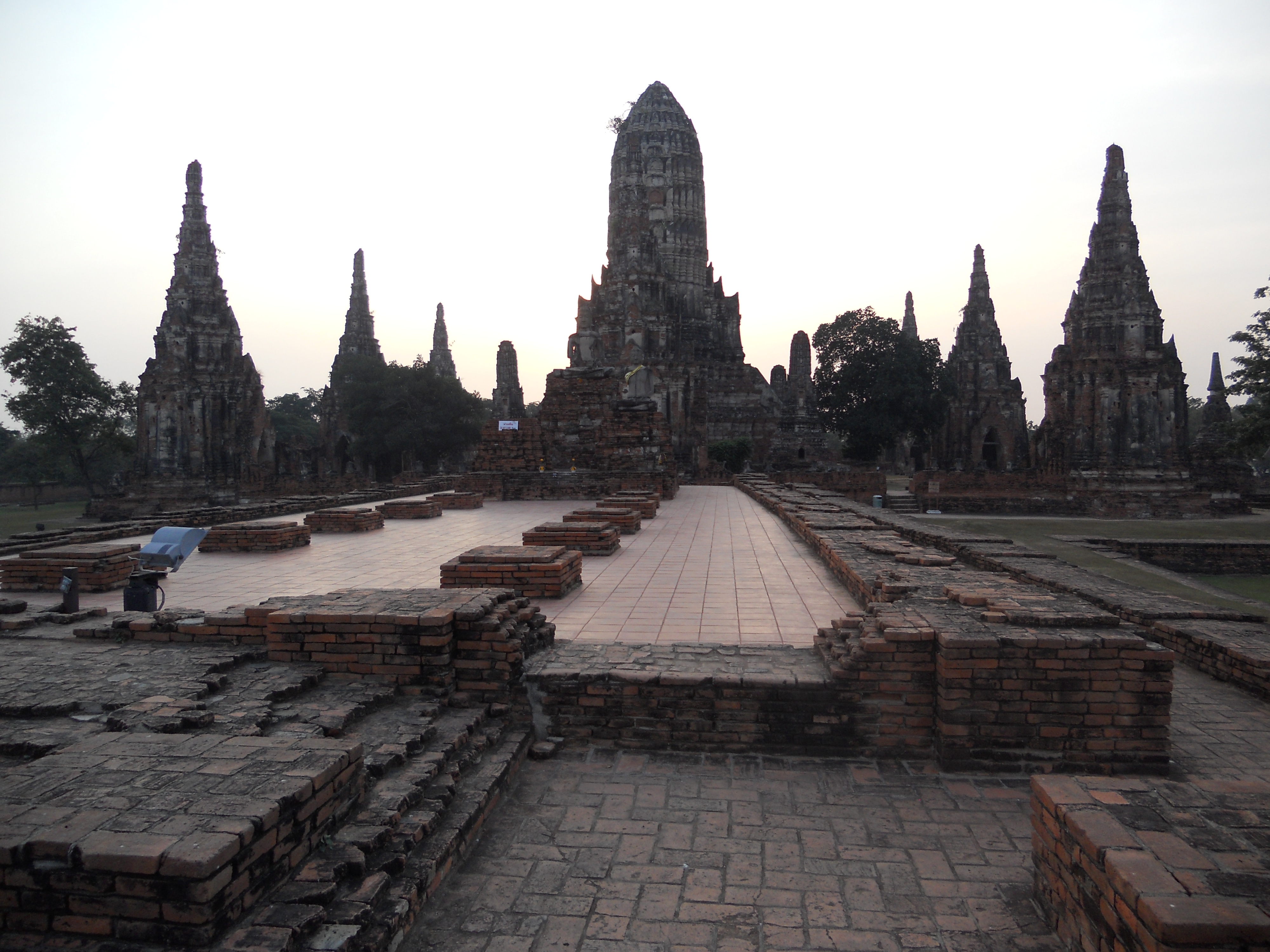
Wat Chai Wattanaram

Later that day, Josh and I joined some other travelers at our guest house for a boat tour of some of the ruins off the island. This was pretty fun. Our non-English speaking guide drove us around this long, canoe-like boat and dropped us off at random places with virtually no explanation, simply saying “20 minutes.” Luckily, we managed to find Wat Phanan Choeng, home of another MASSIVE Buddha, Wat Yai Chai Mongkol, a smaller, less impressive temple with an old chedi, and Wat Chai Wattanaram, the most picturesque of them all. Wat Chai Wattanaram was absolutely gorgeous. Of all the ruins we’d seen, this one seemed the most intact, the most symmetric and was, surprisingly, sparsely populated with tourists. We were there around sunset and the whole thing made just a beautiful silhouette against the sky. It was a great way to end our tour. Next stop, Kanchanaburi!

This slideshow requires JavaScript.

Thailand Part 1: Bangkok

Standard

It’s been a couple weeks since I returned from my Christmas trip, and let me just say, Thailand is AMAZING! Seriously, it is by far the most exotic, interesting country I have been to yet in Southeast Asia.  I must admit, as much as my mind loved the country, my body was not always a fan. Over the course of a week and a half my allergies were terrible, my face broke out, and I got diarrhea on several occasions, not to mention I was forced to take several cold showers and totally got my butt kicked on a really strenuous jungle trek. But in the end, everything was worth it, and I got to see some of the coolest sights of my life.

So it all started in Bangkok, Thailand’s capital. Josh, one of my best friend’s from high school, was meeting me there from Tennessee to join me on a two-week, Thailand/Malaysia adventure. Since Josh’s first flight was canceled due to snow, I found myself with an extra day in Bangkok to see some of the sights he hadn’t been interested in. As I made my way down Khao San Road, the touristy/backpacker area near where we were staying, I started to get really excited. Khao San Road was so cool! All up and down the street, the road is filled with markets selling, surprisingly, really interesting stuff including clothes, food (deep fried bugs, yum), paintings and a whole bunch of knock off goods. At night, all the restaurants play pretty good live music and the street performers come out, and it’s just a really fun atmosphere. Before we left the city, I already had bought a t-shirt, a dress, funky Thai pants, a backpack and a Buddha wall hanging, it had been a much-enjoyed shopping trip!

Our room in Bangkok. This was the farthest back I could get without leaving the room, it was so small and the mattresses were so hard!

But as I was walking down the street that first afternoon heading to the bed and breakfast we had reserved, I soon became acquainted with the room accommodations in Bangkok. Our room at the Tuptim Bed and Breakfast was one of the smallest rooms I had ever seen in my life. It came with two twin beds (with hard mattresses) merely a few feet apart and was so small we could not even open the door completely before hitting one of the beds. Not only did this room not have a bathroom, it didn’t even have a closet, and our luggage space was limited to one shelf with a bar overhead. The place had promised hot showers in the community bathrooms down the hall, but as I soon found out, that was often a myth in Thailand. (According to an American woman who was living in Thailand, the water heaters are quite expensive but break easily and no one knows how to fix them, so they just don’t). Thus began the first of many cold showers that would punctuate my Thailand trip.

Anyway, after settling in, I went to the place’s restaurant to order my first official Thai meal: green curry chicken, rice and chocolate milk with ice. It was absolutely delicious, but as I soon learned, don’t drink the water, and ice counts as water…  Things were fine until I reached my first destination, the Jim Thompson House. On first arrival, things were fine. The house is beautiful. It is a mansion made of teak wood comprised of several traditional Thai houses, with quite a collection of art and china. Jim Thompson was the American who made Thai silk famous in the west by organizing the silk production using traditional hand-woven methods. He disappeared in 1967 in Malaysia’s Cameron Highlands and, to this day, his death is still a mystery.

Things were fine and dandy until my stomach started cramping up, and I found myself regretting part of that first Thai meal I had found so delicious. Seriously, it was quite embarrassing. Every time I would stand in line to wait for the next tour group, I found myself running to the bathroom! The only thing I can say is I was eventually able to make it through a 25-minute tour with no problems and was grateful I found myself at a relatively high-class, well-maintained tourist attraction with clean, well-equipped bathrooms.

As I took a cab back to Khao San Road (most of the cabs are delightfully bright pink!), feeling weak, exhausted and dehydrated, I decided to take it easy the rest of the night and chuckled to myself that of course this would happen on my first day, such a stereotypical travel story!

Josh’s plane arrived later that night and by the next morning, we were both semi-well-rested and ready to really hit the ground running. Our first stop was Ko Ratanakosin, Bangkok’s former royal district. Let me tell you, this was one of my absolute favorite sights in Thailand. The grounds are full of temples and former palaces/royal buildings that are absolutely beautiful, full of architecture that I had never seen before. To start, the temples are huge and often come with a “chedi”, a large, bell-shaped tower that often hold relics of Buddha or a Thai king. The temples are covered in gold, colored tiles and mosaics that just sparkle in the sun. They are also full of images of mythical creatures with tails and strange faces that was really just unusual and interesting to see. And unlike all the churches in Europe, these temples are well-maintained and look like they were built yesterday.

Wat Pho, Bangkok's oldest temple housing Thailand's largest, reclining Buddha.

Next we headed to Wat Pho nearby, Thailand’s oldest temple and home of the largest reclining Buddha in Thailand. After having spent a couple hours in awe of the buildings in Ko Ratanakosin, I was delighted to find myself in awe once again: the Wat Pho Buddha is HUGE!  Seriously, as Josh and I waited in line outside the temple, I got a glimpse of Buddha’s head through the window slit, and I’m pretty sure my jaw dropped. This Buddha is 46 meters long and 15 meters high, with my head making up the size of just one of his toes!

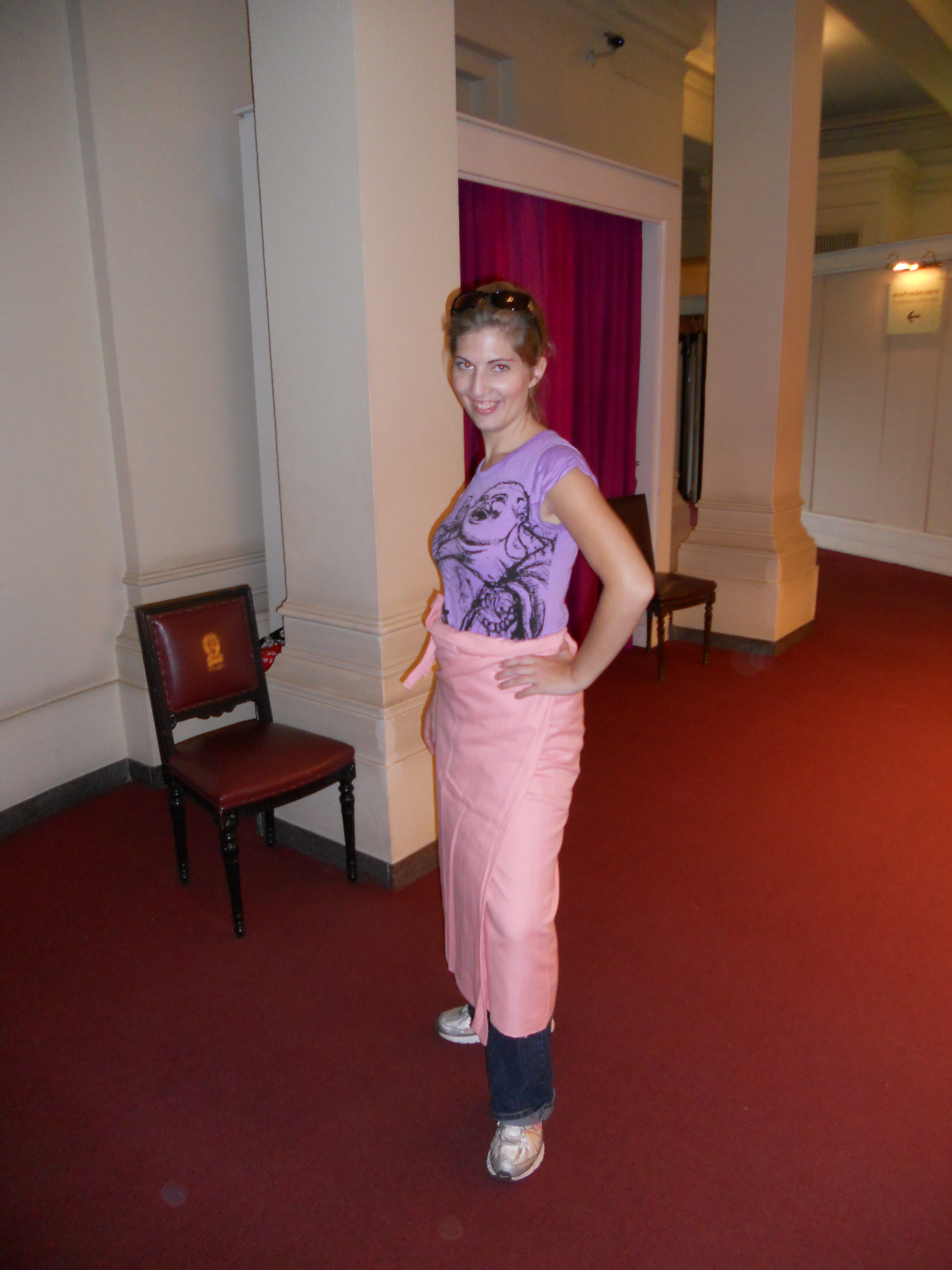
Wearing the sarong I was forced to buy to enter the Ananta Samakhom Throne Hall.

Later that afternoon, we headed over to Dusit Palace Park, Thailand’s current royal district containing the Vimanmek Teak Mansion, a former palace from the early 20th century full of Victorian-like décor after the Thai king got inspiration from Europe. More interesting, however, was the old parliament building turned museum, Ananta Samakhom Throne Hall. The museum has a pretty interesting collection of Thai arts and crafts, including some really cool-looking gold thrones/decorations and some really intricate, iridescent green tapestries colored from beetle wings. What I found both interesting and irritating, however, is that I was forced to buy and wear a sarong to enter the building! Now, just to be clear, I was already fully-dressed including long blue jeans, closed-toe tennis shoes and a t-shirt with my hoodie JUST IN CASE I had to cover even more. Not to mention the fact, I wasn’t even in a temple! But no, on King’s orders, all women must be wearing a skirt or something, so I paid the 40 baht (about $1.30) and wore the sarong, over my jeans. Yeah, I looked hot.

After all the excitement and beauty of day one, I must say day two was a little bit of a letdown. The day started off just fine. Wearing my brand new, super cute (super cheap) Thai dress, Josh and I headed out to visit Wat Arun, a temple full of tall, spire-like buildings covered in porcelain tile. The buildings were beautiful and you can take extremely steep, dangerous steps to walk all over them overlooking lovely views of the Chao Phraya River.  From there, we took an hour-long boat tour of the river to reach another part of the city, where we were treated to a relaxing ride viewing modern Thai houses and giant lizards sunbathing on the rocks.

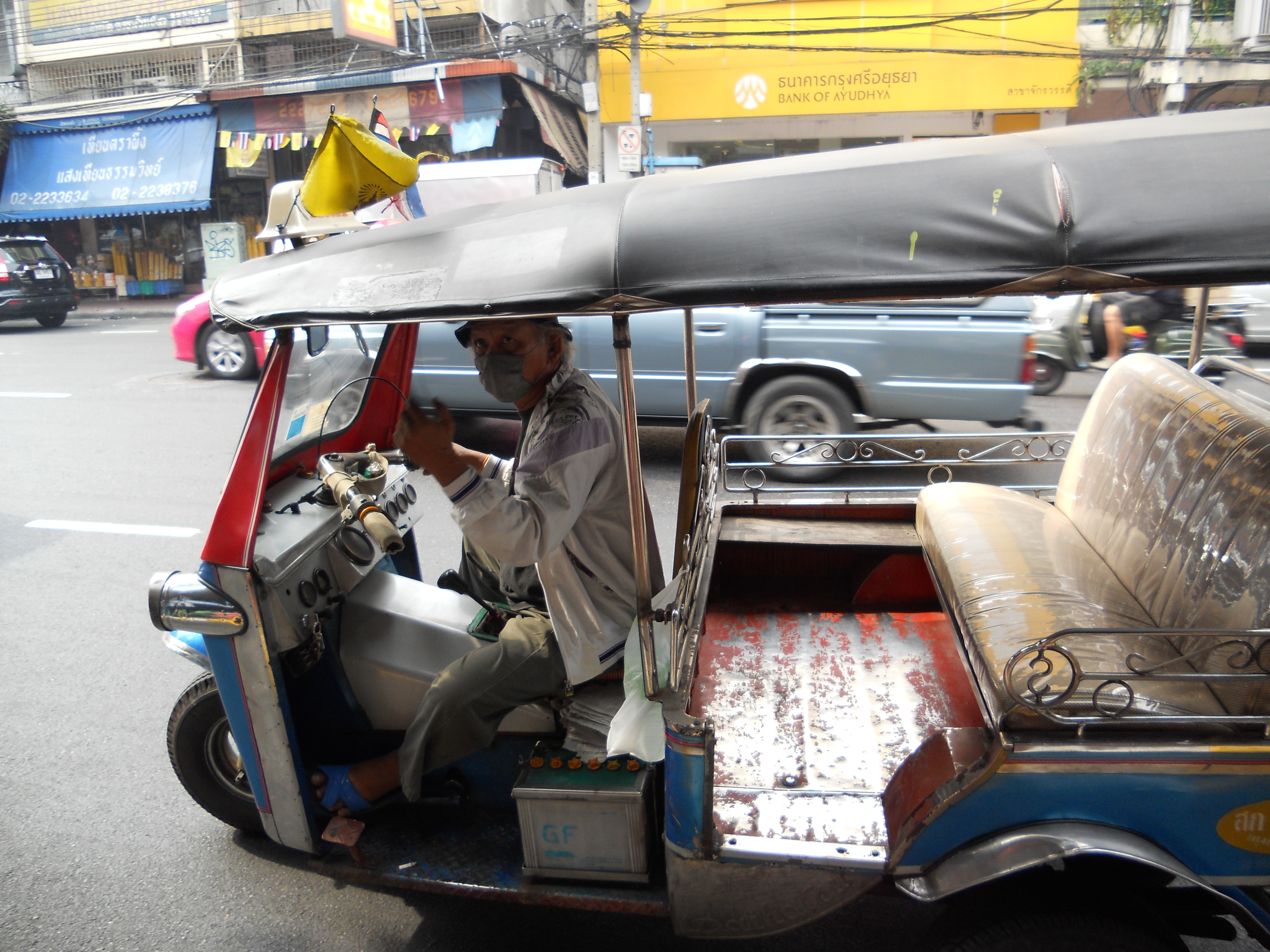
Bangkok tuk tuk driver covering his nose and mouth while driving around Chinatown

All was great until we reached Chinatown, when all the negative ideas I had about Bangkok being crowded and dirty suddenly came to life. The sidewalks are so full, you can’t even walk down them without touching people and the air is so polluted a lot of people cover their mouths and noses as they walk or drive down the street. Furthermore, the stuff they’re actually selling is mostly a bunch of tourist junk, nothing interesting at all. And worst of all, it is never ending!  I swear to you, every time we turned a corner in the hopes of leaving Chinatown, we just found more Chinatown! Finally, I told Josh we just had to grab a cab and get the hell out before I went crazy. I finally was able to get some much needed peace at Wat Traimit, home of a three meter tall, solid gold Buddha where I was able to “meditate” (Josh called it napping, whatever…).

Our day ended with an evening of Muay Thai boxing, a very long evening… Unlike American boxing, in Muay Thai boxing boxers can use all parts of their body (except the head) to hurt their opponent, including the more fun parts like elbows and knees. Honestly, after expecting a really brutal fighting match, I was a bit disappointed that a bunch of the moves ended with the guys really close to each other, almost “hugging” it out. Not that I’m really interested in watching people beat each other for entertainment (not enough testosterone), but if I’m going to sit through five hours of this stuff, I’d at least like to see someone get knocked out or something. Of course, that is exactly what happened during the most interesting fight between the current champion and his opponent. That one was quite exciting but the guy got knocked out in the third or fourth round, so it was over pretty fast. All in all, I’m glad I saw it, but find it unlikely I’ll ever do it again.

So thus ended our stay in Bangkok (at least for a few days). Then Josh and I headed back and prepared to visit Ayutthaya!

Surviving Sarawak

Standard

With the different food, water and climate, everyone said I should expect to get sick when I came to Malaysia, especially in my first few weeks. I was very relieved to find my immune system working full force with not even a cold in my first few months here. In fact, the only sickness I did get was after eating at a high-end Chinese restaurant at the Hilton, not the local street food. So it was just my luck that I got a bout of bronchitis right before my four-day work/holiday trip to Kuching, Sarawak, East Malaysia.

I’d been looking forward to this trip for weeks, ever since I found out I was being sent for work with the chance to stay back and travel for a couple days after. When I started feeling a pressure on my chest and coughing a few days before, I thought it was a cold and my stance against encouraging a global immunity to antibiotics as a result of over prescription stupidly prevented me from going to the doctor beforehand. It wasn’t until my ear refused to pop for nearly a day after my flight and my voice started sounding like Barry White that I realized perhaps I was wrong…

After two days working, resting and drinking as much hot water as humanly possible, it was finally time for my weekend trip. Let me tell you, after waking up throughout the night with a hacking cough, feeling exhausted and feverish, I was not exactly in the best situation to go out exploring Sarawak. But I was also not about to give up my semi-free trip, so I loaded up on cold medicine, lozenges and tea and set out.

Let me just say, Sarawak is absolutely beautiful! It is much cleaner and less congested than KL, and there are green hills and jungles everywhere. Sarawak is one of two Malaysian states that make up East Malaysia on the island of Borneo, which also includes the country of Brunei and parts of Indonesia.

To start off our trip, Jullian and I rented a car and headed out to a crocodile farm where they have lots and lots of crocodiles, as well as cages of other cool animals. The farm was pretty cool. You get to see lots of crocs in cages, and at feeding time, you get to watch them jump in the air for their food. They also have cages of monkeys (like Rafiki), snakes and ponds of exotic fish to look at while you’re there. My highlight, however, was the baby monkey who escaped from her cage to give me and the rest of the tourists quite as a surprise as we were walking down to see the crocs…

Way better than the crocodiles, however, was the orang utan sanctuary at Semenggoh Nature Reserve. The reserve, along with another center, rehabilitates orphaned or displaced orang utans to send them back into the wild. At the reserve, you get to enter into the park at feeding times when the orang utans come back to eat (the plan is for them to eventually learn to get food on their own). It was amazing! I gotta admit, the first 50 minutes were a bit slow. The orang utans came down about 50 feet away to eat,  and I was disappointed that they were so far. But in the last 10 minutes four orang utans came down to our side of the park, where they came within a few feet of us to get food from our park ranger.  They were hilarious too, just swinging all over the trees and trying to steal food from our guide, even when he tried to turn them down. I absolutely loved watching them, and they had to practically drag me away from the park. It was definitely an incredible experience.

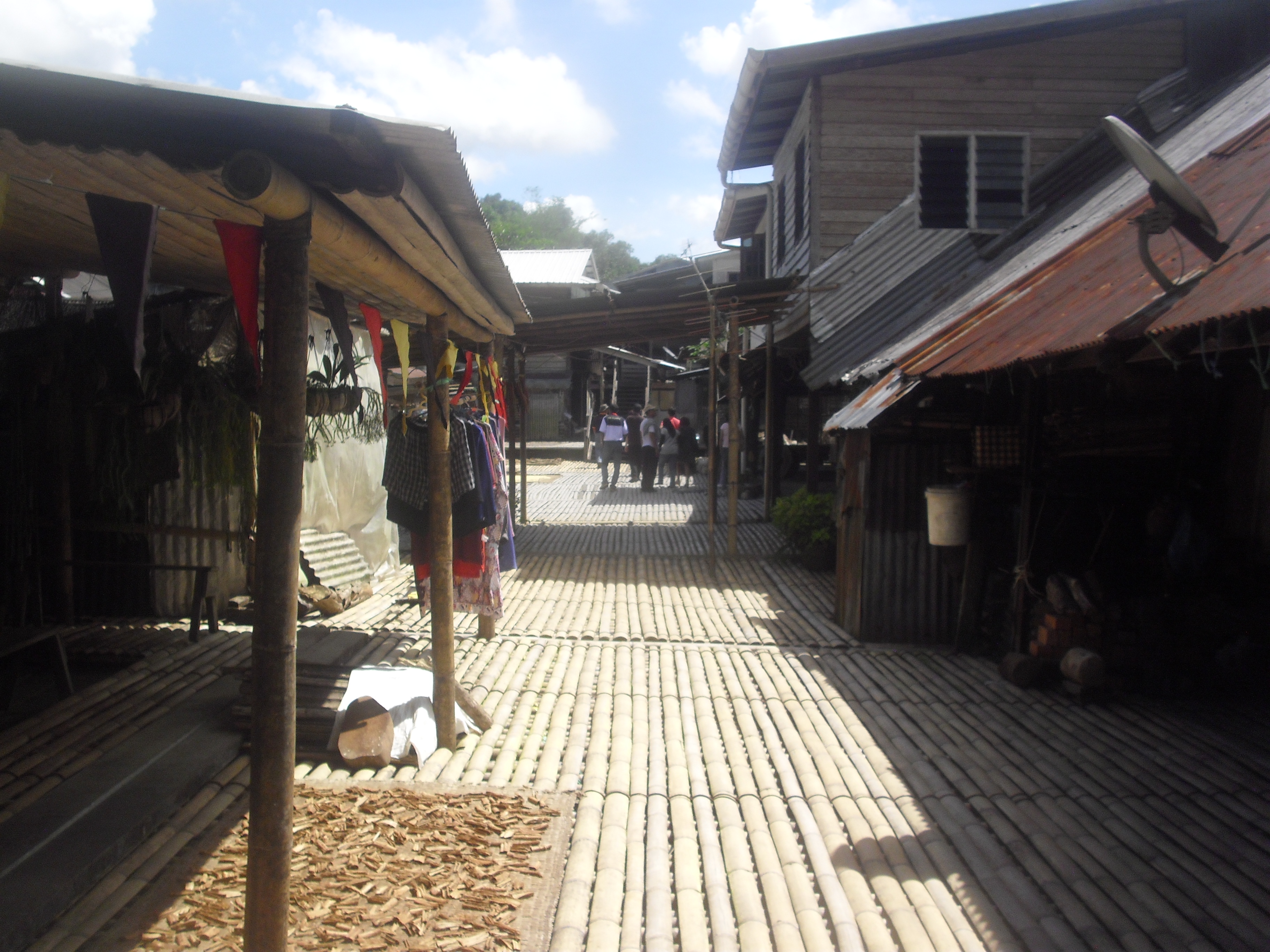
Aside from wildlife, Sarawak is also known as being a major cultural hub in East Malaysia, especially with lots of local aboriginal tribes that are different than the Malay-Chinese-Indian ethnic make-up of Peninsula Malaysia. In between the crocodiles and the orang utans, Jullian and I drove out to visit one of the tribes in a longhouse in the middle of the jungle. A longhouse is literally what it sounds like: a very long house, sort of. Mostly made from bamboo shoots, a longhouse is a very long community building where the

Longhouse

whole village lives. Individual families have their own doors and units, but the outside is like a very long porch which is a common area for everyone. We didn’t get to stay very long, but we got to walk along the building, chat with the people, and check out the skulls room (many tribes were known for headhunting, where it was a mark of honor for a man to take the head of another person. They then save the skull and get a tattoo).

The next day, we were able to learn more about the village we just saw at the Sarawak Cultural Village. Like Detroit’s Greenfield Village, the Sarawak Cultural Village is like a living museum where you get to walk through replicas of the homes of aboriginal tribes where characters dress in costume, perform local dances, traditions and crafts and talk to you about the history. It was fun, you get to see a very different kind of history than I’ve been exposed to and watch a very cool cultural dance show in the end.

Tree house

One of my favourite parts of the trip, though, was just swimming in the South China Sea. Aside from a short trip to the beach at Port Dickson (not known as a very nice beach in Malaysia) this was the first real beach I’d been too while I was here. It was gorgeous! The beach was right next to the hills (or mountains? Can’t really tell the difference) so you can swim while watching the clouds descend into the trees. The water was fun too. Not exactly crystal clear, but the waves were pretty rough making them extra fun to jump into! The resort we stayed at was also pretty unique, we actually stayed in a tree house! Technically, it was a cabin on stilts that sits among the trees, but it was awesome. It came with its own bathroom and shower, air conditioning and a beautiful view of the beach and trees. The fact that the hot water was fickle and there was a creepy crawly shell/crab thing sharing the bathroom with us only added to its charm (sort of).

Now I’m back in KL on a sick day with a full course of antibiotics waiting for my body to recover. Less than three weeks until Thailand!

“10 Million Fireflies”

Standard

Aside from monkeys, some of the other things I wanted to see in Malaysia were its much-acclaimed fireflies. When I was reading about the country way back earlier this year, I came across a side box in one of my guidebooks that mentioned a little village outside of Kuala Lumpur where “millions” of fireflies just light up the forest at night. Of course I had to go! So Jullian and I took a little road trip Saturday afternoon and headed to Kuala Selangor to check it out.

I have to be honest, the fireflies themselves were pretty underwhelming. Thanks to deforestation and the destruction of their natural

A firefly in Kuala Selangor

habitat, the number of fireflies has gone down significantly in the past 20 years so the site isn’t as amazing as it used to be. The trip to get there, however, is quite charming. To see the fireflies, you get in these old, rickety, canoe-like boats that hold about four people. It’s nearly pitch black outside, and the guide takes you across the water for a 20-minute ride along the mangroves where the fireflies are. Though not spectacular, the fireflies really are beautiful. They light up the trees and twinkle like Christmas lights, which was sort of nice since it’s the end of November. What was really interesting to see was how small they are. They’re only a few millimeters long and just a fraction of the length of American (or at least Michigan) fireflies. It was a very cool experience.

The real highlight of Kuala Selangor, however, was the MONKEYS! Before going to see the fireflies, Jullian and I headed to one of the village’s parks to check out the wildlife. Given my recent history being attacked by a monkey in the Batu Caves, I was a bit wearier of them, though still fascinated. In fact, when I saw the sea of macaque monkeys (the same as in the Batu Caves) sitting in the parking lot

Silvered leaf monkeys in Kuala Selangor.

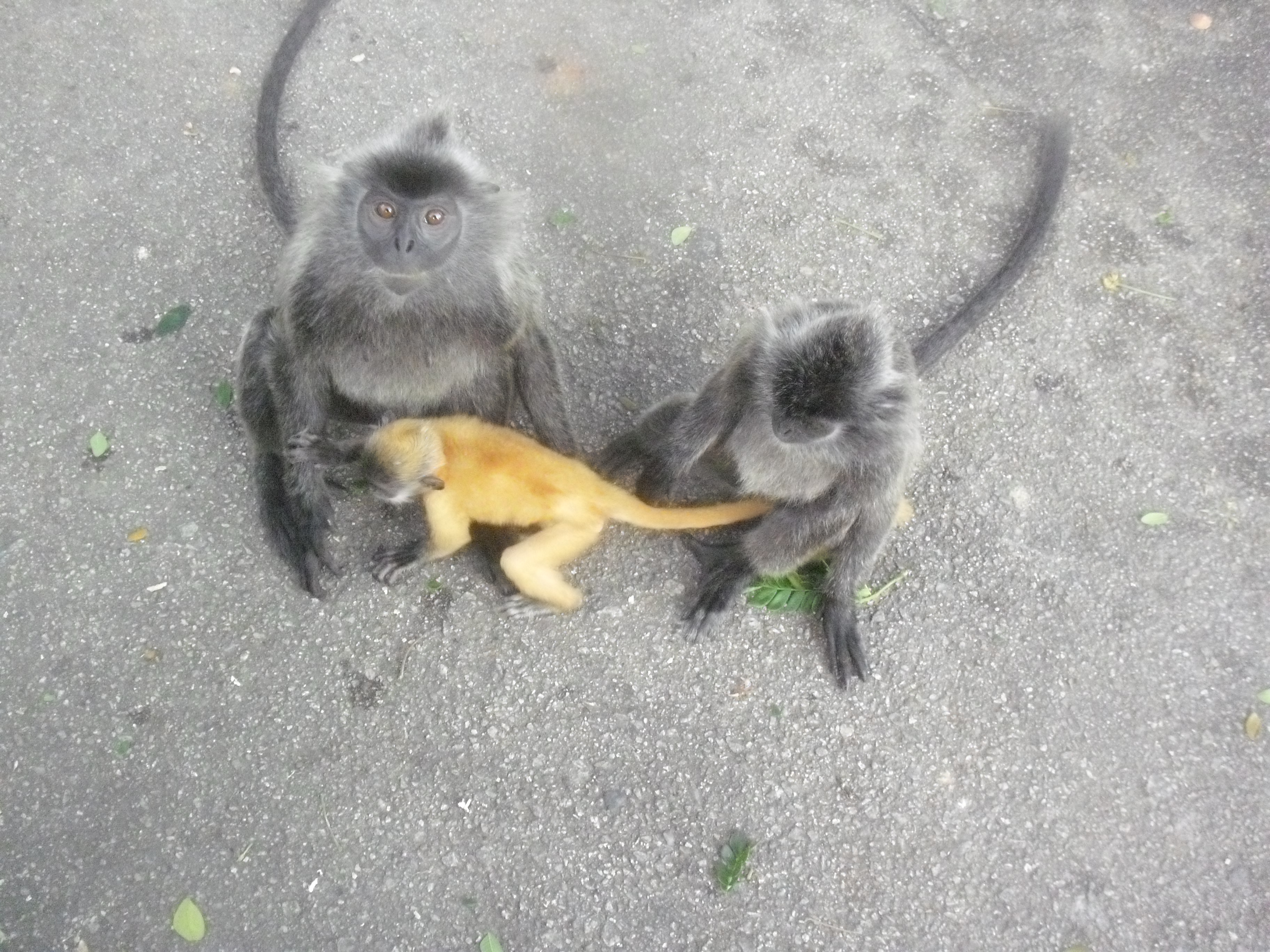
and swinging in the trees as we drove in, I was a bit scared to get out of the car. But when Jullian told me there was a four-foot lizard nearby, I grabbed a stick and got out :). I was glad I did, because when Jullian and I made it to the top of the hill, I found a whole new breed of monkeys I completely fell in love with: silvered leaf monkeys! Unlike macaque monkeys that are brown, can be quite aggressive and have been known to kill babies, the silvered leaf or silvery lutung monkeys were quite gentle and definitely not afraid of humans. You can go right up to them and feed them, and they just come right up to you taking the food, some even climbing up on you to get to it. They are absolutely adorable too, with dark gray fur that’s almost like a Mohawk on top and these sweet little faces. I just adored those monkeys, I could have played with them all day. Sometimes I think I’ve gotten over the culture shock of being here, but the minute I see monkeys I’m in awe all over again. I hope I never lose that.

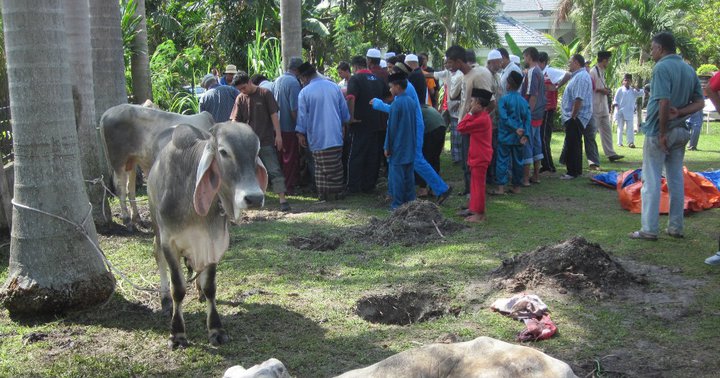
Aside from Kuala Selangor, the week brought about some other new experiences. Last Wednesday Malaysia celebrated Hari Raya Haji to mark the end of the Muslim pilgrimage to Mecca. The event is basically a mass slaughtering of animals meant to commemorate the sacrifice Abraham made instead of his son (in their case, Ishmael). The men use knives to cut the throats of the animals, and the meat is divided among the animal donor, the family of the one slaughtering and those less fortunate.

Muslim men gather to slaughter an animal during Hari Raya Haji to commemorate Abraham's sacrifice.

So anyone that’s ever talked to me for more than five minutes would know that an animal slaughtering is not exactly an Erica-friendly environment. Though I am by no means a vegetarian, I am an animal-lover, overly-emotional and have a pretty weak stomach when it comes to blood. However, my curiosity got the better of me, and I decided to join Jullian and Kevin to visit the mosque of a friend where a slaughtering was to be held. When we got to the mosque, I saw a crowd of men on the lawn with about eight cows and goats tethered to trees (sidenote: Asian cows look different than American cows. Their ears are floppy, they have a hump and they’re more of a brown/gray color). As they went to slaughter the first cow, I kept my distance and took a little stroll around the grounds. When I came back, they had moved on to the goat, so I thought I’d focus my attention on the living animals and distract myself from the slaughter. What I didn’t realize was there had been a mistake in the slaughter of the first cow (they missed one of the jugulars) and the animal lay among the living cows, slowing bleeding to death. When I saw the cow’s gaping neck with the blood dripping down, I left the grounds as quickly as I could and burst into tears. I literally walked to the side of the road and began to sob, it was a very difficult sight for me to see. As I mentioned before, I am not a vegetarian and have no right to judge the killing of animals for food, since I am the happy recipient of the one who does it, but seeing that up close is a little disturbing.

When I headed back (yes, I headed back) they had just finished a goat and another cow, who lay dying on the ground (these two had been done properly the first time and the deaths were a lot quicker). What was particularly sad this time was watching one of the living cows go to the dying cow and actually start licking its face as if to comfort it. Again, it was all a bit sad. Interestingly, I heard from a Malay friend that if you feel sorry for the animal, you are not allowed to consume the meat it provides, since you are supposed to be grateful for what God has provided you. That is also the reason many women don’t attend the event. I think, even if I was Muslim, I would never be able to eat Hari Raya Haji meat.

Now I’m preparing for my next adventure, a four-day trip to Kuching, Sarawak in East Malaysia. Though I am technically going for work, the weekend is all mine! Can’t wait!

Singapore!

Standard

After four months of going stir-crazy in Malaysia, I was finally able to do some traveling last weekend and took a short, three-day trip to Singapore.

A huge part of my decision to come to Malaysia was the prospect of traveling throughout Asia, and though I had the time and money to travel, I was growing increasingly frustrated struggling to find travel buddies. Luckily, my friend Gina, a former colleague of mine who now works in India, contacted me out of the blue one day and asked if I was interested in traveling with her. Two days later, our tickets were booked, and we were set to explore this small, Asian country!

Singapore was very…pleasant. As a former (and briefly-lived) Malaysian state, Singapore is very similar to Malaysia in terms of culture, ethnic make-up and food. Had it not been for the fact that I had already spent several months in Malaysia, I might have been more impressed. Singapore is, however, much more developed and cleaner than Malaysia and is Chinese-dominated (as opposed to Malay-dominated) and, therefore, not a Muslim country. From what I understand, it is also one of the most “westernized” parts of Asia. I’m not going to lie, it was refreshing to be in a country with proper sidewalks and “normal” traffic with cars that stay in their lanes and don’t make me want to run for cover.

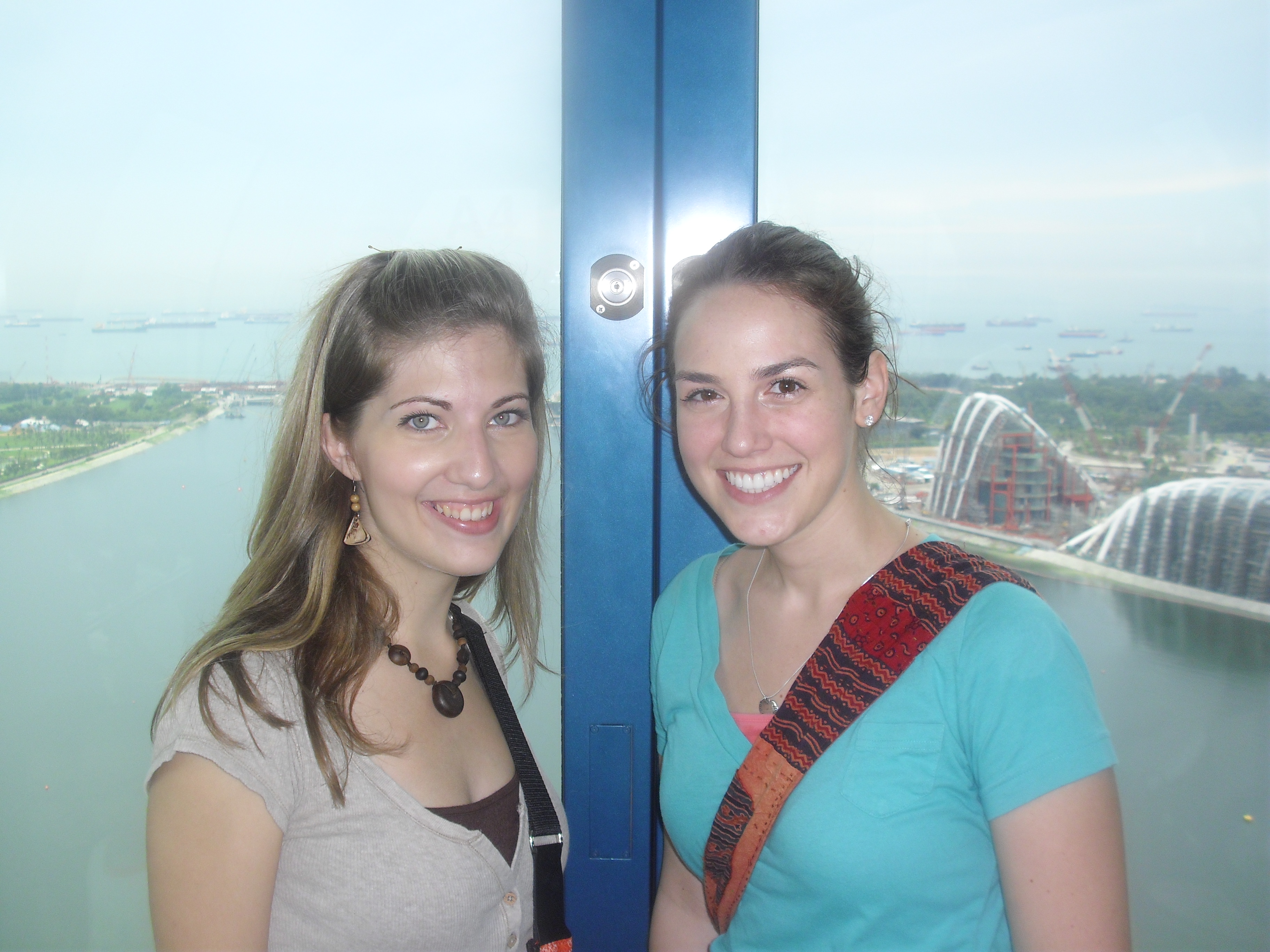
Me and Gina aboard the Singapore Flyer, the world's largest Ferris Wheel.

On day one, we decided to explore the city by foot, hitting some of its famous sights on the way. We started our journey checking out the business district before taking a trip on the Singapore Flyer, the world’s largest Ferris Wheel (much like the London Eye). We then hit up Arab Street where we had an awesome Middle Eastern lunch and checked out the very Aladdin-esque Sultan Mosque. As we headed back to our hotel near Little India, I was determined to find this one particular temple in my guidebook that was supposed to grant wishes and tell fortunes after a somewhat complicated-sounding procedure involving joss sticks, bowing and shaking a cylinder. Of course I wanted to go! As I soon learned, however, messing with Eastern gods is not always a good idea…

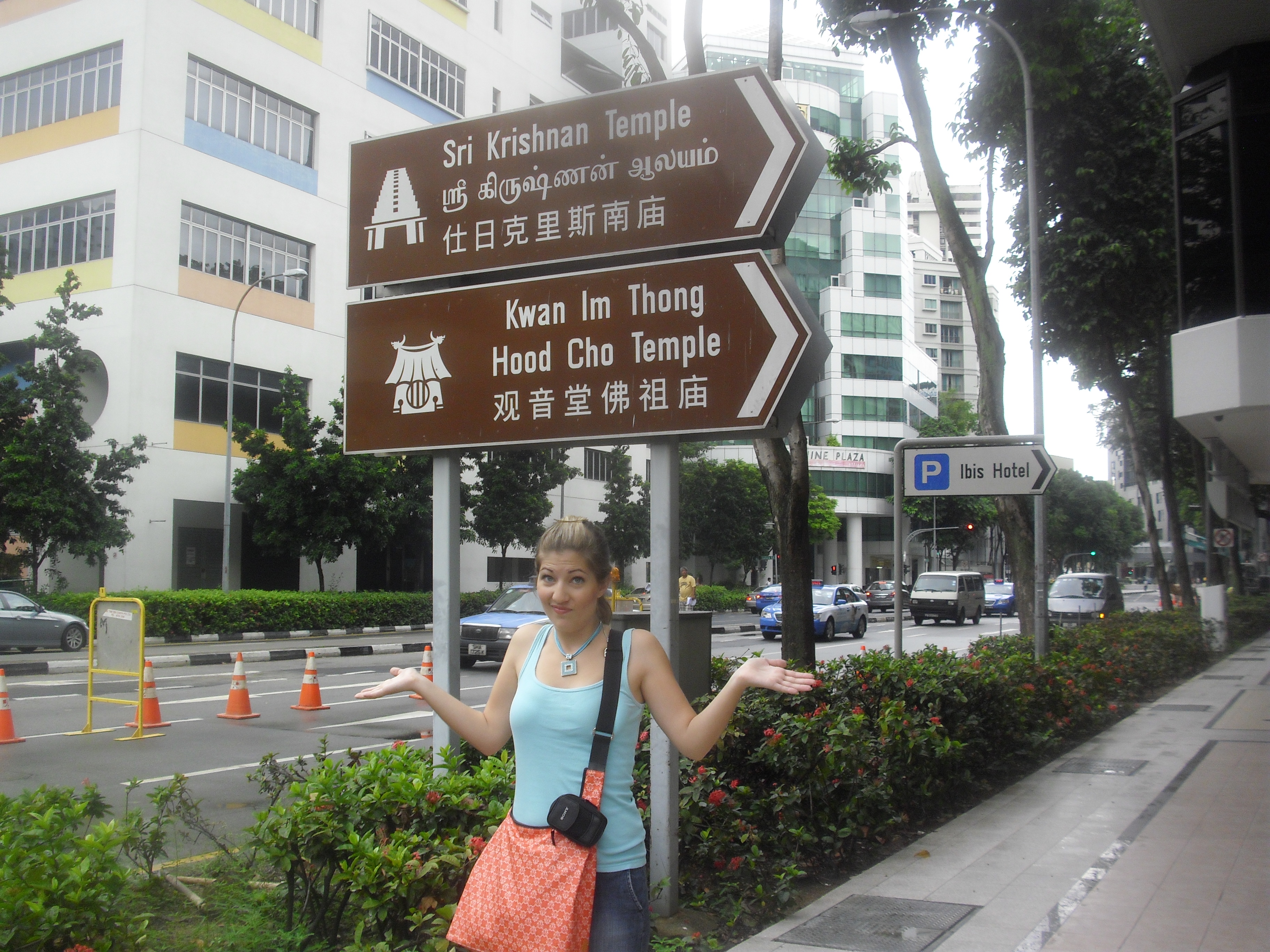
As we walked toward the corner of Waterloo and Middle Streets, the general vicinity of said temple, I suddenly looked up and saw this beautiful Hindu temple before my eyes with a group of people bowing and lighting joss sticks in front. Delighted at our find, Gina and I set out to make our wishes, lighting our joss sticks and bowing very carefully to make sure they came true. As we entered the temple, things got a bit more confusing. I’m not sure if it was because it was Friday afternoon or Deepavali, one of Hinduism’s biggest holidays, but there was a lot of activity going on inside the temple, though none of it seemed to be fortune-telling… As we watched the priests make their offerings and the visitors line up to receive blessings (I think), I began to wander around the temple thinking, “Where are these damn fortune-tellers?” I sheepishly asked one of the men at the counter if there was fortune-telling going on, where he gave me a strange look and said no. Apparently, not only was there not any fortune-telling but there never had been…

Confused, Gina and I stepped outside where I re-opened my guidebook to find out what happened. As I read the words “Kwan Im Thong Hood Cho Temple,” I began to feel really stupid as I realized we were supposed to be at the BUDDHIST temple next door! Whoops…

Unfortunately, the Buddhist temple had just closed for the day, so we decided to head over to Chinatown to see another famous Buddhist temple, the Sacred Buddha Tooth Temple. Just our luck, my guidebook was three hours off on its “opening hours” and the temple had just closed. Buddha clearly was not interested in seeing us that night.

The next day, we set off to see some of Singapore’s natural elements with a visit to its Botanic Gardens, the Singapore Zoo and the Night Safari, with the Sacred Buddha Tooth Temple squeezed in-between. I must say, the gardens were lovely. There were acres of paths that led around beautiful trees, plants and flowers before surrounding a romantic lake full of swans and turtles, a lovely setting in which to read a book if you could just ignore the sweltering heat…

Inside the 100 Dragons Hall at the Sacred Buddha Tooth Temple in Chinatown, Singapore.

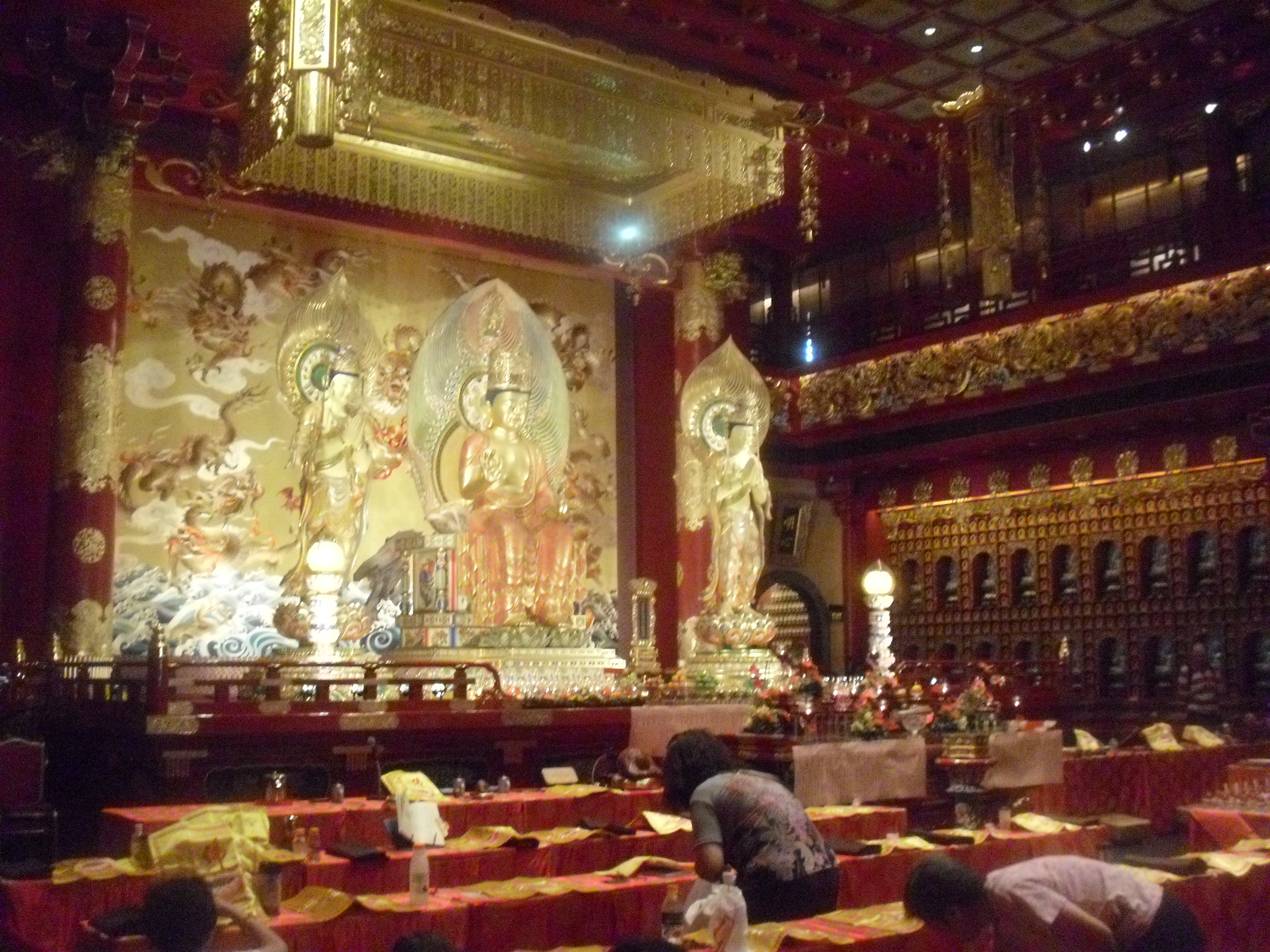
Next, we finally made it to the Sacred Buddha Tooth Temple, which was really quite impressive. The whole thing is four stories tall, with the temple on the ground floor, a Buddha museum on another floor, a rooftop garden, and a separate temple on the fourth floor containing the well-protected, beautifully-encased relic of one of Buddha’s teeth. Just entering the ground floor alone is a pretty spectacular sight with a huge golden Buddha at the back of the room surrounded by 100 Buddhas around the walls. I thought it was very cool and very interesting.

After that, we decided to head out to the north of the island for the much-acclaimed Singapore Zoo and Night Safari. Though neither Gina nor I are big zoo-people, the Singapore Zoo is supposed to be one of the best in the world, so we decided to check it out. For a zoo, it is pretty awesome, but at the end of the day, it’s still a zoo. What does make it special is the fact that the animals are contained with mostly hidden or natural barriers, such as moats, that make it appear more as though you’re actually experiencing them in the wild. My biggest draw to the zoo was the chance to get a photo with an orang utan. I was soon disappointed, however, when I found out you don’t actually get to hold one, you just stand in front of them while the guy snaps a picture. Still, I was mere inches away from three of them during the photo, close enough that people started shrieking at me, because one nearly peed on me! (It was still super cool!) The Night Safari next door was decent. It’s basically a zoo at nighttime that lets you observe nocturnal animals while you ride around in a tram. Again, pleasant, but not life-changing.

Me after mixing up a Hindu temple with a Buddhist temple. Whoops!

On day three we decided to try our luck again at the Kwan Im Thong Hood Cho Temple and get our fortunes told before checking out one of Singapore’s smaller islands. Despite my genuine interest in Eastern religions, I apparently had not yet been forgiven for my original temple mix-up by either the Hindu or the Buddhist gods… After lighting our joss sticks, Gina and I went inside the temple and were given a cylinder full of wooden sticks. You’re supposed to kneel before the Buddha statue, make your wish and shake the sticks until one comes out. Then, you shake these two, red semi-circles. If one lands face up and the other face down, your stick is a winner. If not, you have to try again.

Ok, simple enough. I knelt down on the carpet, made my wish and began to shake…and shake…and shake… the darn things were not coming out! I looked around the room to see if anyone else was struggling and watched my fellow templers shake out a stick with ease. Even Gina, a fellow foreigner, managed to shake out a winning stick on the first try. This was not a good sign.

So I shook more vigorously. This time, three sticks came out. Again, not a good sign, but I was not giving up. Finally, after much patience and one “false” stick, I managed to drop one (just one) and have the two semi-circles fall in opposite directions.  I raced up to get my fortune, and given the events of the past two days, I shouldn’t have been surprised at what I found:

“Interpretation: Bad. Best to do what you’re doing now. Be quiet and experience peace. Do not hope for good results. Best to forget your problem.”

Then, after looking up my fortune number in the fortune book (66, of course) I soon read that my marriage was going to fail, my crops were going to die and if I get sick I should make offerings to the gods to expel my demons. Moral of the story, apparently Eastern gods don’t appreciate it when you mix them up…

After that uplifting morning, Gina (who got a semi-decent fortune, by the way) and I headed over to Pulau Ubin, a small island off Singapore’s northeast side and the only part of the country that has not yet been touched by urban development. Pulau Ubin was BEAUTIFUL! After days of well-organized tourist attractions and over-commercialization, it was refreshing to find a small part of Singapore that just seemed a little more down-to-earth. That being said, the minute you reach the island you’re immediately approached by locals competing for your business to rent you a bike to cycle around the island…

A house on Pulau Ubin in Singapore.

Anyway, Pulau Ubin really is charming. To get there, you head to Changi Village on the east side of Singapore and wait until there are at least 12 people to fill a rickety old ferry to take you to the island. Once arrived, you’re greeted by a quaint little village of bicycle rental shops, seafood restaurants and friendly locals, eager to help you on your adventure. Minus the fudge, horse poop and no-car rule, the island was a bit a Mackinac-esque, which I found delightful. Gina and I quickly rented out bicycles (warning, they’re really not in that great of shape) and set to explore. Let me tell you, it was AMAZING! Despite being undeveloped, the island is covered in well-paved roads with very little traffic and is amazingly peaceful. It’s like you get to leisurely ride around the jungle enjoying palm trees, banana trees, old Singaporean homes built on stilts, without any of the stress of mosquitoes or dangerous animals. The only drawback (for me) was it was a bit hilly, and after two and a half days of walking non-stop, my butt was not really into any more physical exertion. Though we had originally wanted to explore the tougher mountain bike trails, Gina and I decided to hit the mossy 1 km trail and call it a day.

Now I’m back in KL, recovering from an intense but very enjoyable weekend and starting to plan my next trip. My work is sending me to Kuching, the capital of East Malaysia, in two weeks and soon after, I’ll be heading to Bangkok to meet a friend for a two-week trip throughout Thailand and Malaysia. Life is good!